Construction Machinery 15th Five-Year Plan: 2030 Revenue Target of RMB 1.2 Trillion
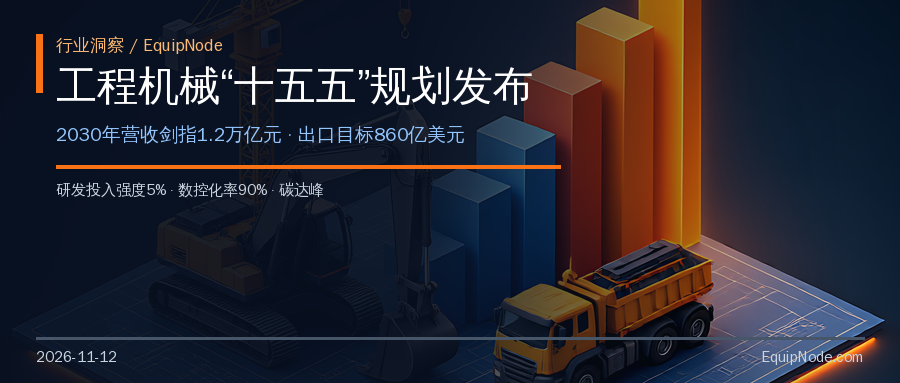
On October 20, 2026, the China Construction Machinery Association (CCMA) officially released the "15th Five-Year Development Plan for the Construction Machinery Industry (Trial Edition)". This is the industry's first systematic roadmap aimed at 2030 after entering a new cycle: by the end of the 15th Five-Year Plan period, R&D intensity at above-designated-size enterprises must reach 5%, revenue must exceed RMB 1.2 trillion, exports must reach USD 86 billion, large complete machines and key components must become autonomously controllable, and the industry must achieve carbon peak. For Chinese construction machinery, which has topped the global rankings for many consecutive years, the question this document answers is very direct — once scale has reached the front ranks of the world, what will drive the next five years of winning?

The 14th Five-Year Plan's trump card: exports nearly triple in five years
Start with the plan's review of the past. In 2025, 270 major enterprises recorded revenue of RMB 874.9 billion, up 7.15% year on year; total profit was RMB 57.5 billion, up 28.1% year on year. Full-year excavator sales reached 235257 units, up 17.0%, and loader sales reached 128067 units, up 18.4%. Exports were the biggest highlight: rising from USD 20.96 billion in 2020 to USD 60.169 billion in 2025, nearly tripling over five years, whereas the target set under the 14th Five-Year Plan at the time was only USD 28 billion — exceeded by a factor of 2.1.
The global rankings moved up in step. On KHL's *International Construction* 2026 global top 50 construction machinery ranking (based on fiscal 2025 data), XCMG Group rose to No. 3 with USD 14.207 billion, becoming the first Chinese brand to enter the global top three; 13 Chinese companies made the list with a combined USD 48.862 billion, accounting for 20.4%, ranking first among all countries in number of entries. Industry exports reached USD 53.514 billion in the first nine months, up 22% year on year, with external demand still the strongest source of incremental growth at present.
Hard targets for 2030: RMB 1.2 trillion revenue, USD 86 billion in exports
The plan lays out two sets of quantitative targets. On revenue: industry revenue is expected to exceed RMB 1.2 trillion by 2030, requiring a compound annual growth rate of about 6.5% from RMB 874.9 billion in 2025. On exports: export value is expected to reach USD 86 billion by 2030, implying a CAGR of about 7.4%. Both growth rates are below the actual levels of 2025 (revenue +7.15%, exports +13.8%), which means incremental growth will no longer come from an explosion in total volume, but from a recovery in domestic demand and higher product added value.
The capability targets are worth a closer look: R&D intensity at above-designated-size enterprises reaching 5%, the CNC rate of key processes at key enterprises reaching 90%, industrial internet platform penetration of 85%, and artificial intelligence deeply integrated across the full chain of R&D and design, manufacturing, construction and operations and maintenance; at the same time, systematic solutions are to be formed in 10 key application scenarios including smart open-pit mines, ultra-high-voltage power transmission, underground space, intelligent material handling and urban renewal. The plan also requires core components to be autonomously controllable — high-pressure hydraulics, heavy-duty bearings, seals and sensors: for these "last mile" items there is no room for the "close enough" gamble.
Intelligence in three steps: 2027, 2029, 2030
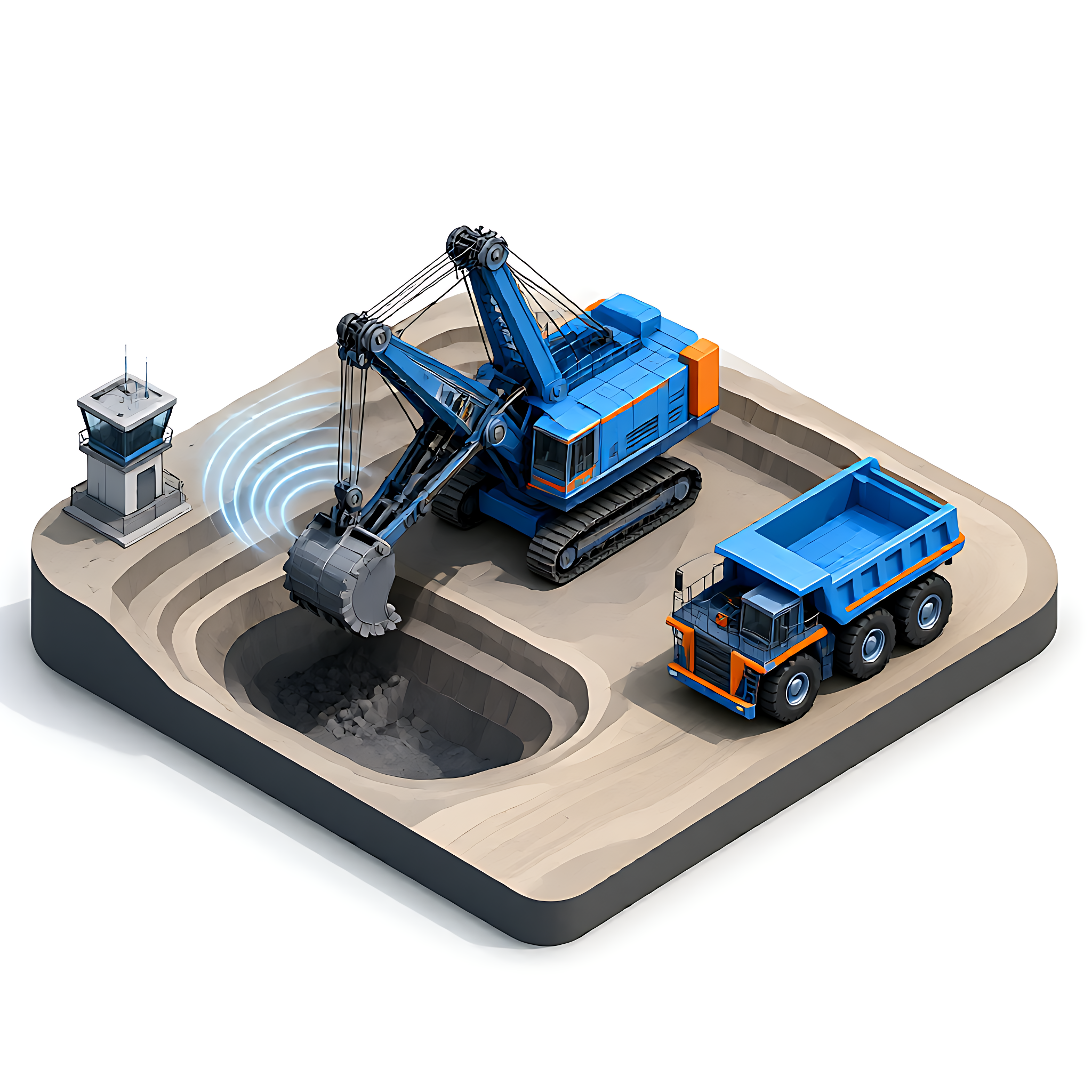
The intelligence section sets out an explicit timetable, making it the most operationally actionable part of the entire plan:
- 2027: the share of smart modules and remote-controlled models to rise significantly;
- 2029: conditionally autonomous equipment to enter mass production at smart mines and ports;
- 2030: unmanned equipment delivered in closed scenarios, with the CNC rate of key processes reaching 90%.
The path is likewise "mines first, ports follow, job sites replicate". The plan is also candid about the real-world gap: overseas autonomous mine trucks have already entered thousand-vehicle fleet operations — Caterpillar has deployed more than 820 units and Komatsu operates over 1000 AHS units — while cumulative shipments of domestic autonomous mining trucks had reached about 8500 units (sets) by mid-2026. In the highlights across the two halls at bauma CHINA 2026, autonomy and electrification are likewise the leading stars.
Green transition: 58% domestic versus 5.5% exports
The green targets are for the industry to reach carbon peak and for new-energy construction machinery to basically meet construction needs, with the noise limits of main products reduced by an average of 1~2dB(A). But the status-quo data cited in the plan exposes the largest structural gap: from January to September 2026, the penetration rate of electric loaders in the domestic market exceeded 58%, while exports were only about 5.5%; the domestic penetration rate of electric excavators was about 0.6%, and exports were below 1%. The dividends of electrification currently stay almost entirely in the domestic market.
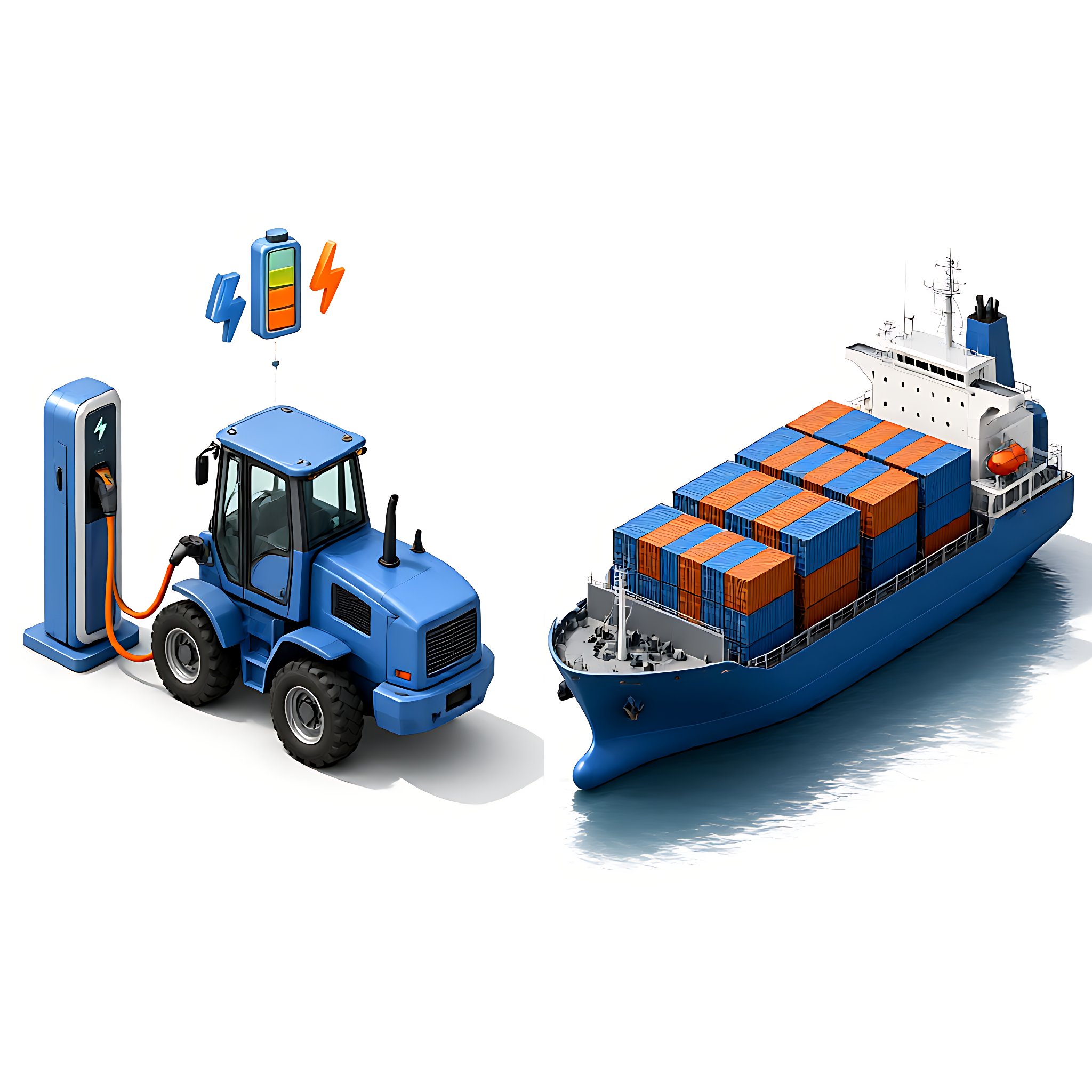
The solution the plan offers is to advance on three fronts — battery-electric, hydrogen fuel cell and hybrid — with charging infrastructure ahead of sales: partner with energy companies to roll out battery-swap stations, fast-charging piles and mobile energy storage vehicles, while building out battery recycling, echelon utilization and remanufacturing systems, and proactively addressing green barriers such as carbon footprints and carbon labels. Electrification must "bloom at home and bear fruit overseas".
From selling machines to selling solutions: the business of a 9-million-unit installed base
The most intriguing line in the plan is buried in the industrial services segment: it encourages enterprises to shift from providing products to providing comprehensive solutions, and to accelerate the development of aftermarket services such as remote operation, autonomous driving and smart construction. The background is that the industry's equipment installed base has reached 9.09-9.88 million units, while OEM revenue remains heavily dependent on new-machine sales. International giants have already shown the way: parts account for 52% of Komatsu's aftermarket business and are planned to rise to 53%, while Caterpillar's Cat Reman remanufacturing offers more than 8000 exchange-for-repair options. The aftermarket is not a sideline, but the ballast of profit and the glue that binds customers.
Revenue rises, profit doesn't: the knot the plan must untie
The divergence in the third-quarter reports shows how urgent the problem is: in the first three quarters of 2026, of the 20 listed construction machinery companies that had disclosed third-quarter reports, 17 posted year-on-year revenue growth, but only 9 posted year-on-year net profit growth; in the first half of 2026, revenue at key enterprises grew 15.5% while profit grew just 0.21%. The plan therefore writes the comprehensive rectification of "involution-style" competition, standards leadership and quality supervision into its safeguard measures, leaving room for profit on quality investment — the transition from big to strong will not happen on its own; it can only be resolved through development.
In closing
Over the five years of the 15th Five-Year Plan, the industry must focus on answering whether it is "good and strong". RMB 1.2 trillion in revenue, USD 86 billion in exports, 5% R&D intensity, a 90% CNC rate — these figures will ultimately land on concrete procurement choices: more reliable machines, smarter configurations and more localized service.
For the latest prices and lead times on SANY pump trucks, electric loaders or mining equipment, please contact our sales team. EquipNode provides one-stop support for machine selection, cross-border logistics and localized after-sales service.