The Big Three H1 Reports: Overseas Sales Carry Profit, FX Losses Eat Growth

The 2026 half-year reporting season has closed, and the report cards handed in by the three construction-machinery giants share one thing in common: revenue is up across the board, yet profit has been gnawed away by the same bookkeeping line item. First let's lay out the key figures from the three half-year reports, then look at the global standings in the KHL Yellow Table 2026, and finally settle the question of whether going overseas actually pays.
Three Half-Year Reports, All Posting Positive Revenue Growth
Zoomlion released its half-year report on August 27: H1 operating revenue of 27.135 billion yuan, up 9.17% year on year, of which 11.6 billion yuan domestic (+5.08%) and 15.535 billion yuan overseas (+12.45%). Net profit attributable to parent shareholders was 2.102 billion yuan — a figure held down by FX, which we'll return to below. Net operating cash flow was 2.42 billion yuan, up 38.12% year on year, with a cash collection rate of 103.82%: the strongest collection quality of the three.
XCMG Machinery posted H1 operating revenue up 11.75% year on year, the fastest growth among the big three. Looking back at Q1: XCMG did 29.791 billion yuan in the single quarter (+9.26%), SANY 24.1 billion yuan (+14%) and Zoomlion 12.952 billion yuan (+6.89%) — the sector's Q1 revenue was positive across the board.
SANY built on a 2025 base of 56.3 billion yuan in full-year overseas revenue, up 15%, and kept its double-digit growth going in H1 2026. More notable is the profit mix: in 2025 SANY's net profit rose 41% year on year, and operating cash flow reached 2.8 billion US dollars.
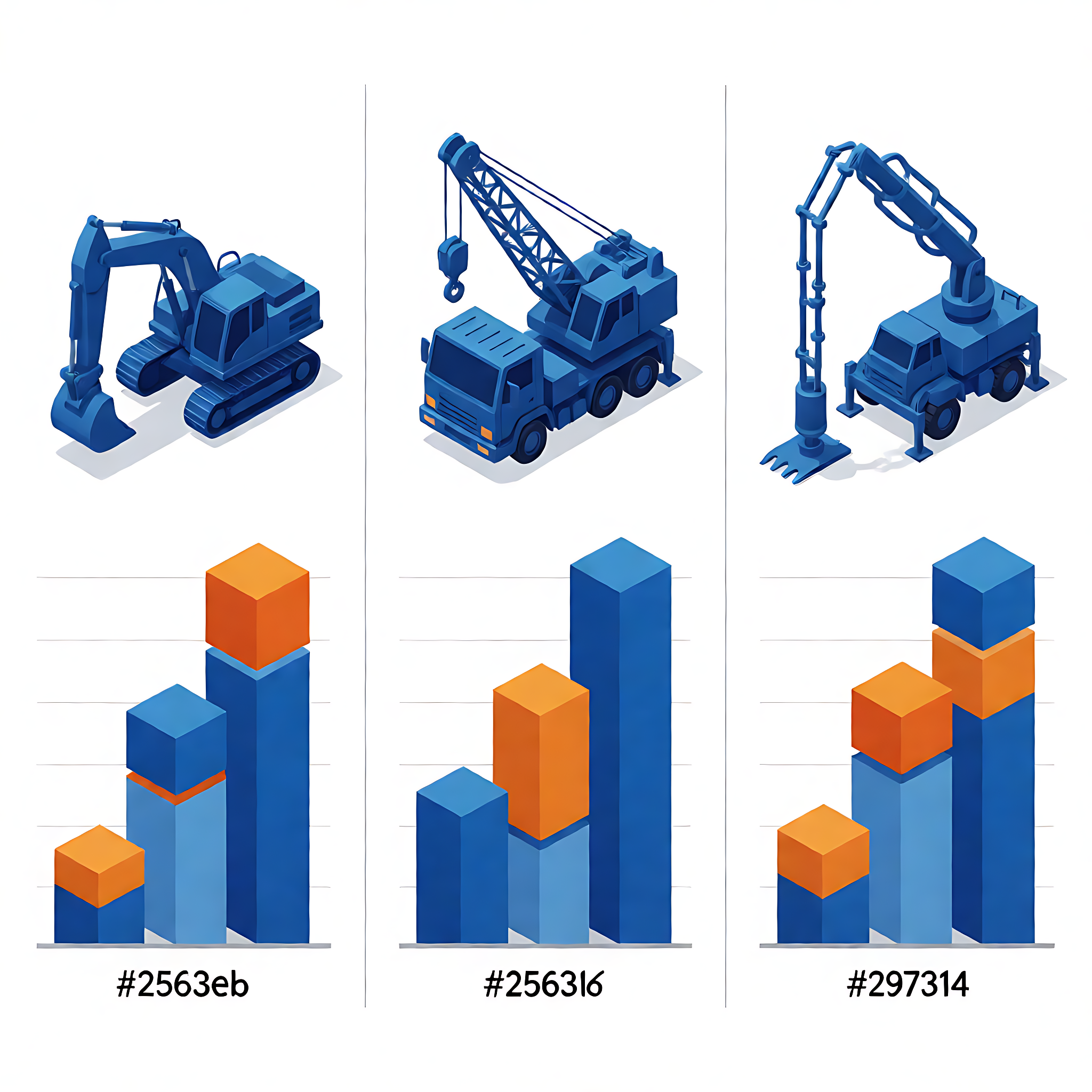
Yellow Table 2026: Where Chinese Manufacturers Sit
The Yellow Table 2026, published by KHL Group's magazine "International Construction", is the industry's recognized global league table. This year's list has several material changes:
- Top 50 combined sales of 246.6 billion US dollars, up 3.8% year on year — the third record high in five years
- Caterpillar holds firm at number one with roughly a 15.2% market share
- XCMG rose to third globally with a 5.8% share on sales of about 14.2 billion US dollars, the only Chinese manufacturer in the top five
- SANY ranks sixth at 12.58 billion US dollars, Zoomlion climbed two places to 11th (6.81 billion US dollars), and LiuGong broke into the top 20 (4.72 billion US dollars)
- A total of 13 Chinese companies made the Top 50
On the crane-focused T50 list, XCMG is third (14.37 billion US dollars) and SANY fourth (12.72 billion US dollars) — the first time two Chinese manufacturers have entered the top five together.

Climbing the table has been powered by overseas business. SANY's overseas revenue share hit 62.73% in 2025 (it was only 45.25% in 2022), with overseas contributing 71% of gross profit and an overseas gross margin of 31.7%, well above domestic. XCMG's overseas revenue share climbed to 48.2%; Zoomlion's overseas revenue share reached 57.25%, up another 1.67 percentage points year on year, with emerging markets accounting for more than 70%. For a closer look at this round of localization tactics, see our earlier piece Construction Machinery in Overseas Deep Waters: Localization Becomes the Decisive Move.
The FX Cut: The Bookkeeping Truth Behind Revenue Growth Without Profit Growth
Zoomlion's half-year report has one figure that must be unpacked: net profit attributable to parent shareholders of 2.102 billion yuan, excluding the temporary FX losses caused by the appreciation of the RMB, it was 2.802 billion yuan, up 17.19% year on year. In other words, about 700 million yuan of the profit gap came from book currency movements, and most of these positions had not yet been settled at the end of the reporting period, with no corresponding operating cash outflow.
This is not Zoomlion's problem alone. The headline of Caixin's August 31 report put it bluntly: "Overseas Revenue Lifts the Big Three's H1 Revenue, but FX Losses Weigh on Earnings". The sector already saw "revenue growth without profit growth" in Q1, for the same reason — FX. The harder you export and the larger your foreign-currency exposure, the uglier book profit looks when exchange rates turn against you — this is known as construction machinery's "FX trap".
For buyers, the practical meaning of this is concrete: when reading OEM financial reports, separate FX gains and losses from operating profit. Operating cash flow, cash collection rate and net profit excluding FX are the three clean metrics for judging a company's real operating condition.
The Real Gap Versus Caterpillar and Komatsu
The claim that "the three combined still can't beat Caterpillar" is widely circulated. To quantify it: Caterpillar's equipment sales were about 37.8 billion US dollars in 2024; in Q2 2026 its building products and services revenue grew 35% year on year, and in October it announced an extra 1 billion US dollars of investment in compact equipment. Komatsu's profit fell in 2025 because of tariffs, but its sales were still growing, and in June 2026 it was discussing following competitors in raising prices in North America.
The gap is not in growth rate but in per-unit value and service premium: average unit prices for Chinese excavators imported into Guinea, Ghana and South Africa reached 120,700, 147,400 and 107,200 US dollars respectively — far above the US market average of 7,000 US dollars, showing that emerging markets are putting Chinese equipment into heavy-duty work such as mining and that value added is rising. Yet judged by the roughly 10% share of global overseas revenue held by the five Chinese OEMs combined, there is still plenty of room.
The good news is that the pie itself is growing: MarketsandMarkets estimates the heavy construction equipment market will expand from 160.1 billion US dollars in 2026 to 226.9 billion US dollars in 2033, a CAGR of 5.1%. Q1 excavator sales across the industry totaled 73,300 units, up 19.49% year on year, of which exports grew 36.06%. Prices are healing as well — from March 2026 onward SANY, XCMG, Zoomlion and LiuGong successively issued price adjustment notices; saying goodbye to low-price rat-race competition is good for the margins of the whole industry.
What This Scorecard Means for Buyers
Bundle the points above into one strand, and for real decisions it comes down to three lines:
OEM cash flow is healthy, and payment terms and delivery are steadier than in the past two years — Zoomlion's 103.82% cash collection rate and +38% operating cash flow show the industry is no longer chasing volume on credit
High overseas margins feed back into the domestic market, leaving limited room for high-end models to get cheaper — the price increase notices are already up, and [electric models](../en/blog-news-20261006.html) and large-tonnage products are where each maker is directing its resources
Buyers should look at real profitability, not headlines — profit excluding FX is the real profit, and whether a supplier can keep investing in its service network comes down to this number
If you would like quotes and configuration recommendations for specific SANY, XCMG or Zoomlion models, welcome to contact our sales team; we will put together a plan around your working conditions and budget. For complete-machine cost estimates, see the aftermarket savings ledger.