Why Electric Wheel Loaders Drop the Torque Converter: Drivetrain Explained
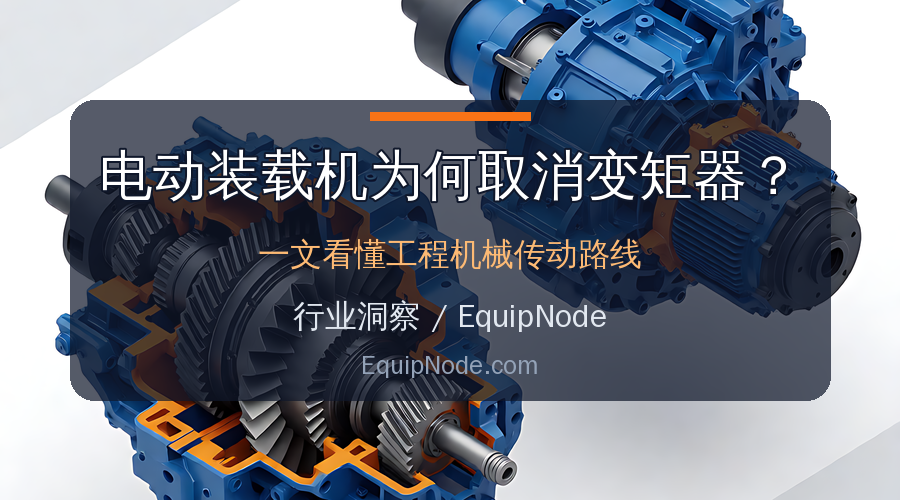
The moment a 5-ton loader scoops up 3 tons of sand and gravel, the engine is not directly "pushing" the wheels. Power first passes through a hydraulic torque converter, then a powershift transmission, and then travels down the driveshaft to the drive axle — losing energy at every step before it finally becomes bucket lift and forward motion. This drivetrain architecture, refined over more than half a century, is being cut in half by electrification. In September 2026, 58.64% of new loaders sold in China were electric — and most of them have no torque converter at all.
This article takes the drivetrain apart piece by piece: what problem each component solves, why the automotive transmission playbook doesn't transfer, and why these parts suddenly became unnecessary the moment the electric motor arrived.
1. Why Construction Machinery Can't Use Automotive Transmissions
Let's rule out the intuitive idea first: can you just bolt a passenger-car torque-converter automatic onto a loader? No — for three reasons.
First, the load profile is completely different. A passenger car spends nearly all its time overcoming rolling and aerodynamic resistance at a steady state. A loader faces shoveling impact: for the few seconds the bucket drives into the pile, resistance can double instantly, and the transmission has to absorb that shock under load without stalling or shattering gear teeth. Second, the frequency of direction changes. In a single work cycle a loader goes "forward to load — reverse — forward to dump," adding up to thousands of direction changes per day, each one required at full torque. Third, the speed range. A loader typically never exceeds 20 km/h on the job, yet it needs to deliver maximum traction continuously — exactly the low-speed, high-load region where an ordinary transmission is least efficient.
So construction machinery took an independent technical path: the hydraulic torque converter handles impact and high torque at low speed, while the powershift transmission handles direction changes and gear shifts under load.
2. Hydraulic Torque Converter: A Soft Coupling That Transmits Force Through a Chamber of Oil
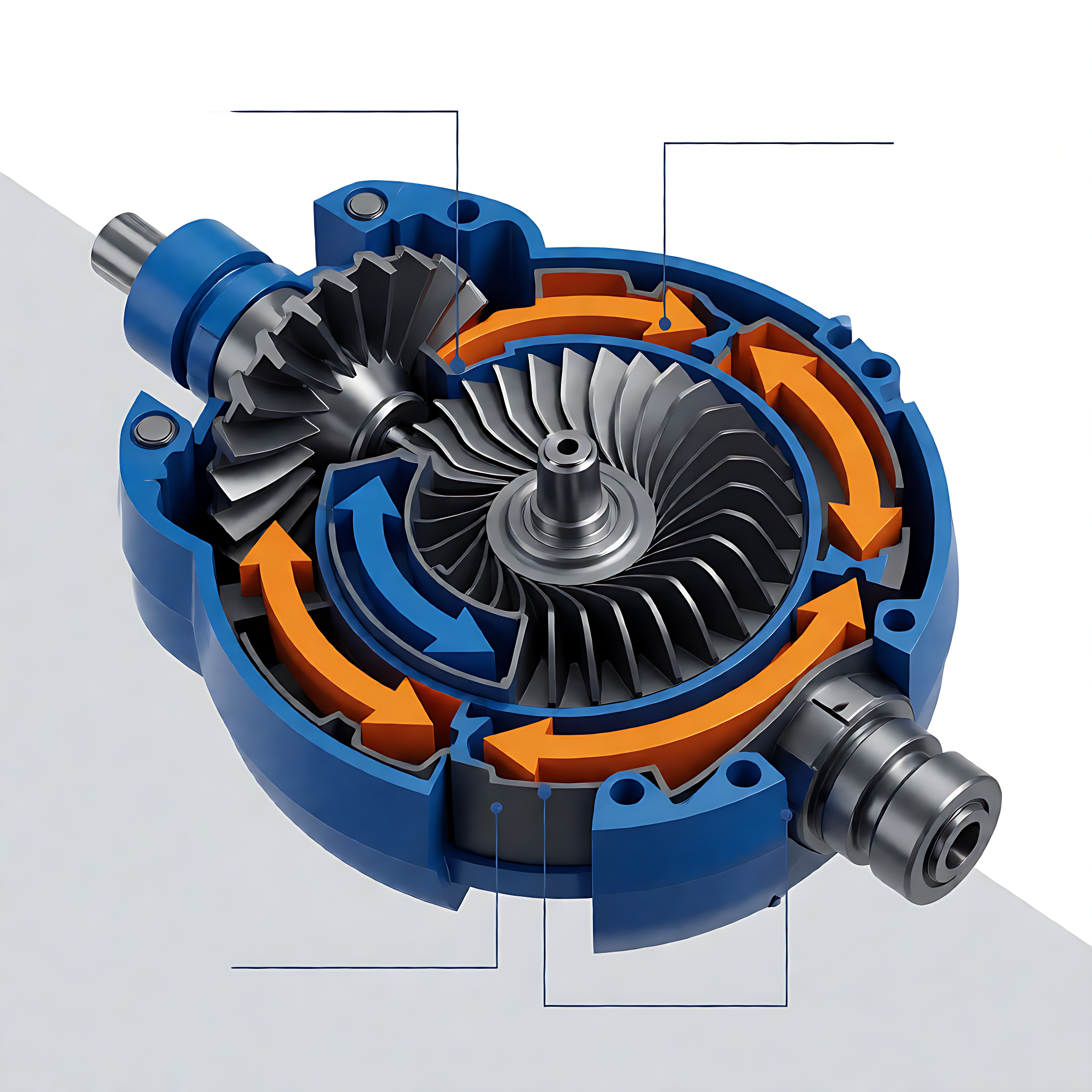
The principle of a hydraulic torque converter is not complicated. The engine spins the impeller, which acts like a centrifugal pump and flings working oil toward the turbine. The oil strikes the turbine blades and turns them, transferring power from the impeller to the turbine "through thin air" — there is no rigid connection between the two, only oil.
That word "soft" is its core value. When the bucket drives into the pile and resistance spikes, the turbine can slow down or even stall while the engine keeps spinning without stalling; the impact load is absorbed by the oil. At the same time, the stator redirects the oil flow so that torque is multiplied — typical converters in the industry deliver ratios between 2 and 4 times, equivalent to automatically getting a two-to-four-times "low gear" when you start loading.
The cost is equally clear: transmitting power through oil inherently involves slip, and the efficiency curve is parabolic, peaking at roughly 80% to 85% — and only within a narrow speed-ratio band. Step outside that band, and the lost power essentially turns into heat in the oil. Every veteran operator knows what "if the converter oil is hot, it's time for a break" means.
3. Powershift Transmission: Shifting Without Interrupting Power
The converter solves the problem of force; the powershift transmission solves the problem of gears. Its key difference from a manual transmission is that every gear-clutch pack is a normally engaged, wet multi-plate design — shifting simply releases one clutch pack and engages another, with power flow never interrupted.
That delivers two characteristics construction machinery requires. First, forward and reverse gear sets are structurally symmetric, so changing direction doesn't require passing through neutral and idling — one press of the pedal flips the machine from forward to reverse. Second, the shift process is hydraulically cushioned, so shifting mid-loading produces no sudden jump in power.
The complete drivetrain of a conventional loader takes shape here: engine → hydraulic torque converter → powershift transmission → driveshaft → front and rear drive axles. The system is mature and reliable, but its drawback is equally clear — every stage in series eats into efficiency, and the longer the chain, the less power makes it to the wheel ends.
4. When the Electric Motor Arrives, the Middle Stages Suddenly Become Redundant
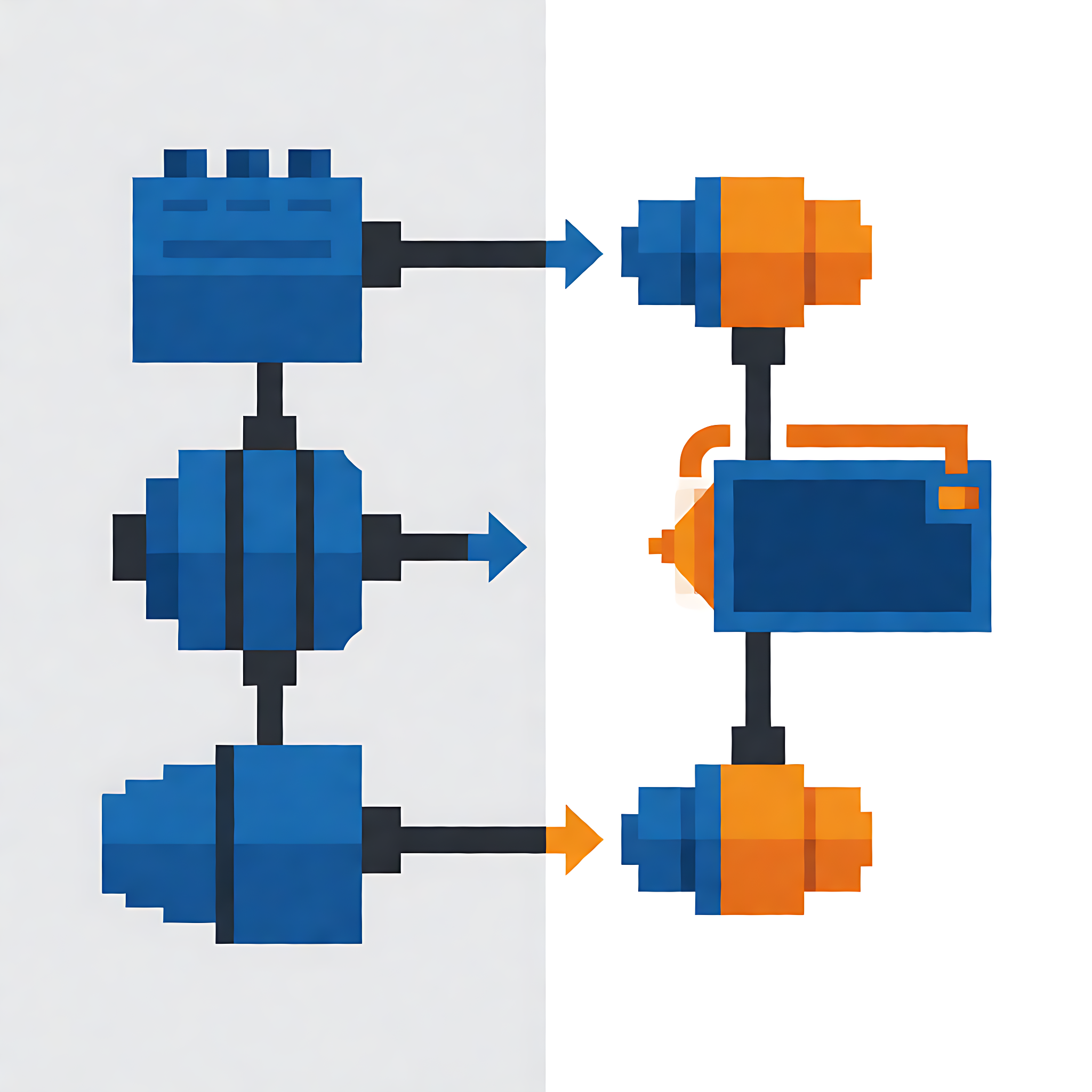
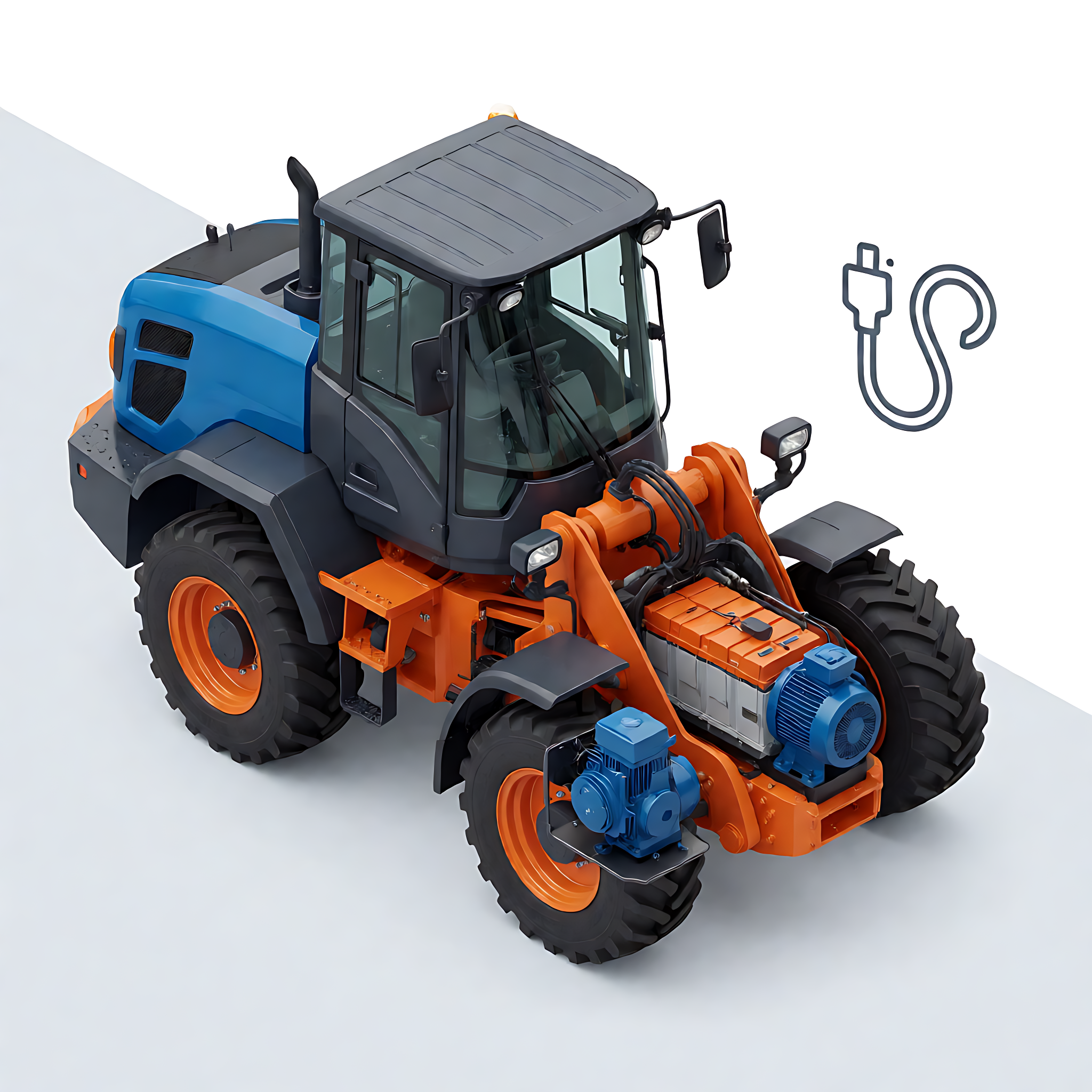
Electrification doesn't "optimize" this drivetrain — it removes the middle layer. The logic is that the electric motor's external characteristics happen to match a loader's operating demands exactly: the motor delivers peak torque at zero speed, and the constant-torque region extends all the way to base speed, so the top reason for a torque converter's existence — high torque at low speed — simply disappears. A converter relies on slip to absorb vibration, but a motor's torque response is measured in milliseconds, so the controller can do torque cushioning directly, more precisely than oil can. Reverse is a joke of a problem — just spin the motor the other way, and the direction clutch can be deleted from the drawing outright.
This is not a paper exercise; 2026 models have already put it into production:
- Shantui LE70-X5 electric loader: equipped with a Fast two-speed electronically controlled transmission and a zero-speed continuously variable-speed motor, it explicitly drops the torque converter, with an officially stated 20% improvement in drivetrain efficiency over the previous generation;
- XCMG XC968HEV-PRO hybrid loader: its travel system uses a tandem dual-motor arrangement, with one motor driving the front axle and the other the rear, and no transmission and no torque converter in between — sharply reducing the stages where energy is lost;
- Academia is following suit: a research team at Shanghai Jiao Tong University specifically demonstrated a shift-control strategy for battery-electric drive that eliminates both the hydraulic torque converter and the reverse-direction clutch, showing that "de-converterization" is now a settled direction the industry recognizes.
The trend isn't limited to loaders. Passenger cars and heavy trucks are following the same path. In the heavy-truck segment, conventional central drive (motor + reducer + driveshaft) achieves a combined efficiency of about 85%, while an e-axle solution that integrates the motor, reducer, and differential into the axle can exceed 94% — the shorter the chain, the more you save. Once electrification takes hold, competition in drivetrains shifts from "are the gears well made?" to "how well integrated is the system?"
As a side note, drivetrain suppliers' own financial reports corroborate the direction. Take transmission supplier Jindao Technology: the share of its revenue from electric-forklift transmissions has climbed from 18.53% at the time of its IPO to 33.35% in the first half of 2026. Nobody knows where the money is flowing better than the people who build transmissions.
5. Data: 58.64% Domestic Penetration, but Only 9.84% in Exports
Sales figures tell the most honest story about how fast a technical shift is happening. According to statistics from the China Construction Machinery Association, 5773 loaders were sold domestically in September 2026, of which 3385 were electric, putting domestic electric penetration at 58.64% — more than half of all new machines are already electric. Stretching that to January through September, a cumulative 33865 electric loaders were sold domestically. As recently as 2023 that figure was only in the thousands for the whole year; it broke 10,000 in 2024 and passed 27,000 in 2025 — two orders of magnitude in three years.
Exports paint a completely different picture: 6646 loaders were exported in September, but only 654 were electric — a penetration rate of 9.84%, less than one-sixth of the domestic figure. The reason is not hard to understand: domestically there is complete charging infrastructure and room for arbitrage on electricity prices, while overseas mine and infrastructure sites are generally short on power and diesel remains the only practical energy source. This also means that, for the time being, electric loaders' drivetrain solutions are primarily being tested by domestic operating conditions.
The practical impact on buyers: when purchasing a new machine, an electric model's drivetrain inspection checklist is far shorter than a combustion machine's — no torque converter oil, no transmission filter, no driveshaft universal joints — so the maintenance list is trimmed down. This complements the logic in Which hard metrics matter when assessing used equipment: used combustion machines require close attention to drivetrain wear, while new electric machines shift the focus to battery health.
6. In Closing: The Deleted Parts Are the Proof of Progress
Looking back over half a century of drivetrain evolution: the hydraulic torque converter was created to solve impact and torque multiplication with purely mechanical and hydraulic means in an era without electronic controls; the powershift transmission was created to reverse direction without interrupting power. Both were clever answers for their time. Once the electric motor packages torque response, forward/reverse rotation, and speed control into a single solution, these components step back from "essential" to "optional."
Two signals are worth watching over the next two to three years. First, whether export-market electric penetration can jump up from single digits — that depends on power infrastructure at overseas construction sites. Second, whether the hybrid route can resolve range anxiety in ultra-long-shift mining scenarios — XCMG's dual-motor, no-transmission design is essentially an answer to that scenario. To see which recent models have taken this path, see A roundup of new construction machinery models in October.
EquipNode aggregates construction machinery inventory from around the world, with in-stock channels for both electric and combustion models. If you'd like pricing on electric loaders or a comparison of drivetrain solutions across brands, contact our sales team for a detailed configuration sheet.