Three Giants Half-Year Reports: Revenue Rises Across the Board, Profit Splits
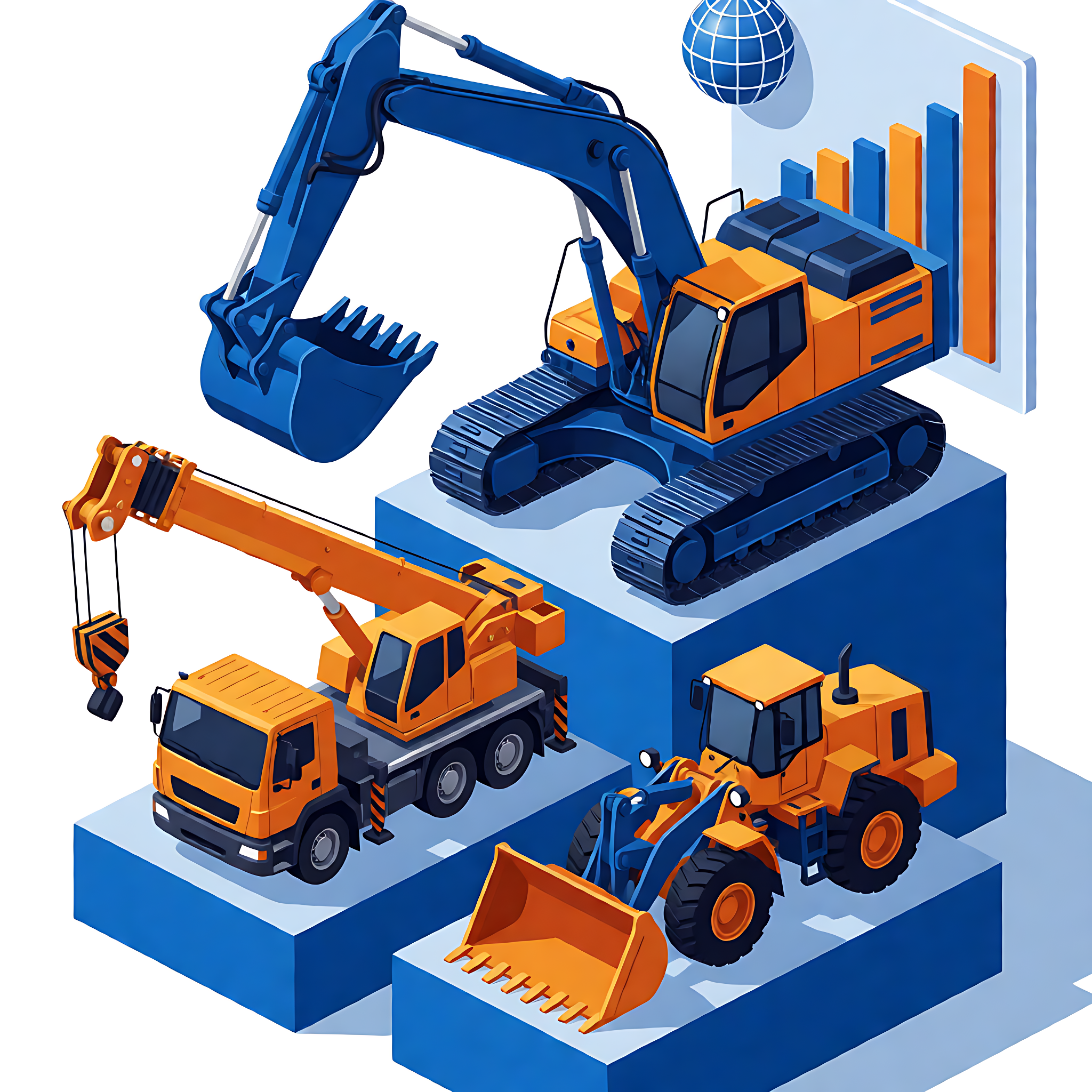
The construction machinery industry's annual "seat race" saw little change on the leaderboard this year, but a great deal of change in the accounts. The 2026 Yellow Table, released by KHL Group in late April, shows the world's top 50 manufacturers sold a combined US$246.6 billion in 2025, up 3.8% year on year to a record high. Caterpillar held firm in first place with a 15.2% share, while XCMG Machinery sat steadily third with US$14.207 billion and a 5.8% share — the highest position of any Chinese company on the list.
But switch the camera to the first-half 2026 earnings reports and the story forks: SANY Heavy Industry, XCMG Machinery and Zoomlion all posted year-on-year revenue growth, ranging from 9.17% to 19.49%; the profit line, however, moved in three directions — SANY grew modestly, Zoomlion delivered double-digit growth excluding currency-exchange effects, and XCMG showed a clear divergence between revenue and net profit. Same year, same wave of going global: why do the numbers add up so differently?
First, the Ranking: Positions Unchanged, the Value Behind Them Changed
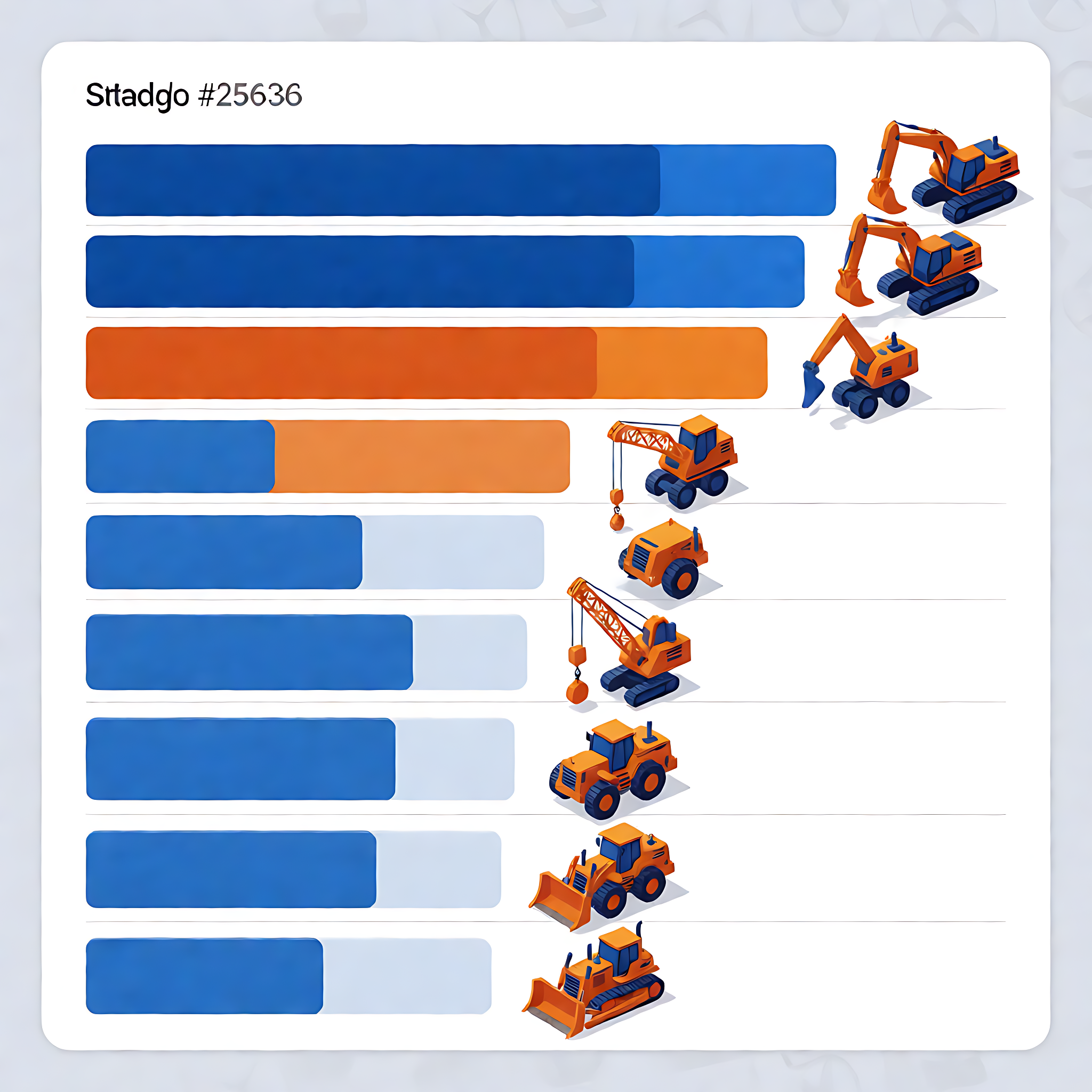
The Yellow Table's ranking logic is simple: order by prior-year sales. The 2026 top ten, in sequence, are Caterpillar, Komatsu, XCMG Machinery, John Deere, Liebherr, SANY, Volvo CE, Hitachi Construction Machinery, JCB and Sandvik. The faces in the top ten have not changed for many years; the changes have taken place in the internal structure.
Three signals deserve attention. First, Chinese brands hold two of the top-ten slots, but Deere and Liebherr sit between XCMG and SANY — a sign that individual breakthroughs have been achieved, while the depth of the pack still lags. Second, revenue by region is Asia 45%, Europe 28% and North America 27%: Asia remains the center of gravity of the global construction machinery industry, which also explains why Chinese OEMs' first choices for overseas expansion are so heavily concentrated in Asia-Pacific, Africa and Latin America. Third, the top 50's combined US$246.6 billion exceeds even 2023's US$243.4 billion, showing the industry as a whole is still expanding — only the way the increment is distributed has changed. Last month's sales data already supplied a footnote to the slope of Chinese brands' overseas climb: excavator sales rose 14.4% year on year in September, and cumulative exports exceeded domestic sales for the first time; see September excavator sales up 14.4%: cumulative exports exceed domestic sales for the first time.
Put these three points together and the list's conclusion is this: the market has not shrunk and Chinese brands' share is climbing, but between "selling more" and "earning more" there is more than one hurdle.
Three Half-Year Reports Side by Side: Revenues Rise Together, Profits Diverge
At the end of August 2026, the three industry leaders released their half-year reports in quick succession; laid side by side, the data is most revealing.
| Company | Operating revenue | YoY | Net profit attributable to the parent | YoY | Overseas revenue share |
|---|---|---|---|---|---|
| SANY Heavy Industry | RMB 53.506 billion | +19.49% | RMB 5.690 billion | +9.13% | 61.33% |
| XCMG Machinery | RMB 61.247 billion | +11.75% | RMB 3.962 billion | -9.09% | Overseas exceeded domestic for the first time |
| Zoomlion | RMB 27.135 billion | +9.17% | RMB 2.102 billion | +17.19% excluding FX effects | 57.25% |
SANY has the most balanced revenue mix. Excavation machinery revenue reached RMB 21.306 billion, up 21.77% year on year, with domestic market share holding first place; concrete machinery contributed RMB 9.022 billion, up 21.25%, remaining the world's number-one brand; pile-driving machinery came in at RMB 2.187 billion, a surge of 63.11%. Overseas core-business revenue was RMB 32.040 billion, up 21.82% and accounting for 61.33% of core-business revenue, with Africa the fastest-growing region at 47.66%, the Americas up 24.70%, and Asia-Pacific and Europe up 17.38% and 12.68% respectively.
Zoomlion's story lies in its "second growth curve." In the first half, emerging businesses — earthmoving, mining, aerial work platforms, agricultural machinery and others — generated roughly RMB 12.5 billion in combined revenue, up about 10%, and now account for more than 46% of the total: the first time non-crane business has carried half the load. Operating-quality metrics are equally impressive: net cash flow from operating activities of RMB 2.420 billion, up 38.12%; a cash-collection ratio of 103.82%, up 5.31 percentage points year on year — evidence that this round of growth is backed by cash.
XCMG's numbers reward the closest scrutiny. Revenue of RMB 61.247 billion, up 11.75%, kept its position as domestic industry leader, and gross margin even improved 0.41 percentage points to 22.12%; but net profit attributable to the parent was RMB 3.962 billion, down 9.09% year on year, with the decline widening to 14.28% after excluding non-recurring items. An analysis by Sina Finance pointed to two levers: first, net margin fell to 6.54%, down 18.85% year on year; second, inventory as a share of total assets rose across three consecutive half-year reports, from 18.16% to 19.7% and then 21.22%. Revenue up, profit down, inventory up — that combination usually points to one thing: channel loading and front-loaded expenses.
The Second Reason for the Divergence: FX Losses, the Blunt Blade
On August 31, Caixin offered a blunt judgment: overseas revenue drove the Big Three's top line in the first half, but exchange losses dragged on profitability. Zoomlion put it most clearly in its half-year report — H1 net profit attributable to the parent was RMB 2.102 billion; strip out the one-off exchange losses caused by the renminbi's appreciation, and it would have been RMB 2.802 billion, up 17.19% year on year. The RMB 700 million difference is the book cost of currency volatility.
This is not one company's problem. All three already derive close to (or more than) 60% of revenue from overseas, export settlement cycles routinely run for months, and once the renminbi enters an appreciating path, dollar-denominated orders signed earlier naturally shrink when converted. The companies also stressed that most of these losses had not yet been settled at period-end and do not correspond directly to operating cash outflows in the current period — a temporary, book-only impact.
For buyers, this carries a very practical corollary: when an OEM's income statement is under short-term pressure, promotions, payment terms and installment plans may in fact become more generous. Buyers looking to purchase in volume often find the bargaining window opens precisely at such moments.
Caterpillar Is Playing a Different Game
Comparison cannot run in only one direction. Caterpillar's Q2 2026 results, released on August 4, put the other side of the "gap" on the table: quarterly revenue of US$20.5 billion, up 24% year on year — the first time it has crossed US$20 billion in a single quarter; earnings per share of US$7.77, or US$8.17 adjusted; and a backlog exceeding US$50 billion.
The real growth came from power. The report shows Caterpillar's sales of generator sets to customers grew 72%, led by large generator sets and gas turbines for data centers and AI infrastructure. The company also resumed production of its 10-megawatt medium-speed gas reciprocating engine platform, designed to fill the prime-power gap between high-speed engines and industrial turbines; together with its dealers it also launched a leasing joint venture called "Major Projects" to take on mega infrastructure and data-center projects beyond the capacity of any single dealer's fleet. On this basis, Caterpillar raised its full-year 2026 revenue-growth guidance to a mid-to-high double-digit range.
In other words, when Chinese OEMs' growth engine is "selling machines in more countries," Caterpillar's engine has partly switched to "selling power to AI data centers." That does not mean the overseas-expansion logic of construction machinery has failed; it means the profit pool of the industry's leaders is expanding outward, and traditional sales-volume comparisons no longer describe the full competitive picture.
M&A and Contraction: The Signal in a Small Deal
On October 22, Nikkei broke a small but intriguing deal: Itochu Corporation is to acquire Hitachi Construction Machinery's sales subsidiary in Taiwan. Set against Hitachi's April showing of "revenue up, profit down" (due to tariff pressure), this is a classic slimming of the channel — handing local sales functions to a general trading company while focusing on products and manufacturing. Hitachi Construction Machinery is meanwhile advancing a rebranding called "LANDCROS", targeted for completion in 2027.
This thread is equally relevant to Chinese brands on the export chain: when tariffs and localization costs raise the bar for self-operated channels, deep integration with local trading houses and dealers becomes the more economical choice. End-market feedback supports this judgment — long-tail overseas demand remains strong. A Norwegian blogger's single order of 70 Chinese mini excavators is enough to illustrate the carrying capacity of grassroots channels; see A Norwegian blogger ordered 70 Chinese mini excavators: the story of a $2,000 Chinese digger going global. Zoomlion has built more than 30 first-tier service hubs, over 530 second- and third-tier outlets and over 300 spare-parts warehouses worldwide, with nearly 7,000 local employees overseas; SANY, for its part, is driving an upgrade from "product export" to "industrial going global." Heavy asset investment in channels is fast becoming the industry's second threshold.
In Closing
Put three half-year reports, one Yellow Table and one Caterpillar filing together, and the real picture of the industry in 2026 looks roughly like this: the demand side has not collapsed — top-50 revenue is still hitting records; Chinese OEMs have captured incremental revenue through overseas expansion, but the profit side has been eroded by currency movements, channel costs and the inventory cycle; and the American company at the very top of the stack is opening a second front with data-center power.
For domestic users and exporters, two lessons follow directly. First, periods of margin pressure tend to be periods when commercial terms are most generous — procurement timing can be moved forward. Second, do not fixate only on machine prices: service-network density, spare-parts responsiveness and financing programs are becoming the main battleground for OEM competition — and all of it ultimately shows up in your total cost of ownership.
For specific quotes and lead times on SANY concrete pumps, electric loaders or XCMG cranes, please contact the EquipNode sales team; we can provide multi-brand comparison proposals and overseas delivery support.