How to Buy Used Construction Equipment Without Getting Burned: 5 Hard Metrics
The 2026 used construction machinery market has produced a somewhat unusual combination: inventory is falling, prices are not rising, and deals are closing more slowly. US used heavy construction equipment inventory dropped 10.45% year over year in August, while asking prices for used compact excavators were still down 1.05% month over month. Back in China, the excavator utilization rate stood at 51.4% in September, and operators and fleet owners know better than anyone what current shift rates look like.
Buyers have grown more cautious and sellers are under mounting inventory pressure, which is precisely when buyers should be doing their homework. But the information asymmetry in used equipment has not changed: odometer rollback, respray touch-ups, substandard remanufactured parts. The traps are the same traps. We break equipment selection down into five hard indicators, each of which you can apply on the spot during an inspection.
Read the Market First: Whose Market Is It Right Now
The latest overseas data comes from Sandhills Global's market report released on September 4, 2026. In August 2026, US used heavy construction equipment inventory fell 2.56% month over month and 10.45% year over year. Crawler dozers posted the largest month-over-month decline at -3.78%, while wheel loaders recorded the largest year-over-year decline at -11.94%. In the medium-equipment segment, used backhoe loader inventory plunged 23.52% year over year.
But asking prices have not risen alongside inventory. Heavy equipment asking prices edged up just 0.52% month over month and remained at -1.55% year over year, while medium equipment asking prices fell 0.74% month over month. The report's conclusion is blunt: dealers report a slower sales cadence and more cautious buyers, even as rental demand remains firm.
Falling inventory combined with soft pricing indicates this is not a market driven by tight supply, but one where demand is hesitating. For buyers, that means two things. First, the pool of available machines is actually shrinking; good units get snapped up quickly, so there is no room to drag your feet. Second, real negotiation room exists, especially on inventory that has been sitting on dealer lots where carrying costs are already biting.

Hard Indicator One: Undercarriage Wear Is More Honest Than Hour Meter Readings
When inspecting a used machine, most people's first move is to lean over the dashboard and read the hour meter. But hours are the easiest parameter to tamper with and the least reflective of real wear. The first thing you should actually look at is the undercarriage.
There is a repeatedly validated figure in the industry: for tracked equipment, the undercarriage system (track shoes, track chain, track rollers, carrier rollers, idlers, and drive sprockets) can account for roughly 50% of a machine's total lifecycle maintenance cost, even though it typically represents only around 20% of the machine's purchase price. In other words, by the time an excavator reaches end of life, the money you spent on the undercarriage may rival what you paid for the machine itself.
How to verify on site: First, check the wear on the track chain links and bushings; measuring pitch with a caliper is far more reliable than eyeballing the surface. Second, inspect the drive sprocket tooth height; teeth that have worn to a point indicate the track assembly has completed a full service life. Third, check the track rollers for oil leaks; a leaking track roller will fail completely within a few hundred hours. Fourth, ask for the track tension maintenance records. Improper track tension is the single largest cause of downtime on tracked equipment, and industry estimates suggest that managing tension properly alone can prevent roughly 85% of undercarriage wear problems.
If the hour meter reads 8,000 hours but the undercarriage condition looks like 15,000 hours, negotiate based on the latter. Conversely, a machine with a freshly replaced undercarriage kit is worth serious discussion even if its hour count runs high.
Hard Indicator Two: Tell Remanufacturing Apart from Refurbishment
These two terms are often used interchangeably in Chinese, but their substance differs by an order of magnitude.
Remanufacturing is a standardized, batch-production process: teardown, cleaning, inspection, repair or component replacement, assembly, and testing, with performance and quality required to match or exceed new. Chinese government agencies including the National Development and Reform Commission have published a consistent set of figures: compared with manufacturing new units, remanufacturing saves 50% in cost, 60% in energy, and 70% in materials, while cutting air pollutant emissions by more than 80%. Refurbishment, by contrast, is usually cosmetic repair and repainting, with no guarantee of restored performance and no guarantee of remaining life in core components.
When buying a used machine, if the seller says "this is a remanufactured unit," press on three points: Are there complete inspection and parts replacement records? Were the key assemblies (hydraulic pump, motor, engine) repaired originals or remanufactured parts? Is there a warranty clause, and how long does it last? If the seller cannot answer, value the machine as a refurbished unit, full stop.
Standards support already exists. In August 2022, the Hunan Provincial Construction Machinery Used Equipment Export Industry Alliance was established in Changsha and issued a local standard; in May 2023, China's first used construction machinery export standard was released in Changsha. This means used equipment destined for overseas markets now has an established acceptance benchmark, and buyers can require sellers to provide inspection reports to that standard at the time of purchase.
Hard Indicator Three: The Parts Supply Chain Determines Ownership Cost
Buying equipment is a one-time expense; running equipment is a long-term one. Whether a used machine is worth taking over depends heavily on the density of parts supply in its region.
A simple way to gauge the maturity of an industrial park is to count the share of parts dealers. Take the Central International Machinery Park in Xiangtan, Hunan: of the more than 200 companies in the park, 39 are trading firms, while more than 120 are parts suppliers, over one third of the total. This structure means that when something breaks, you can get parts the same day, and downtime is measured in hours rather than weeks.
Conversely, if your equipment is headed for a market with thin parts channels, you must stock all wear-prone components up front at the time of purchase: seal kits, filters, track wear parts, and hydraulic hoses. That spending looks like an added investment, but it actually converts uncontrolled downtime risk into controllable procurement cost. This is especially true for export business, where logistics lead times can turn a minor fault into a full jobsite shutdown.
Hard Indicator Four: Export Channels Determine the Residual Value Ceiling
A used machine's residual value depends on where it can be sold in the future.
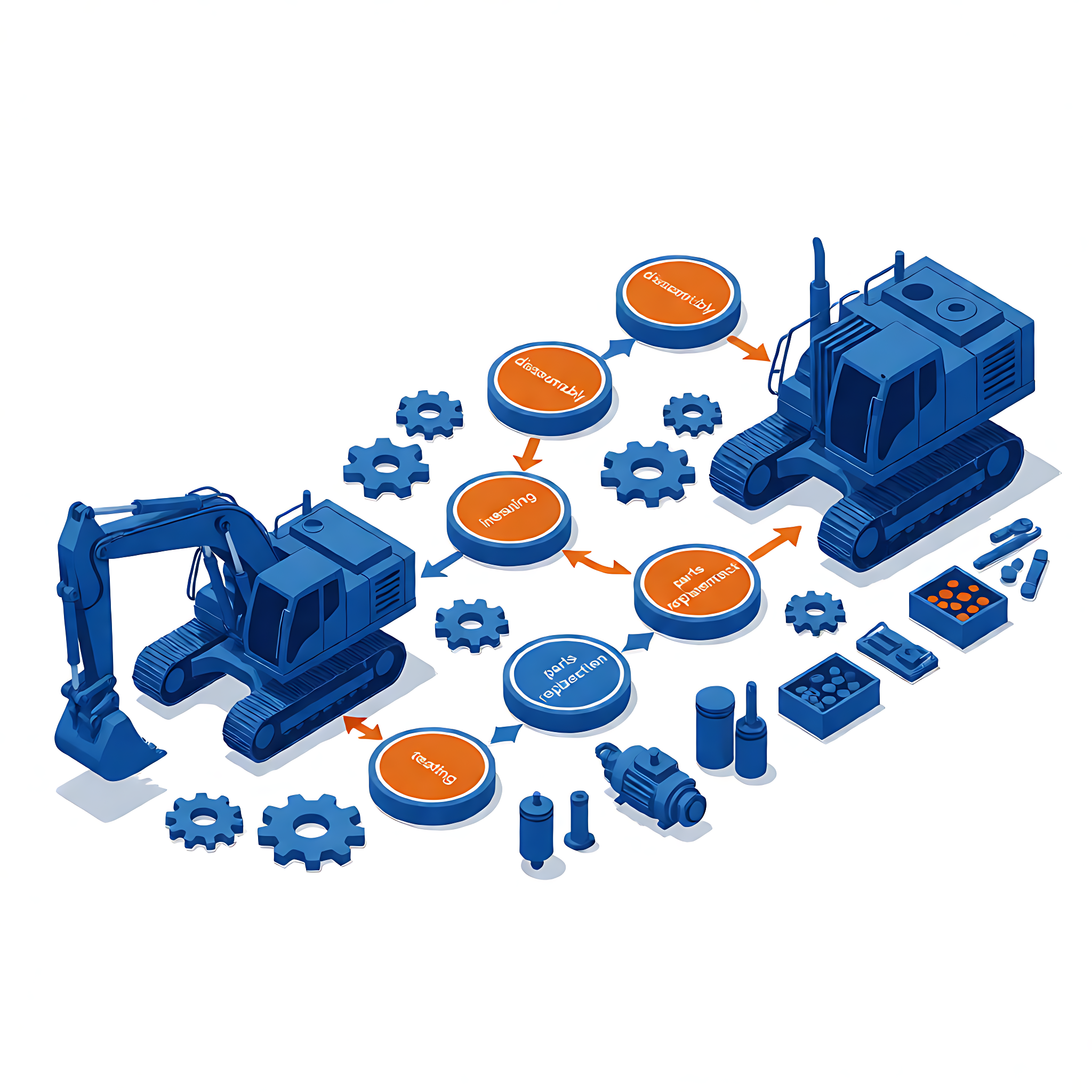
This lane is widening. The Central International Machinery Park in Xiangtan, Hunan recorded 3.5 billion yuan in used construction machinery transactions in 2025, accounting for 75% of the provincial total. The park has built a "buy from China, sell to the globe" chain: some operators source used equipment nationwide, others perform inspection and scoring, some refurbish parts, and others handle export documentation. Under the Xiangtan City Implementation Plan for Reform of the Construction Machinery Remanufacturing System, the city targets 5 billion yuan in remanufacturing industry output by the end of 2026, of which exports will be no less than 800 million yuan. One remanufacturing workshop in the park invested more than 50 million yuan, has annual repair and remanufacturing capacity of over 1,000 units, sells to more than 30 countries, and grows export revenue by more than 50% each year, with orders to Africa alone up 89% year over year.
Demand-side momentum has concrete evidence: during the 4th China-Africa Economic and Trade Expo in June 2025, the park hosted the construction machinery remanufacturing exhibition, drawing 246 foreign guests from 39 African countries as well as 2,280 domestic buyers. Over the three-day show, on-site transactions reached 13 million yuan, with intended orders totaling more than 300 million yuan.
For domestic buyers, the implication is this: buy a used machine from a mainstream brand, with a clear duty profile and complete documentation, and when you want to sell it later, the export channel is a genuine buyer rather than just a scrap-steel price. Domestic mainstream models hold value noticeably better on this channel than niche brands. This follows the same logic behind the popularity of Chinese compact excavators in overseas consumer markets; see our earlier analysis of Chinese compact excavator exports to Europe. As for choosing between crawler and wheeled models, see our crawler versus wheeled excavator selection comparison.
Hard Indicator Five: Leave Room to Negotiate Within the Transaction Cycle
The final factor is time. The Sandhills report explicitly notes that economic uncertainty is lengthening sales cycles for used equipment. A longer closing cycle favors buyers: you can more comfortably arrange third-party inspections, compare prices, and negotiate payment terms without worrying that if you do not act today, someone else will take the machine tomorrow.
A few practical recommendations: First, insist on a third-party inspection. The cost is typically 1% to 2% of the equipment price, and it narrows a risk exposure of hundreds of thousands, or even millions, of yuan. Second, tie installment payments to acceptance, releasing the final payment only after the key assemblies pass trial operation. Third, bundle wear parts and the first service into the contract; negotiation success rates on this line are far higher than on the machine's headline price. Fourth, confirm that the equipment's emissions tier matches the access requirements of your target market, as this directly determines where it can still work and for how many years.
The One-Line Summary
When picking a used machine, do not let the paint and the hour meter mislead you. Undercarriage condition, remanufacturing records, parts supply density, export residual value channels, and room within the transaction cycle. Once all five indicators line up, a machine's true value comes into focus. For current market pricing and remanufacturing options on specific models, contact our sales team for a one-on-one assessment.
EquipNode, the professional construction machinery trading platform, serving global buyers and Chinese manufacturing.