Excavator Attachments for Beginners: How One Machine Does Ten Jobs
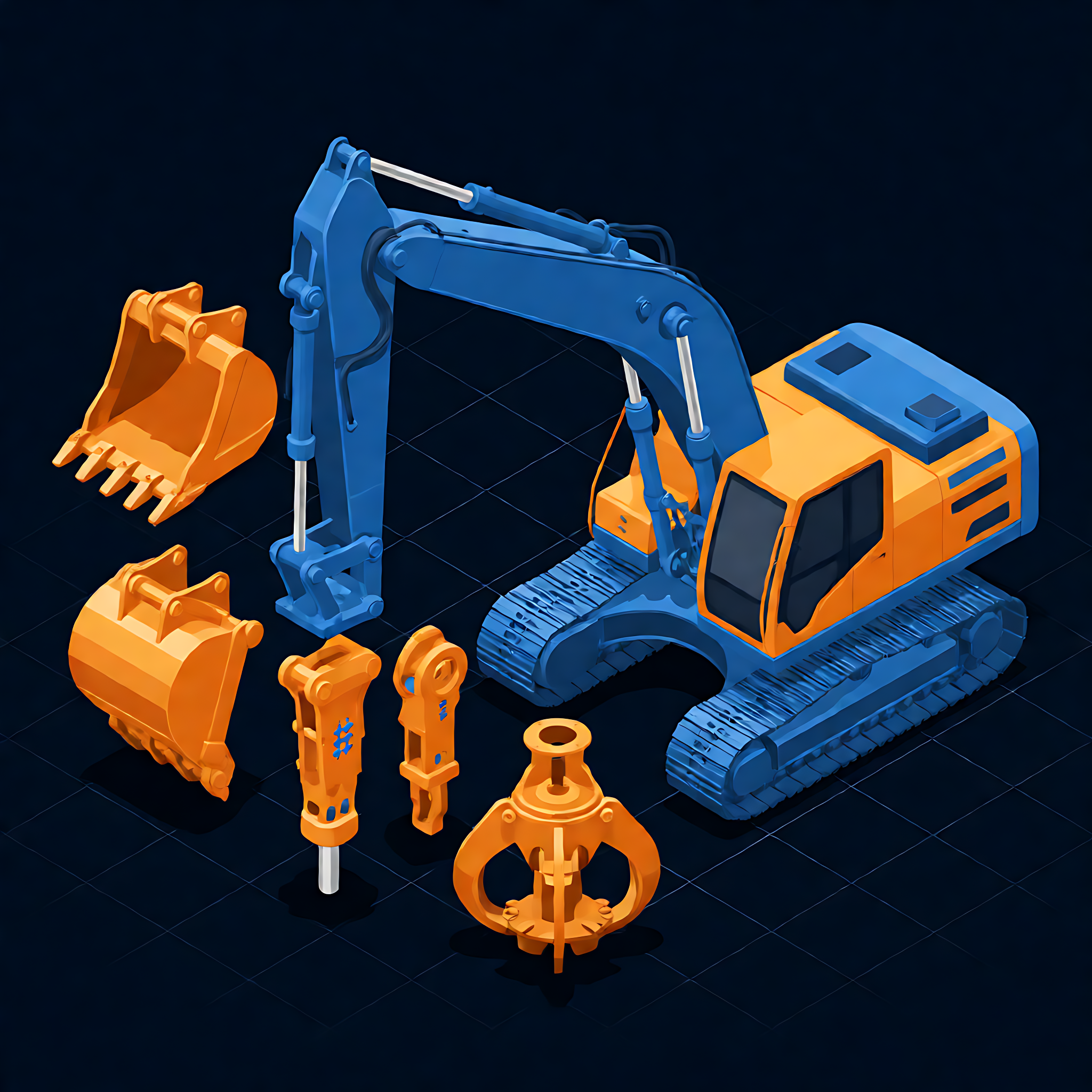
On a jobsite you have probably seen this scene: the same 20-ton excavator digging a foundation pit in the morning, swapping on a breaker to hammer concrete in the afternoon, and coming back the next day gripping logs with a grapple to load timber. What makes it "change faces" is not the operator's skill — it is the attachments.
Attachments are interchangeable work tools hung off the front end of an excavator's boom. In the past one machine came with one bucket and did one job; today, thanks to quick couplers, one machine can become ten machines. This seemingly unremarkable supply chain already reached a global market size of US$9.2 billion in 2026, and is expected to climb to US$14.8 billion by 2033.
1. Ten Common Attachments and What Each One Does
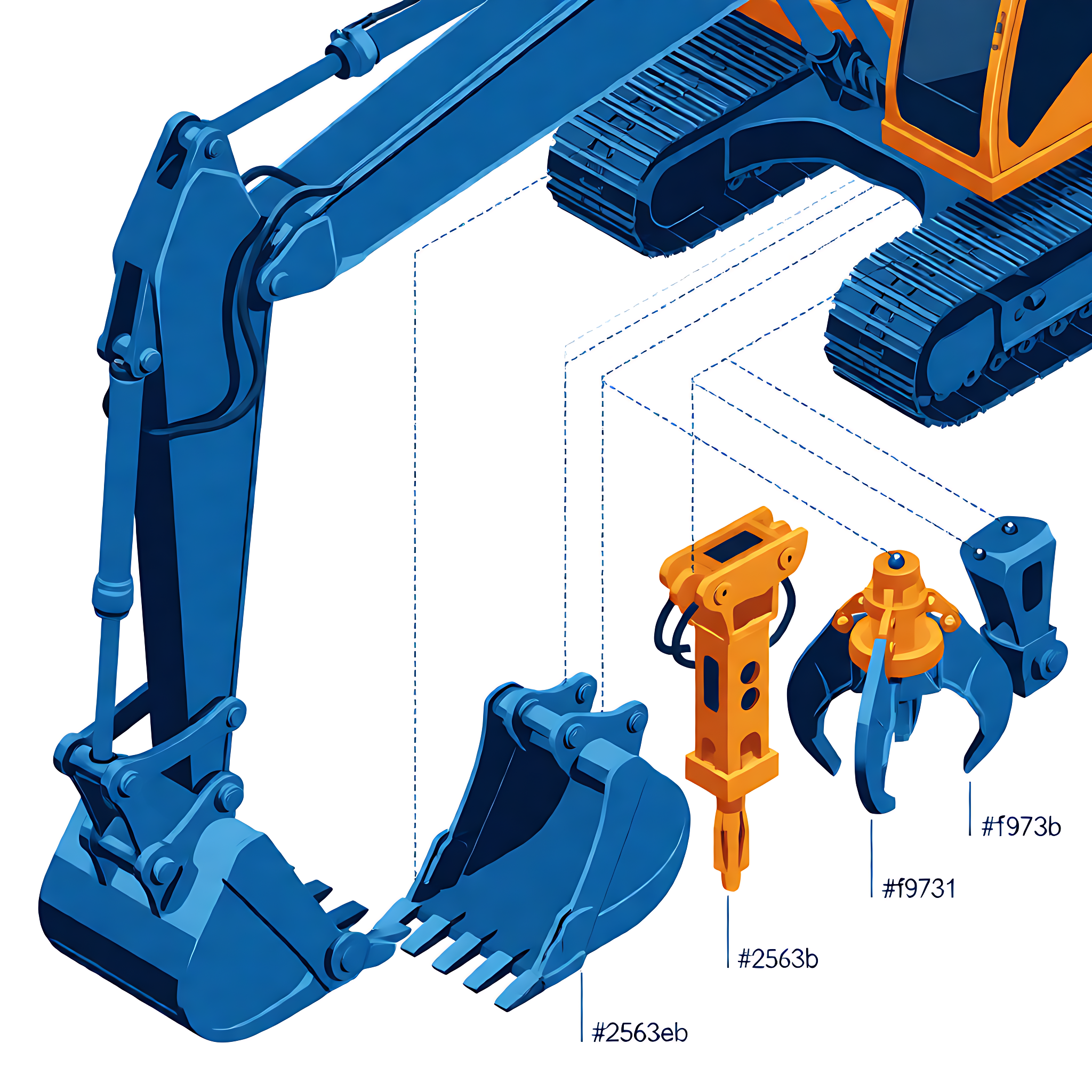
On mainstream equipment platforms, attachments are already a standard category. Here are the ten most-used ones laid out — just match them to your needs when selecting:
- Breaker: the most widely used attachment, replacing jackhammers to break concrete and rock. Mainstream models are fitted to excavators of 10 tons and above; for 35-ton class demolition work, the common breaker impact energy is about 1500~3000 joules, and Epiroc's breaker product line covers 1~70 ton class excavators
- Hydraulic shear/cutter: the mainstay for tearing down buildings and reinforced concrete structures — "cleaner" than a breaker
- Steel grapple / log grapple / stone grapple: grabbing and loading scrap steel, timber and stone; essential in scrap recycling and port operations
- Ripper (single-tooth bucket): for hard soil, frozen ground and weathered rock — far less effort than digging with a regular bucket
- Auger: piling, digging tree holes and erecting utility poles; a high-frequency tool in municipal and landscaping work
- Crushing bucket: crushes while it digs, finishing excavation and crushing in one step; suited to conditions where hard chunks are mixed into the earthwork
- Vibrating plate compactor: trench backfill compaction — it can go where rollers cannot
- Quick coupler: does no work itself, but it is the key that lets every attachment above "clock in at any time"
- Tiltrotator: a premium part that gives attachments a "wrist"
- Forks / lifting hook: short-distance handling of sheet material and precast parts
In one sentence: dig with a bucket, break with a hammer, grab with a shear, compact with a plate — everything else is a variant of these four.
2. Quick Couplers: The Gap Between 8 Minutes and 30 Seconds
Whether attachments actually get used does not hinge on the attachment itself — it hinges on speed of changeover.
The traditional pin-on process for swapping a bucket goes: the operator shuts off the engine, gets out, takes a hammer and punch and drives out two pins, drops the old bucket, positions and mounts the new one, then hammers the pins back in. Under real jobsite conditions this sequence takes 8~12 minutes, and the person has to work standing beneath a suspended attachment — one of the fatal risk points repeatedly reported by the US CDC/NIOSH.
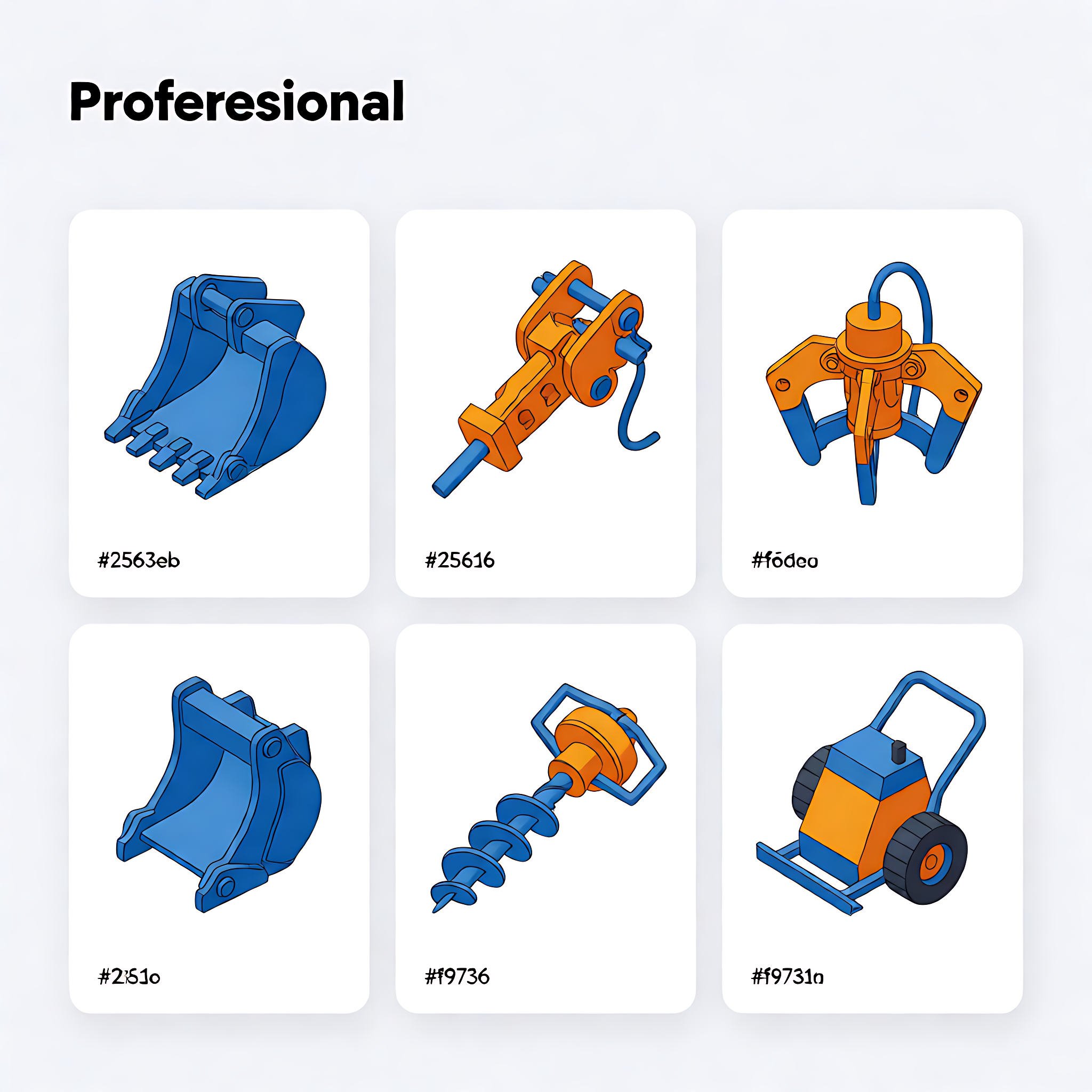
A hydraulic quick coupler compresses this step to 15~30 seconds: the operator flips a control valve from inside the cab, a cylinder pushes the hook claws to bite onto the attachment's ear plates, and a mechanical safety lock provides automatic backup. Nobody leaves the cab, nobody touches a hammer, nobody stands under a suspended load.
The math is easy:
Change over 6 times a day and pin-on connection wastes about 1 hour of labor, while a quick coupler takes almost no time at all
The more awkward the changeover, the more the operator sticks to "one bucket to the end" — the result is forcing a digging bucket to chew through a breaker's job, accelerating wear on bucket teeth and structural parts
A quick coupler is a one-time investment, and the return shows up in the utilization rate of the whole machine
So there is a consensus when selecting: for machines that swap attachments frequently, a quick coupler is not an option — it is standard equipment.
3. Tiltrotators: Giving Attachments a "Wrist"
If the quick coupler solves "changing fast," the tiltrotator solves "reaching accurately."
It mounts between the stick and the attachment, giving the attachment 360° continuous rotation plus 45° tilt to each side — effectively a wrist for the excavator, letting you twist the bucket face or grapple to any angle against the work surface without moving the tracks. For municipal pipe networks, fine grading, trench backfill and other conditions where "every move of the machine costs money," its value is most obvious. Field feedback from overseas machine owners: on machines fitted with a tiltrotator, finishing-type work can be completed 30%~40% faster.
The price is equally blunt: it costs 8~15 times as much as a standard hydraulic quick coupler, and mainstream application is concentrated on small and medium machines of 10~15 tons and below. Large-scale mining and bulk earthwork conditions basically have no use for it, because there the efficiency bottleneck is not the angle — it is bucket capacity.
The conclusion is plain: a tiltrotator is an amplifier for precision work, not a universal upgrade.
4. The US$9.2 Billion Attachment Business: Who Gets the Money
The growth logic of the attachment market differs from that of the base machines — base machines track new project starts, attachments track the reuse rate of the existing fleet. The larger the global excavator fleet and the more owners pursue one machine doing many jobs, the higher attachment penetration goes.
Several institutions basically see it the same way:
- Grand View Research: global excavator attachment market of US$8.7 billion in 2025, US$9.2 billion in 2026, US$14.8 billion in 2033, compound annual growth 7.0%
- Coherent Market Insights: US$9.21 billion in 2026, US$13.51 billion in 2033, CAGR 6.6%
- Maximize Market Research: US$7.72 billion in 2025, US$12.37 billion in 2034, CAGR 5.37%
They disagree at the decimal point but agree on direction: attachment growth runs steadily above the 5.1% of heavy construction equipment overall over the same period (MarketsandMarkets basis). Structurally, buckets, breakers and grapples eat most of the share, while the fastest-growing segment is attachments with smart interfaces — pressure, angle and count data fed back to the cab, turning an attachment from a "hunk of iron" into a "monitorable consumable."
For buyers the practical meaning is: attachments are one of the highest repeat-purchase categories in the aftermarket, and also a litmus test of a dealer's service capability — whether it can match attachments to your job conditions, and whether it has localized attachment repair capability, often decides three-year cost of ownership more than the machine quote does. We worked through the detailed math on this in our Aftermarket Money-Saving Ledger.
5. Three Hard Rules for Choosing Attachments
Get the attachment choice wrong and, at best, it cannot be used; at worst, it will choke the hydraulic system. Three rules, in priority order:
1. Flow and pressure must match — "it fits" does not mean "it works"
Attachments are driven by hydraulic flow. Typical requirements: an auger needs about 10~20 gallons per minute, a breaker 5~12, a hydraulic thumb 4~8, a rotating grapple 5~10 (rated for compact machines). If the host machine's pump flow falls below what the attachment needs, the attachment "has strength it cannot put out"; conversely, pushing a small attachment with high flow raises oil temperature and shortens seal life. Check the host machine's spec sheet first, then pick the attachment.
2. Leave margin in the tonnage class — do not buy at the lower limit
Breakers and hydraulic shears both have clear adaptation tonnage ranges. Buying right at the lower limit means running the attachment long-term at the edge of full load: impact energy decays fast, and the boom takes heavy impact loads. The experienced approach is to jump up half a class, trading a little maneuverability for structural life.
3. The safety lock must be a mechanical second line of defense
If a quick coupler fails, the attachment drops from height. A hydraulic lock can bleed off pressure; a mechanical safety lock will not — which is exactly why every major market makes the mechanical secondary lock a mandatory requirement. Put this one item on your acceptance checklist, and never substitute "probably won't" for "definitely won't."
6. The Buying Order for Beginners
If you are new to the business and working to a budget, the recommended configuration order is:
Quick coupler first — it decides whether every attachment you buy afterward can actually be put to work
Breaker next — the highest coverage of job conditions, and the easiest to resell on the secondhand market
Thumb/grapple next — the efficiency gain for handling debris and loading trucks is the most visible
Auger and compaction plate by project — rental prices are low, no need to buy everything at once
Tiltrotator last — only worth it on small and medium machines where precision work makes up a high share
If you want to work out which base machine you should buy first, see our earlier Complete Breakdown of Excavator Types; if you are already comparing models, Seven Excavator Types: A Complete Breakdown has a more detailed parameter comparison.
EquipNode provides excavators, loaders and the full range of attachments — selection and supply services — for contractors worldwide. If you need an attachment package configured for your job conditions, or a quote on breakers and quick couplers, please contact our sales team, and we will give recommendations based on machine model, flow parameters and project type.