Excavator Types Explained: Crawler vs Wheeled vs Mini

title: A Complete Guide to Excavator Types: Crawler, Wheeled, or Mini — How to Choose?
description: An in-depth comparison of crawler excavators, wheeled excavators, and mini excavators — covering core differences, use cases, and key selection criteria to help contractors make the most cost-effective equipment purchasing decisions.
keywords: excavator types, crawler excavator, wheeled excavator, mini excavator, equipment selection, construction machinery guide
What's the most common piece of construction equipment on any job site? The answer is undoubtedly — the excavator. But not all excavators are created equal. Crawler, wheeled, and mini models differ dramatically, and choosing the wrong one can delay your project and blow your budget by over 30%. This article breaks down the core differences across working principles, performance specs, and real-world applications so you can make a confident decision.
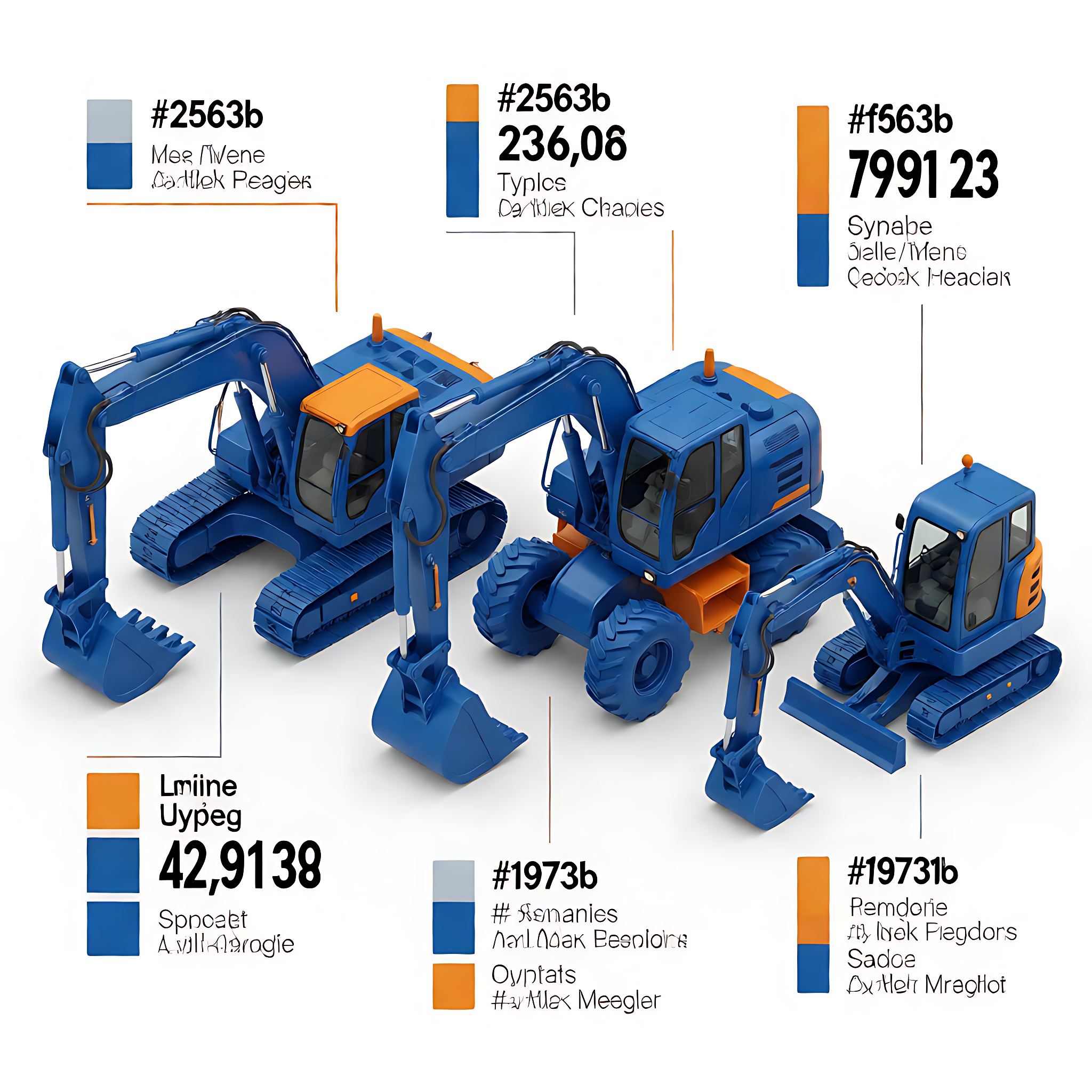
1. Crawler Excavators: The Heavy Infantry of the Job Site
Crawler excavators dominate the market, holding over 85% share in China alone. They run on two steel tracks that distribute weight over a large contact area, keeping ground pressure low. This gives them stable footing even on muddy, rocky, or soft soil conditions.
### Key Advantages
- Full 360° rotation: The cab and working attachment can swing continuously, completing the dig-swing-dump cycle without repositioning the machine.
- Exceptional stability: The track undercarriage spreads the machine's weight evenly, providing far superior anti-tip performance on slopes and uneven ground compared to wheeled models.
- Deep digging capability: Mid-to-large crawler excavators can reach digging depths of 6–10 meters, with breakout forces exceeding 200 kN — ideal for deep foundations, mining, and heavy-duty operations.
- Versatile attachment ecosystem: Quick couplers allow swapping between breaker hammers, hydraulic shears, grapples, rippers, and dozens of other tools, making one machine do the work of many.
### Main Limitations
- Travel speed is slow (typically under 5 km/h), so moving between sites requires a flatbed trailer.
- Driving on paved roads causes surface damage, limiting their use in urban street work.
- Higher purchase and operating costs — a 20-ton class crawler excavator typically costs between ¥800,000 and ¥1,500,000 (approximately $110,000–$210,000 USD).
### Best Suited For
Mining, large-scale earthwork, deep foundation construction, building demolition, and land clearing. Representative models include the SANY SY215 and SY365, Caterpillar 320, and Komatsu PC200.
2. Wheeled Excavators: The Flexible Urban Operator
Wheeled excavators swap tracks for rubber tires, gaining excellent road mobility. They can travel at 20–40 km/h and drive themselves between job sites without a trailer. In the industry, they've earned the affectionate nickname "rubber duck" — because, frankly, they do look a bit like a waddling duck.
### Key Advantages
- High mobility: Drives on public roads like any regular vehicle, making it ideal for road maintenance and municipal projects that require frequent site-to-site moves.
- Pavement-friendly: Rubber tires won't damage paved surfaces, so there's no post-construction road repair needed.
- Dual-end operation: Equipped with a loading bucket on the front and a digging arm on the rear, one machine can excavate and load simultaneously.
- Lower purchase cost: At the same tonnage, wheeled excavators typically cost 20–40% less than their crawler counterparts.
### Main Limitations
- Digging depth and breakout force fall short of comparable crawler models.
- Stability is weaker on soft or sloped ground, often requiring outriggers for support.
- Swing angle is typically limited to 180–200°, offering less flexibility than the 360° rotation of crawler machines.
### Best Suited For
Urban municipal projects, road repair, landscaping, agricultural water management, and light infrastructure work. Representative models include the SANY SY95W, Liebherr A924, and Volvo EW140.
3. Mini Excavators: The Specialists of Tight Spaces
Mini excavators generally refer to machines weighing under 6 tonnes. Don't let their size fool you — they deliver impressive precision. In recent years, driven by a surge in urban renewal and interior demolition demand, mini excavator sales growth has outpaced every other weight class.
### Key Advantages
- Ultra-compact footprint: The smallest models are under 1 meter wide, able to pass through a standard doorway for indoor work.
- Minimal ground disturbance: Light overall weight means they won't tear up finished pavement or lawns.
- Easy transport: A small trailer or even a pickup truck can haul one, keeping logistics costs very low.
- Fuel economy: Hourly fuel consumption is just one-quarter to one-third that of a mid-size excavator.
### Main Limitations
- Limited digging force — cannot handle hard rock or heavy breaking tasks.
- Restricted working radius and dump height, making them unsuitable for large earthwork projects.
- Less stable overall; counterweight management is important when working in deep excavations.
### Best Suited For
Interior demolition, patio and garden landscaping, pipeline installation, small-scale agricultural waterworks, and tight urban spaces. Representative models include the SANY SY16, Doosan DX35Z, and Kubota U-15.
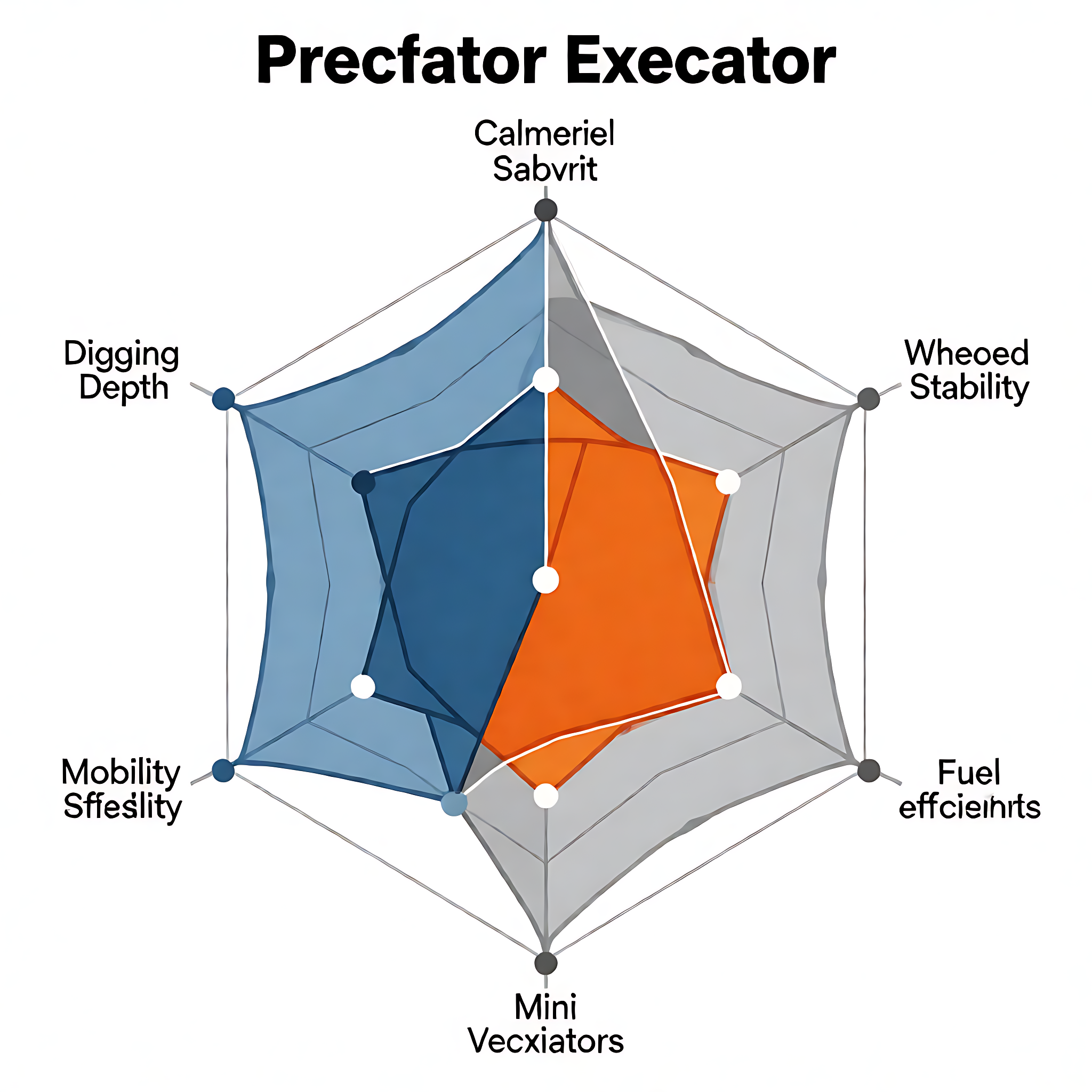
4. Side-by-Side: Core Specifications Comparison
| Specification | Crawler (20-ton class) | Wheeled (10-ton class) | Mini (3-ton class) |
|---|---|---|---|
| Operating Weight | 18–22 tonnes | 8–12 tonnes | 2–4 tonnes |
| Max Digging Depth | 6–7 m | 4–5 m | 2–3 m |
| Travel Speed | 3–5 km/h | 20–40 km/h | 5–10 km/h |
| Swing Angle | 360° continuous | 180–200° | 360° continuous |
| New Unit Price Range | ¥800K–¥1.5M (~$110K–$210K) | ¥400K–¥800K (~$55K–$110K) | ¥100K–¥300K (~$14K–$42K) |
| Fuel Consumption | 12–18 L/hr | 8–12 L/hr | 3–5 L/hr |
| Ground Adaptability | Excellent | Fair | Limited |
| Road Mobility | Poor | Excellent | Moderate |
| Digging Power | Excellent | Moderate | Limited |
5. How to Choose: Three Key Questions
Faced with three types of excavators, many procurement managers don't know where to start. The good news is that you really only need to answer three questions:
### Question 1: What kind of terrain are you working on?
If your site is in a quarry, muddy construction zone, forest, or on a slope, a crawler is the only reliable choice. If the job is on paved roads, hardened ground, or requires frequent travel between sites, a wheeled excavator offers a clear efficiency advantage. If the work area is extremely tight — indoors, in a garden, or in a narrow trench — the mini excavator is your only option.
### Question 2: How deep do you need to dig?
For deep foundation or trench work exceeding 4.5 meters, only a crawler excavator will do. For shallow excavation (under 3 meters) where simultaneous loading is also needed, a wheeled excavator offers the best value. Mini excavators are well suited for shallow trenches, tree pits, and other light-duty tasks in the 1–2 meter range.
### Question 3: How many hours per year will the machine be used?
If a machine will only run a few hundred hours per year, renting a mini or wheeled excavator is more cost-effective than buying. If annual usage exceeds 2,000 hours with consistent job conditions, purchasing a crawler excavator provides the best long-term value. For specific leasing or purchasing options, feel free to contact our sales team.
6. Industry Trends: Electrification and Smart Technology Are Reshaping the Selection Process
Since 2026, the market share of electric excavators has grown rapidly. Brands like SANY, XCMG, and Zoomlion have all launched full electric product lines spanning from mini to mid-size classes. The direct benefits of electrification include: operating cost reductions of over 40% (electricity costs far less than diesel), longer maintenance intervals, and zero-emission compliance that enables indoor construction permits.
This means that indoor demolition jobs — previously only possible with mini excavators — may soon be handled by mid-size electric crawler excavators. Stronger breakout force combined with zero emissions will redefine how we select equipment for indoor construction.
On the smart technology front, remote operation, autonomous path planning, and automated loading systems have moved from concept to mass production. EquipNode continues to track these technological developments, providing customers with the latest equipment recommendations and procurement solutions.
*EquipNode — Your global construction equipment consulting and procurement platform. For the latest pricing and technical specifications on any excavator brand, don't hesitate to reach out.*