China Stage V Emission Rules: Complete Guide to 2026 Construction Machinery Policy

title: China's Stage V Standard Is Coming: A Complete Guide to 2026 Construction Machinery Emission Rules
description: China's Stage V emission standard for non-road mobile machinery is set to take effect in 2026, compounded by expanding city ban zones and the green transformation of trade shows. The construction machinery industry is undergoing a systemic shift. This article provides an in-depth analysis of key policy points and enterprise response strategies.
keywords: non-road mobile machinery emission standards,Stage V emission standard,construction machinery environmental policy,bauma Shanghai 2026,BICES 2027,emission ban zones
author: EquipNode
date: 2026-07-23
In the second half of 2026, the construction machinery industry stands at a critical policy crossroads. From national-level emission standard upgrades to the expansion of local urban ban zones and the green transformation signals from international trade shows, multiple policy forces are converging simultaneously to accelerate industry reshuffling.
1. Stage V Emission Standard: The Timeline Is Now Clear
The upgrade of non-road mobile machinery emission standards is the policy variable drawing the most industry attention right now.
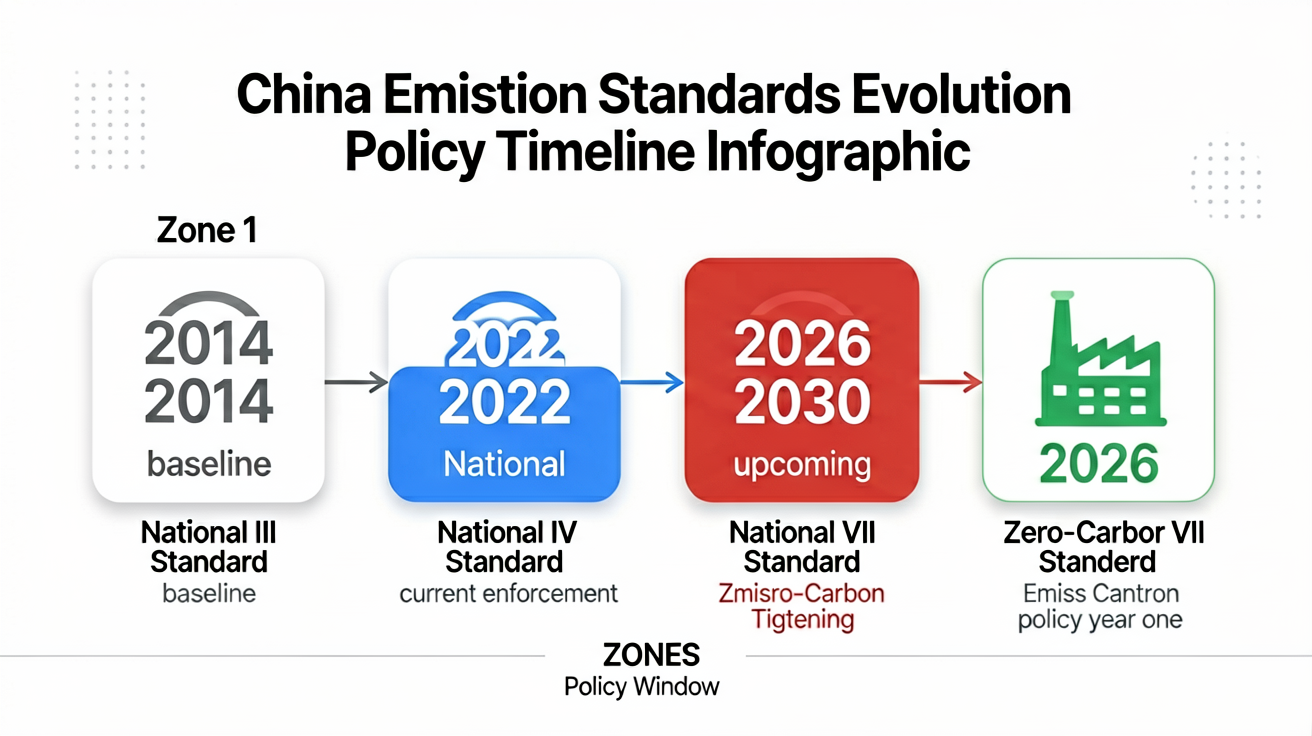
China's non-road mobile machinery emission standards have gone through nearly 15 years of iteration, from Stage I to Stage IV. Stage IV took effect in December 2020 for engines above 56 kW and expanded to 37–56 kW engines in December 2022. Following the established timeline, the Stage V standard is expected to be officially implemented between 2026 and 2027.
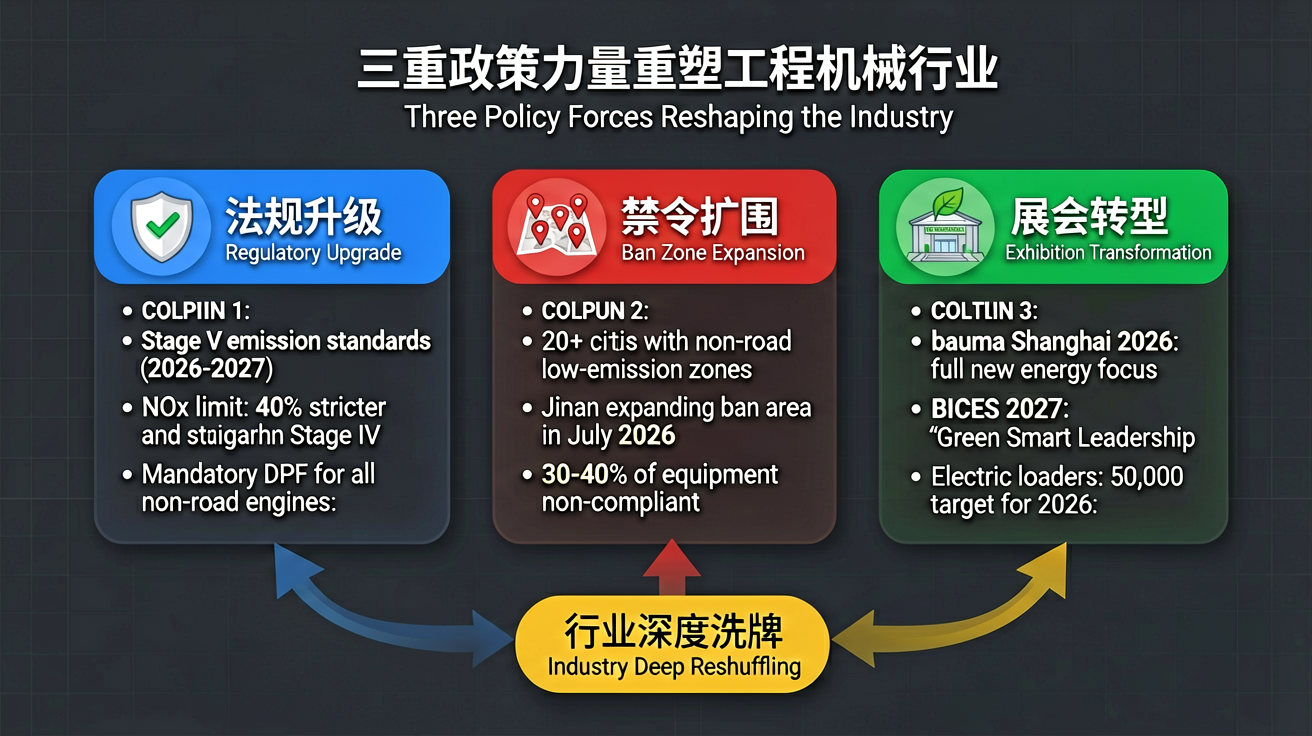
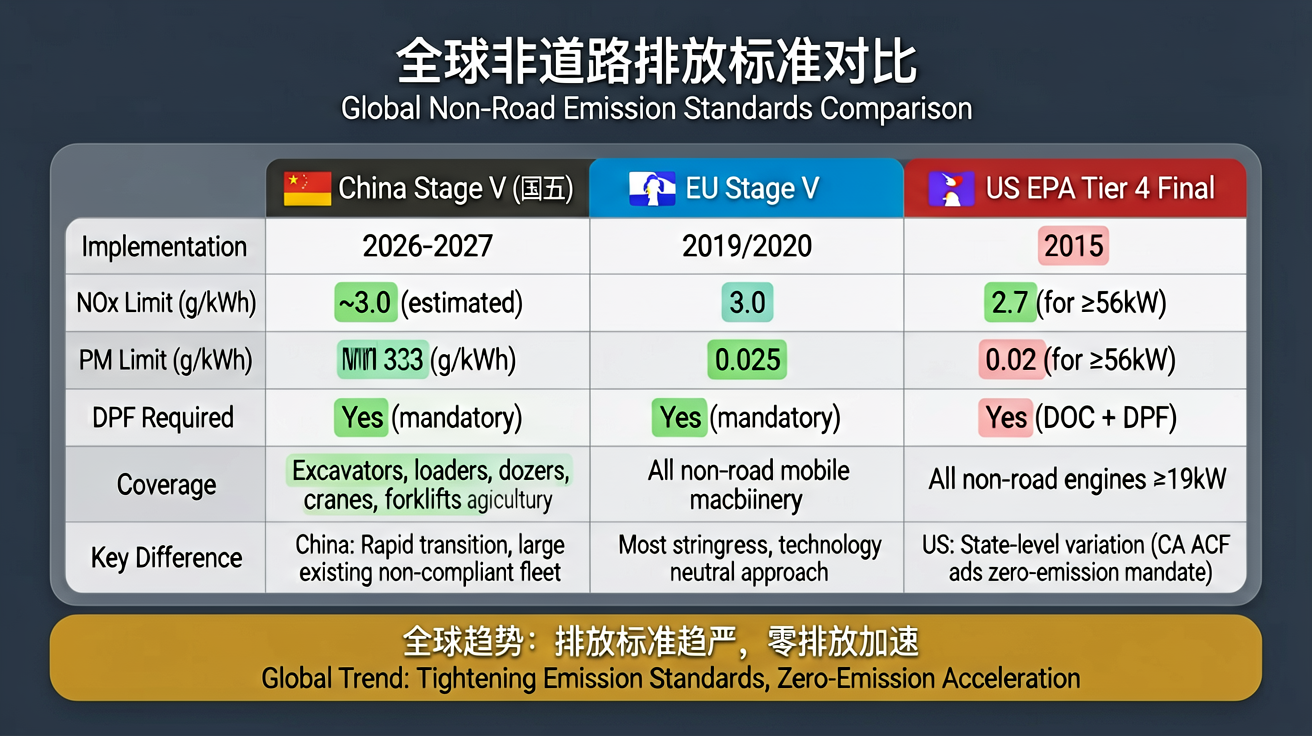
The core changes of Stage V include: nitrogen oxide (NOx) emission limits approximately 40% lower than Stage IV; mandatory installation of Diesel Particulate Filters (DPF); and particulate matter emission limits aligned with the EU's Stage V. This means the technical pathways of existing production equipment will require comprehensive adjustments, particularly for small and medium-sized engine manufacturers, where the technical barrier will rise significantly.
Worth noting is that among currently operating non-road equipment in China, approximately 30% to 40% still operate at Stage III or below. The phase-out and replacement of this aging equipment fleet will unleash enormous market demand. According to industry estimates, replacement demand from the existing installed base alone could generate a market worth over 100 billion yuan.
2. Urban Ban Zones Continue to Expand
Alongside the national standard upgrade, local government emission controls are also accelerating.
Jinan recently issued a "Notice on Adjusting High-Emission Non-Road Mobile Machinery Ban Zones," further expanding the restricted areas for high-emission equipment. This is not an isolated case — first-tier cities such as Beijing, Shanghai, Shenzhen, and Guangzhou have long implemented non-road low-emission zone policies, prohibiting Stage III and below equipment from entering core construction areas.
The expansion of ban zones directly impacts construction companies' equipment procurement decisions. Operating within a ban zone requires the use of equipment meeting Stage IV or higher emission standards, which in turn accelerates the pace of equipment replacement. For rental companies, equipment compliance has already become a core competitive advantage.
In practice, the impact of ban policies varies across equipment categories. High-frequency equipment such as excavators and wheel loaders is affected first, while the replacement pressure on relatively lower-frequency equipment such as cranes and tower cranes is somewhat more relaxed. However, the overall trend is consistent: the room for non-compliant equipment is rapidly shrinking.
3. bauma Shanghai 2026: New Energy Takes Center Stage Across the Entire Supply Chain
In July 2026, bauma Shanghai was held as scheduled, but this year's show theme was markedly different from previous years.
The organizers positioned the event as a "New Energy Full Supply Chain Exhibition Platform," meaning that new energy technologies — electrification, hydrogen fuel cells, and hybrid power — are no longer fringe topics but have become the absolute centerpieces of the show. From OEMs to core component suppliers, from battery systems to charging infrastructure, the complete presentation of the new energy supply chain is reshaping the industry's expectations for the future.
This shift reflects a pragmatic market choice. In 2025, annual sales of Chinese electric wheel loaders surpassed 30,000 units, and the target for 2026 aims to reach the 50,000-unit threshold. The market penetration rate of electric excavators is also climbing steadily. New energy is no longer a "concept play" but is becoming real sales growth.
For equipment buyers, the message from bauma Shanghai 2026 is clear: new energy equipment has reached a maturity level sufficient to support large-scale deployment. The question is no longer "whether to buy" but "when to buy."
4. BICES 2027: Green and Smart Leadership Becomes Industry Consensus
Following bauma Shanghai, preparations for BICES 2027 are also accelerating. In July 2026, the BICES 2027 press conference was held in Beijing, with the theme set as "Green & Smart Leadership, Sharing Excellence."
This theme precisely captures the industry's two major development directions: green transformation and intelligent operation. Green transformation corresponds to emission standard upgrades and new energy adoption, while intelligent operation corresponds to the deployment of technologies such as autonomous driving, remote operation, and digital twins.
Zoomlion's recently released embodied intelligence humanoid robot Z01 represents a microcosm of the construction machinery industry's extension into intelligent systems. Although humanoid robots are still some distance from mass commercialization, the integrated capabilities of perception, decision-making, and execution it demonstrates are being gradually transplanted onto traditional equipment such as excavators and wheel loaders.
BICES 2027 is scheduled for September 2027, by which time the Stage V standard is expected to have been officially implemented. The show will serve as a key window for showcasing new technologies and products, and a pivotal milestone in industry restructuring.
5. International Policy Linkage: EPA Revisions and Global Trends
Emission policies for construction machinery are not a China-only issue.
In July 2026, the U.S. Environmental Protection Agency (EPA) proposed revisions to heavy-duty engine rules, seeking to eliminate the DEF (Diesel Exhaust Fluid) power-reduction measures. While this policy adjustment primarily targets on-road vehicles, it also carries reference significance for the technical pathway choices of non-road equipment.
On the emission standards front, the EU's Stage V, in effect since 2019, has become the world's most stringent non-road emission benchmark. The U.S. EPA's Tier 4 Final has been fully enforced since 2015, and California has gone further through its Advanced Clean Fleets (ACF) regulation, requiring public fleets to procure zero-emission non-road equipment beginning in 2026.
The global tightening of emission policies also impacts Chinese construction machinery exporters.
Equipment exported to Europe and North America must meet local emission standards, requiring enterprises to plan for global compliance from the product development stage onward. According to the Association of Equipment Manufacturers (AEM), its member companies have collectively invested over $23 billion in decarbonization research and development.
6. How Should Enterprises Respond? Three Key Actions
Facing the wave of rapidly materializing policy changes, construction machinery enterprises need to respond on three fronts.
First, accelerate product compliance upgrades. Once the Stage V standard takes effect, non-compliant products will no longer be eligible for sale or registration. Enterprises must complete engine selection, DPF matching, and whole-machine calibration ahead of schedule to ensure a smooth product transition within the deadline.
Second, build out new energy product lines. Based on the product lineup at bauma Shanghai 2026, new energy equipment has already moved from concept to mass production. Enterprises must establish competitiveness in core categories such as electric wheel loaders and electric excavators, or they will be left behind in the next wave of market consolidation.
Third, seize service opportunities in the existing installed base. A large volume of Stage III equipment faces phase-out, but not all of it has reached the end of its service life. Aftermarket services such as refurbishment, remanufacturing, and compliance upgrades are emerging as a new growth point. If you'd like to learn about equipment compliance upgrade solutions, feel free to reach out to us for professional consultation.
Conclusion
2026 is a landmark policy year for the construction machinery industry. Emission standard upgrades, expanding ban zones, and the green transformation of trade shows — three forces are simultaneously reshaping the industry landscape. For enterprises, this is not a multiple-choice question but a mandatory one. Proactive preparation and adaptive strategy are essential to gaining a favorable position in the new round of competition.
*For more construction machinery industry policy analysis and technical insights, follow EquipNode. If you need specific equipment pricing or compliance upgrade solutions, feel free to contact our sales team.*