August 2026 Construction Machinery Sales: Export Growth Drives Recovery

title: August 2026 Construction Machinery Sales Data Released: Export Growth Exceeding 30% Sustains the Recovery
date: 2026-09-21
author: EquipNode
category: Market Data
tags: construction machinery, excavator, sales data, export growth, market analysis
Halfway through Q3 2026, China's construction machinery industry delivered a report card of "heated overseas, stable domestic." According to the latest August sales brief published by the China Construction Machinery Association, 8 out of 12 major monitored categories achieved year-over-year growth while 4 declined, continuing the industry's modest recovery trend seen since the beginning of the year. Meanwhile, overseas markets continued to serve as the growth engine, with excavator export growth exceeding 30% for the third consecutive month, providing critical support for domestic companies' profit structures.
I. August Core Data at a Glance: An 8-Up, 4-Down Divergent Picture
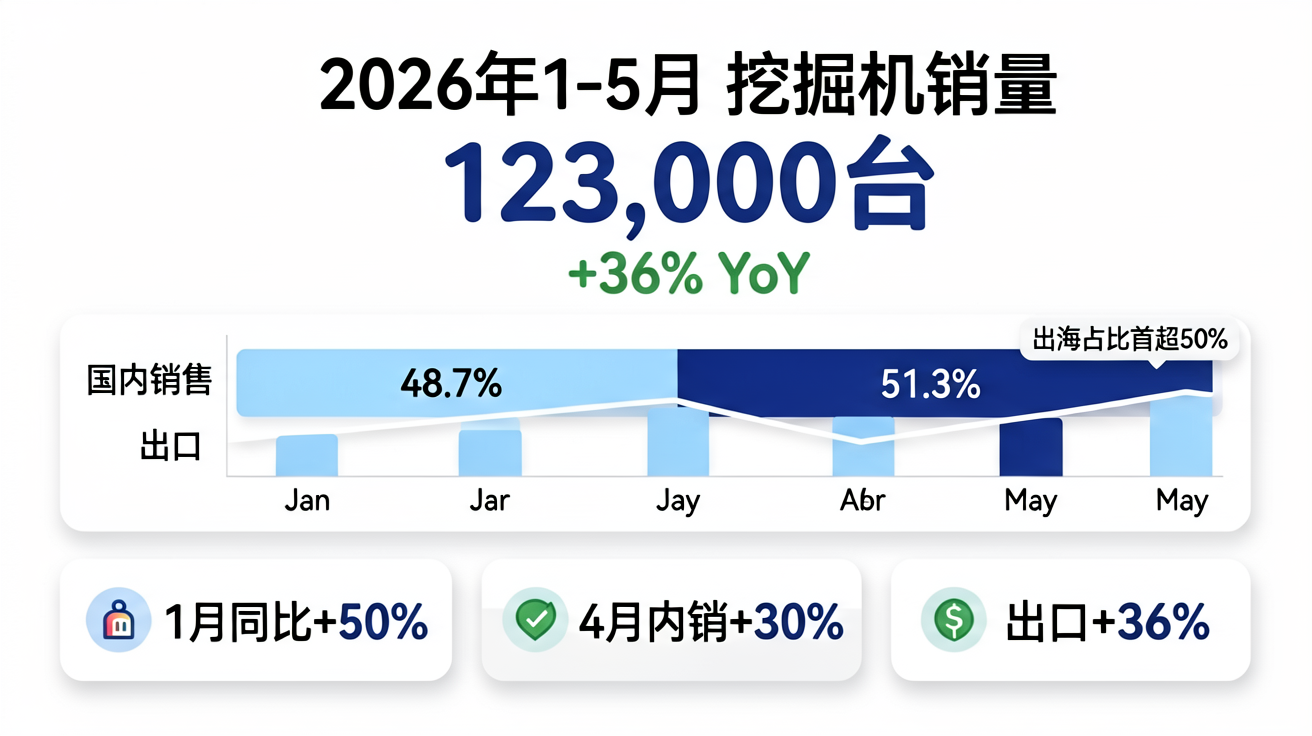
Data released by the China Construction Machinery Association in mid-September shows that in August 2026, major industry products exhibited a divergent pattern of "8 up, 4 down." Excavators and loaders sustained their positive growth momentum from the first half, becoming the primary drivers of overall sales.
National Bureau of Statistics data further corroborates this trend: in August 2026, China's excavator output reached 33,192 units, up 18.5% year-over-year. While this growth rate moderated from the first-half peak, it still represents a strong performance against the high base of the same period last year.
Looking at cumulative data, excavator sales in the first half of 2026 surpassed 152,000 units, representing year-over-year growth exceeding 26%. June alone saw domestic sales growth surpass 30%, setting a new high for the year. Entering Q3, the growth rate narrowed somewhat, but absolute volumes remained at elevated levels.
Notably, operator rate data previously published by the China Construction Machinery Association also sent positive signals. In August 2026, the national construction machinery operator rate rebounded overall, with month-over-month improvements across multiple provinces. Sustained infrastructure investment was the primary driver, with the concentrated commencement of major engineering projects providing a stable source of equipment demand.
II. Exports Accelerate Again: Monthly Growth Exceeds 30% for Three Consecutive Months
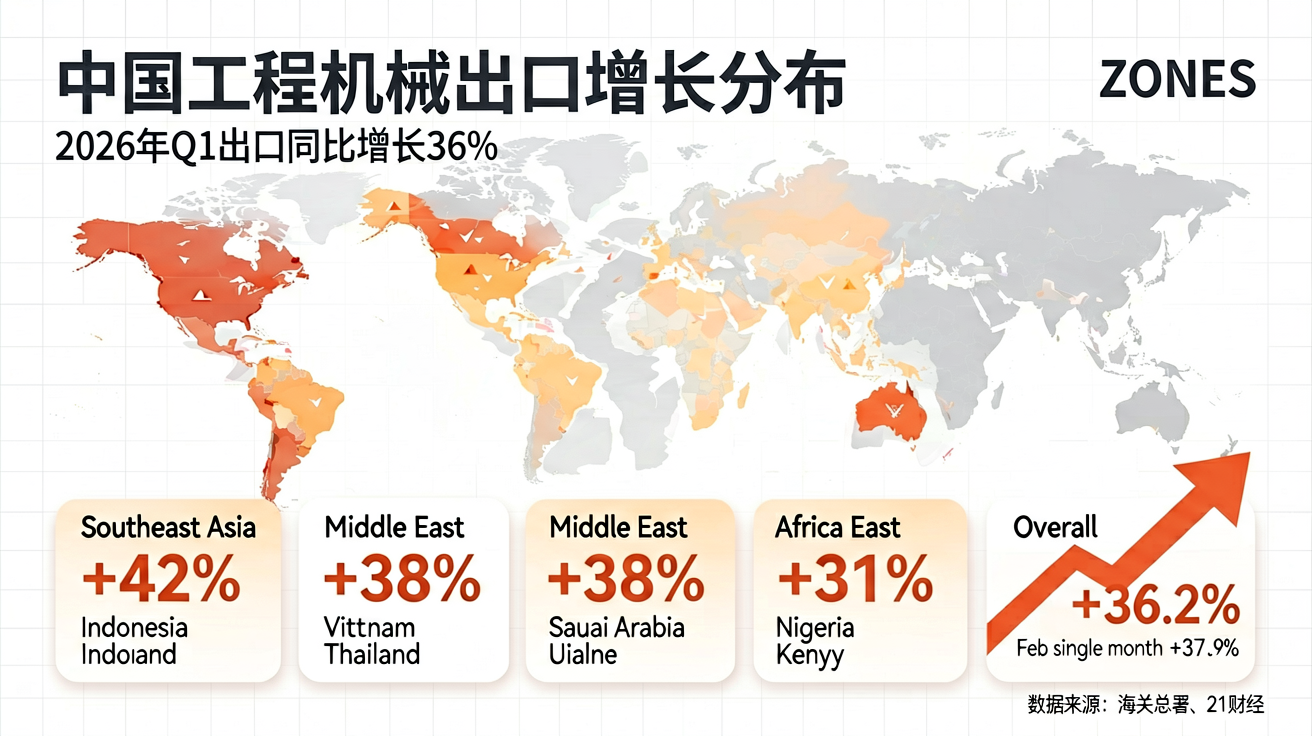
If domestic sales represent "stability," then exports represent "fervor." Customs data shows that in August 2026, China's excavator export growth once again broke through the 30% mark, continuing the strong momentum seen since the beginning of the year.
Looking back at full-year data, Q1 excavator export growth had already exceeded 36%, making it the absolute main driver of industry growth. January through April cumulative exports approached 120,000 units, with the share of total sales climbing steadily. Total H1 exports reached a record high of $34.37 billion, with significant year-over-year gains.
On export destinations, Southeast Asia, the Middle East, and Africa remain core markets. SANY Heavy Industry has successively delivered large equipment orders in South America and Thailand, while XCMG is also accelerating and deepening its overseas market footprint. Additionally, initial progress has been made in penetrating high-end European and American markets, with domestic brands steadily gaining product recognition in these regions.
The overseas expansion of electrified products deserves particular attention. Domestic electric excavators and electric loaders are increasingly competitive in overseas markets thanks to cost advantages and rapid technological iteration. Some overseas customers have begun including Chinese electric construction machinery on their preferred procurement lists, opening entirely new growth horizons for the industry.
III. Profit Pressure: The Structural Dilemma of Revenue Growth Without Earnings Growth
However, behind the sales growth, profit performance has been a cause for concern.
Multiple broker research reports and listed company semi-annual reports reveal that in the first half of 2026, leading construction machinery enterprises broadly faced a "revenue growth without earnings growth" predicament. SANY Heavy Industry, XCMG Machinery, and Zoomlion Heavy Industry — the three major leaders — saw net profit growth significantly lag behind revenue growth, with some companies even posting year-over-year net profit declines.
The core cause of this situation is foreign exchange losses. With overseas business proportions rising substantially, the impact of RMB exchange rate fluctuations on corporate profits has become increasingly pronounced. In the first half of 2026, combined foreign exchange losses among major construction machinery companies reached several billion yuan, directly eroding a considerable portion of operating profits.
Additionally, intensifying market competition is compressing profit margins. To capture overseas market share, some companies have made price concessions, which, combined with fluctuations in raw material costs and logistics expenses, have pressured overall gross margins.
The good news, however, is that among the 24 construction machinery companies that have disclosed semi-annual reports, over 80% are profitable, and the industry's fundamentals remain sound. Since Q3, as exchange rate volatility has begun to stabilize, the drag from foreign exchange losses on profits is expected to ease, and sector profitability is poised for a recovery in the second half of the year.
IV. Global Landscape: Chinese Companies' "Volume" vs. Caterpillar's "Price"
Looking at the global construction machinery market, an interesting contrast is emerging.
According to the 2026 Yellow Table published by the KHL Group (Top 50 Global Construction Machinery Manufacturers), a total of 13 Chinese companies made the list, collectively commanding approximately 20% of the global market share. XCMG Group has remained in the global top three for multiple consecutive years, while SANY Heavy Industry and Zoomlion Heavy Industry also hold positions in the global top ten.
Yet in sharp contrast, a single company — Caterpillar — generates annual revenue exceeding that of China's top three leaders combined. In Q2 2026, Caterpillar raised its full-year sales growth outlook, citing stronger-than-expected equipment demand driven by the data center construction boom.
This data reflects the Chinese construction machinery industry's reality of having "volume without price." Domestic brands have expanded rapidly in mid-to-low-end and emerging markets with cost-performance advantages, but in terms of brand premium capability in high-value-added products and mature markets, there remains a significant gap compared to international giants such as Caterpillar and Komatsu.
Komatsu recently announced plans to increase supply capacity for the North American market — a move that, from a different angle, reflects the international market's strategic response to the rapid expansion of Chinese brands.
V. Second-Half Outlook: Three Main Themes Worth Watching
Looking ahead to the second half of 2026, the trajectory of the construction machinery industry can be understood through three main themes:
First, the sustainability of export growth. Overseas markets remain the core source of incremental growth for China's construction machinery. Infrastructure demand in Southeast Asia, the Middle East, and Africa continues to run strong, and project implementations along Belt and Road Initiative countries provide long-term support for equipment exports. However, caution is warranted — as the scale of domestic equipment exports expands rapidly, some countries may introduce trade protection measures, creating risk of a marginal slowdown in export growth.
Second, the stabilizing role of domestic infrastructure. The continued progression of major engineering projects is the core support for domestic sales. The "Excavator Index" shows that in August, operator rates improved month-over-month across multiple provinces, and the physical work volume of infrastructure investment is materializing at an accelerating pace. In the second half, as the sustained release of special bond funds continues, domestic demand is expected to remain steady.
Third, the industrialization of the electrification transition. Electric construction machinery has moved from concept to mass production and delivery. SANY, XCMG, and Zoomlion Heavy Industry have all launched series of electric products, with applications in specific scenarios such as mining and ports becoming increasingly mature. Electrification not only reduces customers' total cost of ownership over the product lifecycle but has also become an important lever for domestic brands to differentiate themselves in overseas markets.
Conclusion
The construction machinery industry in 2026 is at a critical stage of "volume rising under price pressure." Robust export growth has provided the industry with momentum, but pressure on the profit side serves as a reminder that enterprises need to shift from scale expansion toward value creation. For procurement professionals and investors, tracking the progress of leading companies' overseas expansion and the development of their electrified product lines will be key to capturing industry trends.
For the latest pricing and configuration options on specific equipment, feel free to contact the EquipNode sales team — we provide professional selection guidance and one-stop procurement services.