What to Do When Equipment Repair Costs Skyrocket

title: What to Do When Equipment Repair Costs Skyrocket
date: 2026-08-28
author: EquipNode
category: Parts & Aftermarket
tags: [Maintenance, Parts Procurement, Repair Costs, Remanufacturing, MRO Market]
In 2026, the global construction equipment aftermarket is undergoing a profound transformation. Rising repair costs, worsening labor shortages, and volatile parts supply chains are forcing every equipment manager to rethink the "repair vs. replace" decision calculus.
Why Repair Costs Keep Rising
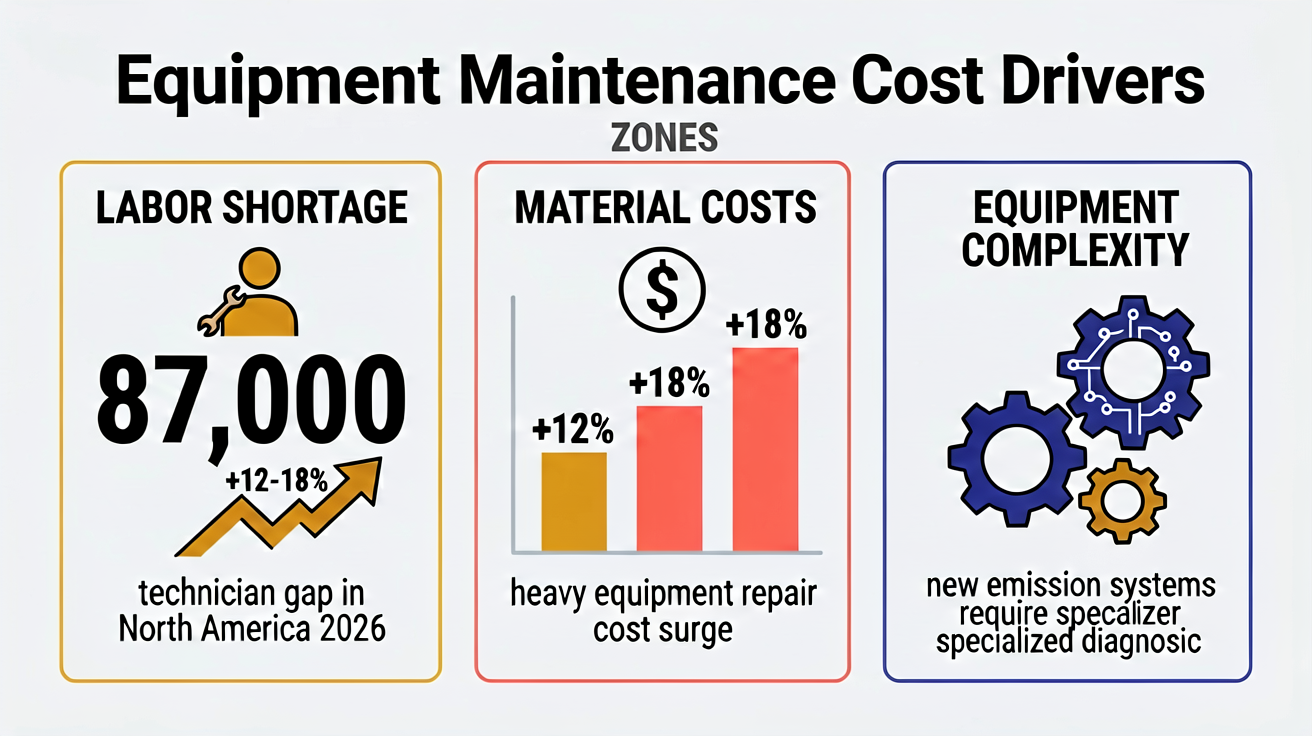
Fleet Equipment Magazine's April 2026 heavy-duty repair trends report reveals that the industry is facing a "triple squeeze": rising material costs, a shortage of skilled technicians, and increasing equipment complexity. In the United States, heavy-equipment repair bills have increased 12%–18% year-over-year, with some high-end models incurring repair costs that exceed their annual depreciation.
This trend is not unique to the United States. The Chinese market faces similar pressures — as the China IV emissions standards are fully implemented, servicing new emissions systems requires specialized diagnostic equipment and training. Traditional "experience-based" repair methods are becoming increasingly inadequate.
Key Data:
- The North American heavy-duty repair industry labor shortage has widened to 87,000 workers (2026 figures)
- The construction equipment MRO (Maintenance, Repair, and Operations) market is projected to reach $1.2 trillion by 2034
- Approximately 40% of equipment failures can be attributed to improper maintenance practices
The Right to Repair Movement: DIY or Pay Up
In 2026, John Deere is facing lawsuits once again — this time not over agricultural equipment, but over "Right to Repair" issues in the construction equipment sector. Both WSJ and Equipment World have reported that the lawsuits demand OEMs (Original Equipment Manufacturers) provide independent repair shops and end users with access to diagnostic tools, service manuals, and genuine parts.
The core tension behind this movement: OEMs want to lock in aftermarket revenue through closed repair ecosystems, while users and independent repair shops argue this drives up repair costs. Multiple U.S. states have begun pushing legislation that would require manufacturers to provide digital access needed for repairs.
Practical Impact for Equipment Owners:
- If the legislation passes, users will be able to use third-party diagnostic tools, potentially reducing repair costs by 15%–25%
- However, quality risks associated with non-genuine parts would be borne by the user
- Recommendation: Choose brand-certified parts suppliers to balance cost and reliability
SANY's New Parts and Service Initiatives at ConExpo 2026
At the 2026 ConExpo-Con/AGG trade show, SANY America unveiled a comprehensive new parts and service strategy. According to Construction Equipment Guide, SANY introduced:
Regional Parts Centers: Establishing parts distribution hubs across the southern and midwestern United States to shorten delivery times
Remote Diagnostics Systems: Real-time equipment condition monitoring via IoT sensors with proactive alerts for potential failures
Remanufacturing Program: Remanufacturing services for core hydraulic components and powertrain systems at only 50%–70% of new-part pricing
SANY's strategy is clear: strengthen customer loyalty by enhancing aftermarket service capabilities. This aligns with SANY Heavy Industry's global market expansion — selling equipment is the entry point, but services are the long-term revenue stream.
Remanufacturing: The Repair Market's "Cost-Reduction Game-Changer"
Volvo CE has detailed on its official blog how remanufactured (Reman) parts help users reduce TCO (Total Cost of Ownership). Remanufacturing is not simple refurbishment — it involves disassembling, inspecting, replacing worn components, reassembling, and testing to OEM standards.
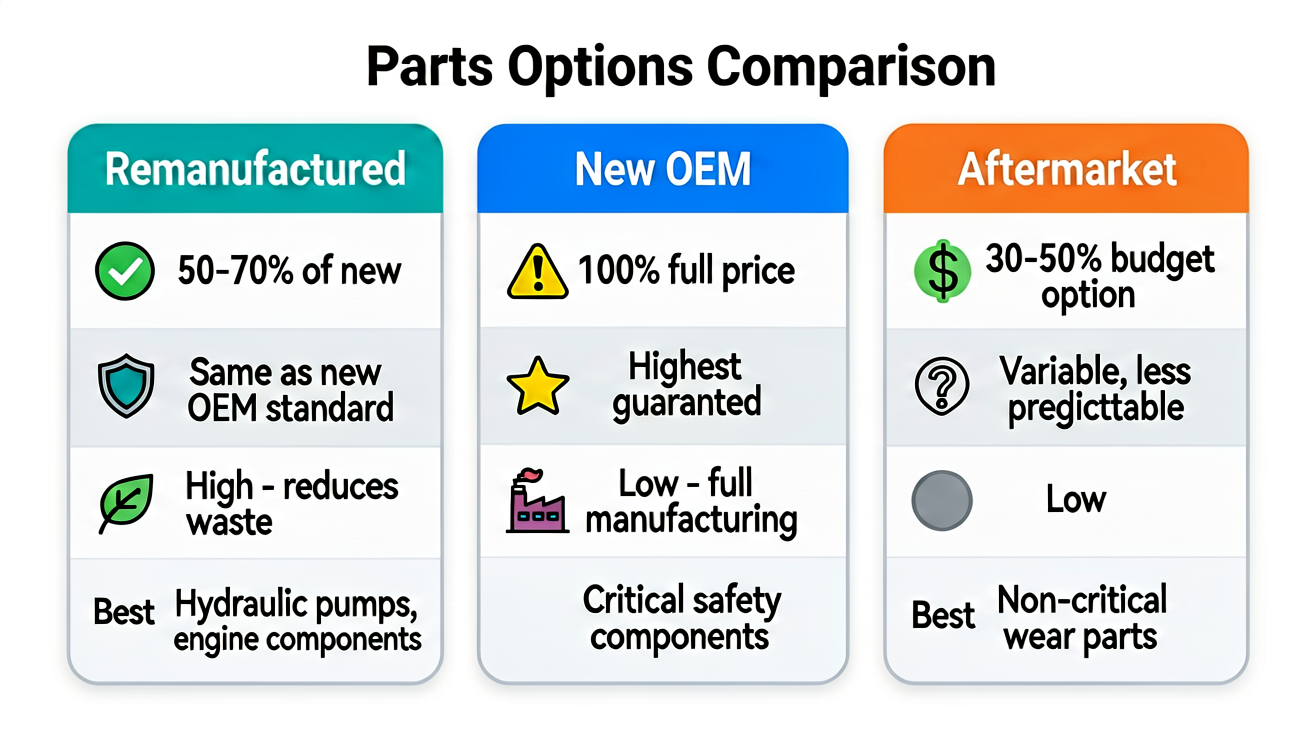
Remanufactured vs. New Genuine vs. Aftermarket Parts:
| Comparison Factor | Remanufactured Parts | New Genuine Parts | Aftermarket Parts |
|--------|---------|-----------|--------|
| Price | 50%–70% of new parts | 100% | 30%–50% |
| Quality Assurance | Equivalent to new parts | Highest | Unstable |
| Environmental Impact | High (reduces waste) | Low | Low |
| Recommended Applications | Hydraulic pumps, engine blocks | Critical safety components | Non-critical wear parts |
Using a 20-ton excavator as an example: a new hydraulic main pump costs approximately 80,000–120,000 RMB, a remanufactured unit costs only 40,000–70,000 RMB, and while aftermarket alternatives are available for just 20,000–40,000 RMB, their service life is typically only one-third to one-half that of OEM parts. From a lifecycle cost perspective, remanufactured parts offer the best value for money.
Volvo's Strategic Parts Distribution Network Expansion
In April 2026, Heavy Duty Trucking reported that Volvo is building a new central parts distribution center in Mississippi. This investment reflects the OEM's emphasis on supply-chain efficiency — with "same-day delivery" now becoming the industry standard, parts availability directly impacts equipment uptime.
New Trends in Parts Supply Chains:
- Forward-stocking model: Shifting from central warehouses to regional forward-stocking locations, with 24-hour delivery becoming the industry norm
- Digital inventory management: Using AI to forecast parts demand, reducing overstock and stockout risks
- E-commerce procurement: An increasing volume of parts is transacted through online platforms, delivering greater price transparency
Five Practical Recommendations for Equipment Managers
1. Establish a Preventive Maintenance Calendar
Don't wait for equipment to fail before scheduling repairs. Follow the manufacturer-recommended maintenance intervals and proactively schedule replacement of hydraulic oil, filters, track shoes, and other wear parts. Preventive maintenance typically costs one-third of reactive repair costs.
2. Choose the Right Parts Strategy
Always use genuine OEM parts for critical safety components (braking systems, hydraulic safety valves, etc.). For general wear parts (bucket teeth, filters, belts, etc.), brand-certified alternatives are a viable option. For core components such as hydraulic pumps and engines, remanufactured parts should be the first consideration.
3. Invest in Operator Training
40% of equipment failures stem from improper operation. A properly trained operator can extend equipment service life by more than 20%. To learn more about SANY operator training services, feel free to contact us.
4. Leverage Remote Monitoring
New equipment in 2026 is widely equipped with IoT sensors. Activating remote monitoring capabilities enables early detection of abnormal vibration, temperature spikes, and other potential issues — allowing repairs to be completed before failures occur.
5. Explore Remanufacturing and Refurbishment Options
For equipment in service for more than five years, consider remanufacturing and refurbishment of core components. This can significantly extend equipment service life while keeping repair budgets under control.
Conclusion
The "golden age" of the construction equipment aftermarket is arriving. As equipment fleet sizes continue to grow, emissions standards are upgraded, and right-to-repair legislation advances, the aftermarket market will continue to expand. For equipment owners, the key lies in shifting from "reactive repair" to "proactive management" — through preventive maintenance, intelligent parts procurement, and remanufacturing strategies, costs can be controlled while maximizing equipment uptime.
For equipment pricing or parts and service inquiries, please contact our sales team: EquipNode Contact Page.
*Data sources: Fleet Equipment Magazine, Equipment World, Construction Equipment Guide, Volvo CE Official Blog, Sandhills Global Market Reports*