Electric and Autonomous: Two Trends Converge

title: "Electrification and Intelligence: Two Lines Converging"
date: "2026-08-25"
author: "EquipNode"
category: "New Products & Technology"
keywords: "electric excavators, autonomous construction, intelligent equipment, CONEXPO 2026"
In 2026, the construction machinery industry is undergoing an unprecedented technological revolution. Electrification and intelligence are no longer two parallel tracks — they are beginning to deeply converge, giving rise to entirely new product forms. From SANY Heavy Industry delivering its 1,000th electric excavator, to Caterpillar unveiling autonomous construction solutions, to the surge in Chinese electric construction machinery exports — these signals all tell us the next decade of construction machinery has already arrived.
Electric Excavators: From Proof of Concept to Large-Scale Delivery
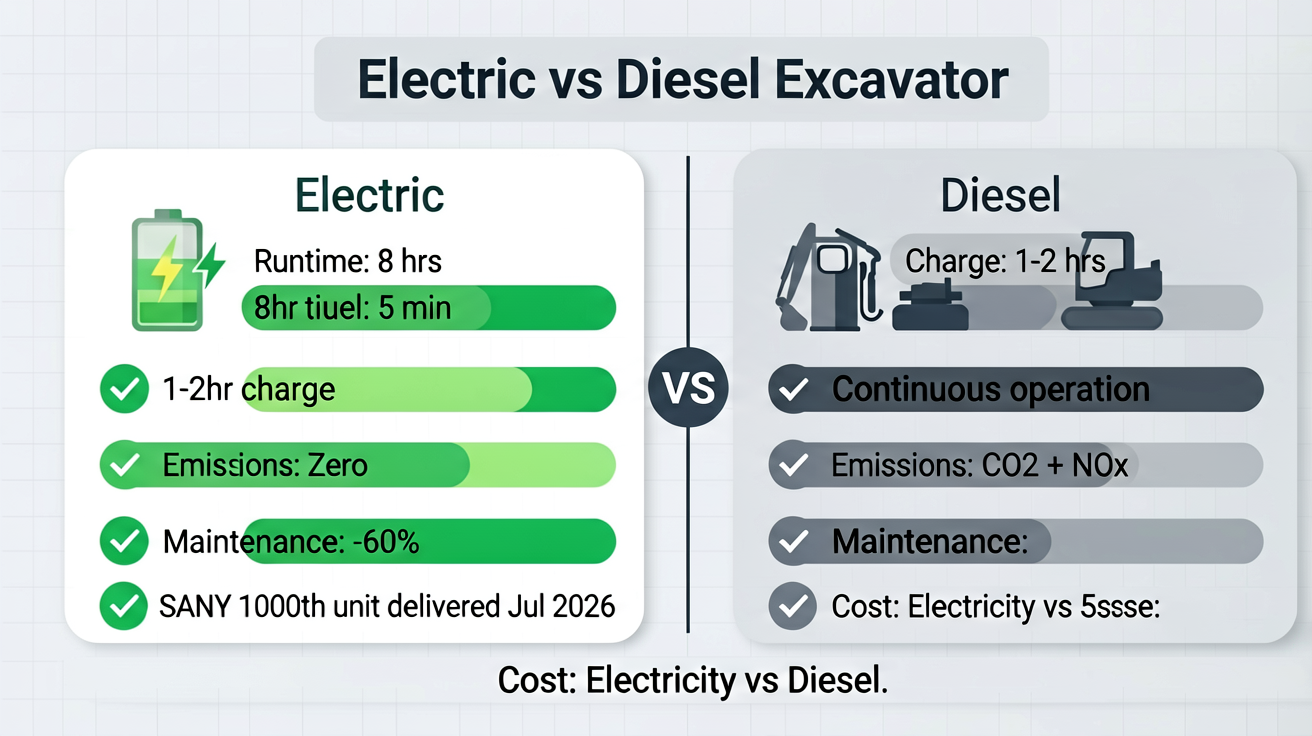
In July 2026, SANY Heavy Industry announced the delivery of its 1,000th electric excavator, a milestone marking the official transition of electric construction machinery from the laboratory to the job site. According to Global Times, Chinese electric construction machinery exports continue to climb, driving the global green transition.
At CONEXPO 2026, multiple manufacturers showcased their electric product lines. Volvo CE launched the EC230 electric excavator with 0% interest financing to lower the adoption barrier for customers. Hyundai Construction Equipment promoted its electric excavator series at the show, emphasizing zero emissions and low noise advantages. XCMG delivered two electric prototypes to Fortescue, validating battery technology reliability in real-world mining environments.
Looking at product specs, current mainstream electric excavators have broken through the 6–8 hour runtime barrier, with fast charging times reduced to 1–2 hours. Take SANY's electric excavator as an example: its lithium iron phosphate battery pack supports 8 consecutive hours of operation, covering a full standard workday. For indoor construction, underground projects, and noise-sensitive areas, the advantages of electric excavators are particularly pronounced.
Autonomous Construction: From Self-Driving to Full-Site Coordination
On the intelligence side, 2026 shows a trend "from single-machine autonomy to full-site coordination." Caterpillar released an AI-driven equipment management and virtual assistant system at CES 2026, deeply integrating artificial intelligence into construction management. Komatsu partnered with AIM to launch a "Physical AI" dozer in the US market, achieving truly autonomous earthmoving operations.
Chinese companies are also performing impressively on the autonomy track. Shuanglin Group, together with Tsinghua University, released an autonomous mining truck convoy solution, and Chinese company CiDi plans to begin overseas sales of autonomous mining trucks this year. Liugong launched an ultra-large hybrid loader and a 127-ton autonomous wide-body truck, showcasing Chinese brands' technical capabilities in mining intelligence.
Worth noting is that autonomous construction is expanding from individual equipment to full-site coordination. Construction firms are no longer just focused on a single machine's autonomous capability — they are pursuing seamless integration across multiple machines and processes. This means the future smart job site will be an AI-scheduled equipment network, where each machine is a node in the network.
The Convergence Trend: Electrification + Intelligence
The most exciting development is the convergence of electrification and intelligence. Electric platforms are naturally suited for intelligent control — battery management systems can precisely monitor the state of every cell, and electric drive systems respond far faster than hydraulic systems, providing more precise actuators for autonomous driving.
For example, an electric excavator's power output can achieve millisecond-level adjustment, which is critical for autonomous digging operations requiring precise control. At the same time, electric systems have stronger data collection capabilities, able to transmit equipment status, operating condition data, and location information in real time — providing the foundation for remote monitoring and intelligent scheduling.
Chinese manufacturers have a unique advantage in this area. BYD Forklifts showcased its full electric product line at its 2026 global product launch, Huawei's industrial AI solutions are penetrating into the construction machinery sector, and the battery-swap technology developed by XCMG in collaboration with BYD has made range anxiety for electric mining trucks a thing of the past.
Five Technology Trends at CONEXPO 2026
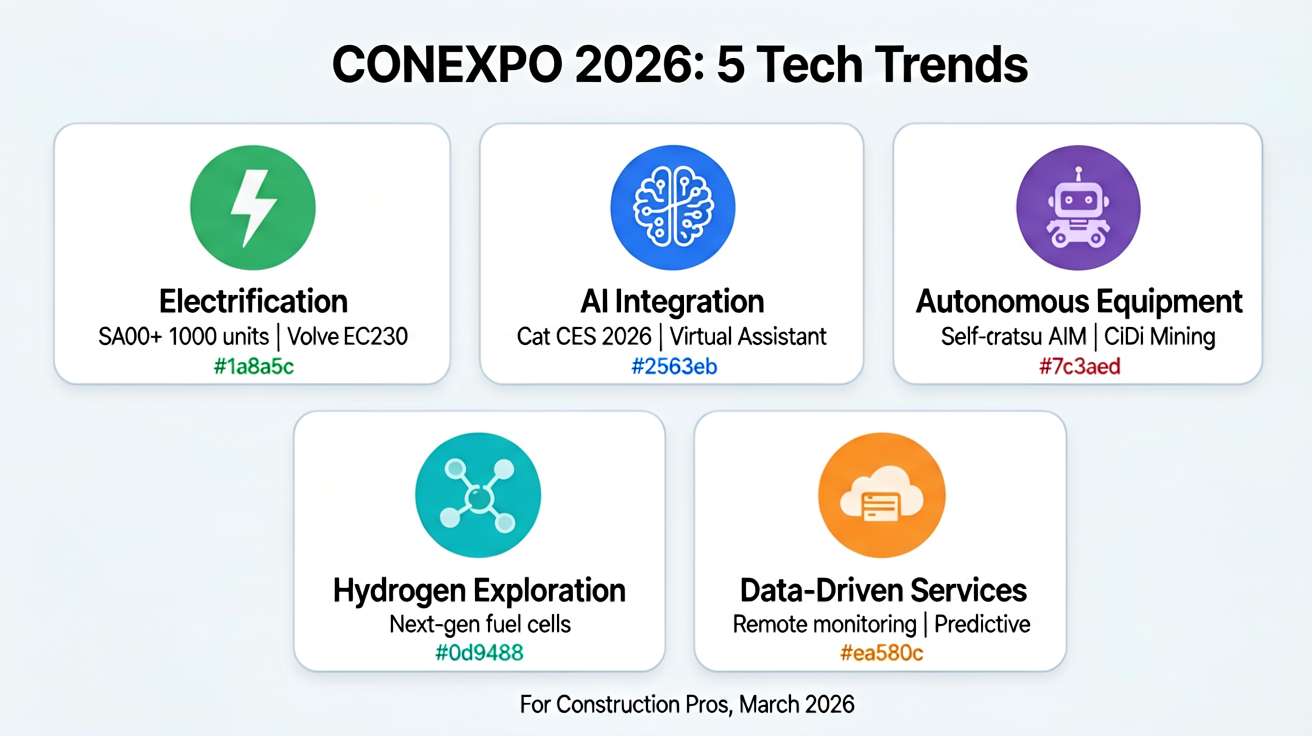
According to For Construction Pros' summary of CONEXPO 2026, the show this year presented five major technology trends:
Accelerated Electrification: From excavators to loaders, electric product lines are rapidly expanding
Deep AI Integration: Construction management, equipment diagnostics, and safety monitoring are all being fully AI-ified
Mature Autonomous Equipment: Moving from the demonstration stage into commercial delivery
Hydrogen Exploration: Some manufacturers are beginning to test the waters of hydrogen-powered construction machinery
Data-Driven Services: Remote monitoring and predictive maintenance are becoming standard
These trends do not exist in isolation — they overlap and reinforce each other. A new electric excavator launched in 2026 will likely feature an AI-assisted operating system, support remote data transmission, and possess partial autonomous operation capabilities, all at once.
Impact on Procurement Decisions
For equipment buyers, electrification and intelligence are changing the decision framework. In the past, selecting an excavator mainly meant considering tonnage, power, and fuel consumption. Now, buyers also need to factor in battery range, charging infrastructure, and intelligent system compatibility.
In the short term, the purchase cost of electric equipment remains higher than traditional diesel equipment, but the total cost of ownership is rapidly converging. Electricity costs are far lower than fuel costs, and electric equipment maintenance costs are significantly lower than diesel equipment. With increasingly strict carbon emission policies, electric equipment may also qualify for policy subsidies and tax incentives.
On the intelligence side, autonomous construction technology can significantly reduce labor costs and improve construction safety. In some dangerous working conditions, unmanned equipment is no longer a "nice to have" but a "must have."
If you would like detailed pricing and technical specifications for SANY electric excavators or other intelligent equipment, feel free to contact our sales team for the latest solutions. EquipNode provides up-to-date product information and procurement support for mainstream global construction machinery brands.