Excavators, Wheel Loaders & Bulldozers: How to Choose Among the Big Three

title: "Excavators, Wheel Loaders & Bulldozers: How to Choose Among the Big Three"
author: EquipNode
date: 2026-08-16
Construction sites are packed with all kinds of equipment, but when it comes to getting the real work done, it always comes down to a few proven machines. Excavators dig, loaders load, and bulldozers push — sounds straightforward, yet choosing the right one trips up plenty of newcomers.
Today we'll give you a thorough primer, breaking down the working principles, ideal applications, and key selection criteria for these three workhorses. Whether you're a procurement officer just starting out or an investor looking to understand the industry landscape, this guide will give you a solid framework.
1. Excavator: The All-Rounder of the Job Site
### 1.1 How It Works
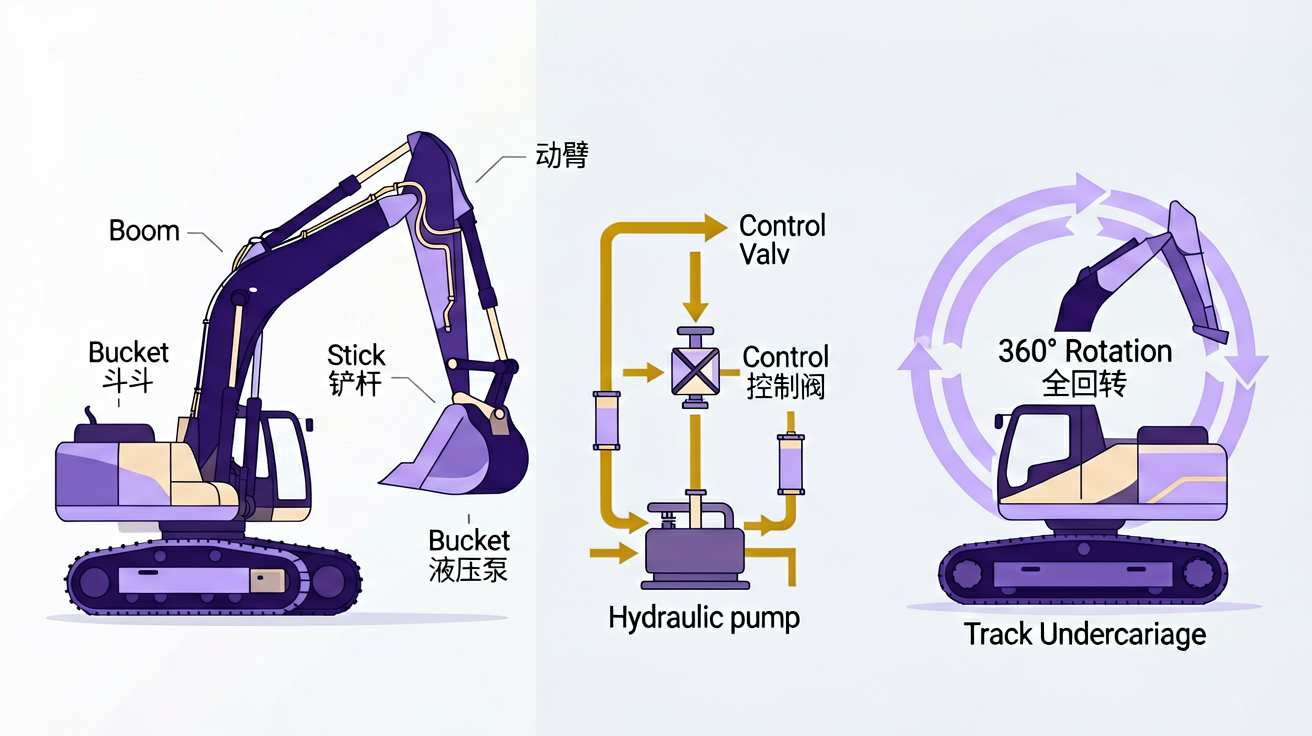
At its core, an excavator is a hydraulically driven articulated arm system. It consists of three main components: the boom, stick, and bucket. Hydraulic cylinders extend and retract to perform digging, lifting, rotating, and dumping operations.
The entire machine sits on a tracked undercarriage (though wheeled versions exist). A swinging platform mounted on the undercarriage can rotate a full 360°, giving the excavator exceptional reach — it can cover a wide working radius without repositioning.
In simple terms: hydraulic pump supplies power → control valve directs oil flow → cylinders drive the joints → bucket gets the job done.
### 1.2 Common Classifications
| Type | Weight Range | Typical Applications |
|------|-------------|----------------------|
| Mini Excavator | 1–6 tons | Municipal work, indoor demolition, landscaping |
| Small Excavator | 6–13 tons | Irrigation projects, pipe laying, small excavations |
| Medium Excavator | 13–30 tons | Earthmoving, road construction, general building |
| Large Excavator | 30–80 tons | Mining, large excavations, water conservancy |
| Ultra-Large Excavator | 80+ tons | Open-pit mining, large quarries |
### 1.3 Key Selection Criteria
- Operating weight: Determines digging force and stability — the heavier the machine, the more powerful the dig
- Bucket capacity: Directly impacts load-per-scoop and overall productivity
- Engine power: Affects hydraulic system responsiveness and sustained operation capability
- Digging depth and reach: Dictates how deep you can excavate and how high you can load
💡 Buying tip: Don't automatically go for the biggest option. For most municipal and civil construction projects, a 13–20 ton medium excavator offers the best bang for your buck. For specific equipment pricing, feel free to contact our [sales team](https://equipnode.com/zh/contact.html).
2. Wheel Loader: The Efficiency Champion of Earthmoving
### 2.1 How It Works
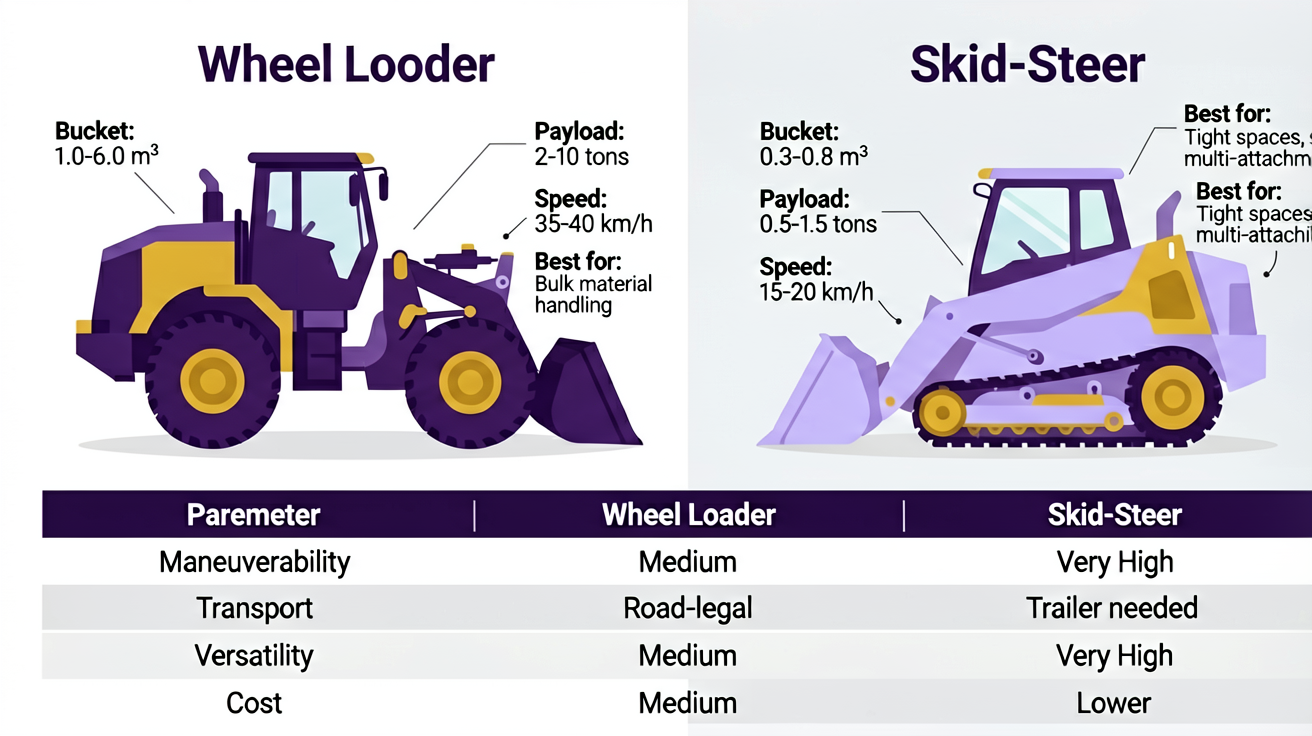
A loader's working principle is much simpler than an excavator's. Essentially, it's a four-wheel-drive vehicle equipped with a large front bucket, controlled hydraulically for lifting and tilting.
The workflow goes like this: drive forward to scoop → raise and tilt the bucket back → haul to the dump point → tilt forward to unload. It's a continuous "scoop-haul-dump" cycle.
Unlike the excavator's tracked undercarriage, loaders use rubber tires, which gives them far greater mobility on hard, flat surfaces — they can relocate quickly and travel longer distances under their own power.
### 2.2 Two Main Types
Wheel loaders are the dominant type. Their advantages include:
- Fast travel between sites — no trailer needed
- High efficiency on hard surfaces
- Simple to operate, quick to learn
Skid-steer loaders are the go-to for tight spaces:
- Compact body that can pivot in place within narrow confines
- Accept a wide range of attachments (augers, breakers, grapples, etc.)
- Ideal for indoor demolition, landscaping, and farming
### 2.3 Key Specifications Compared
| Parameter | Wheel Loader | Skid-Steer Loader |
|-----------|-------------|-------------------|
| Bucket Capacity | 1.0–6.0 m³ | 0.3–0.8 m³ |
| Rated Load | 2–10 tons | 0.5–1.5 tons |
| Max Travel Speed | 35–40 km/h | 15–20 km/h |
| Maneuverability | Medium | Very High |
| Transport Convenience | High (road-legal) | Medium (trailer required) |
💡 Practical tip: If your site is mostly about moving bulk material (sand, gravel, soil), a wheel loader is the way to go. If space is tight and you need to swap attachments frequently, a skid-steer is more suitable. For [loader product details](https://equipnode.com/zh/products.html), don't hesitate to reach out.
3. Bulldozer: The Trailblazer of Earthmoving
### 3.1 How It Works
The bulldozer is the most straightforward of the three: a powerful tracked chassis with a wide blade mounted at the front.
Its core capability is exactly what the name suggests: push. The engine drives the tracks forward through the drivetrain; the blade cuts into the ground and pushes material in the desired direction. The blade can be adjusted for angle, height, and tilt, giving the operator precise control over push direction and depth.
High-end bulldozers also come equipped with a ripper — a set of steel teeth mounted on the rear that can break up hard ground or rock before the blade pushes it away.
### 3.2 Blade Types and Best Uses
| Blade Type | Characteristics | Best Suited For |
|-----------|----------------|-----------------|
| Straight (S-Type) | Simple construction, high push force | Short-distance straight pushing, site clearing |
| Angle (A/U-Type) | Rotates up to 30° left or right | Road base construction, trenching |
| Semi-U | All-around performance | Large-area grading |
| Full-U | High capacity, efficient pushing | Mining overburden removal, large earthmoving |
### 3.3 What Makes the Bulldozer Unique
The bulldozer fills an irreplaceable role in the following scenarios:
- Large-area site grading: The blade is typically 3–5 meters wide, covering a huge swath in a single pass
- Mining overburden removal: Clearing the surface layer to expose ore beneath
- Emergency response: After earthquakes or floods, bulldozers are among the fastest machines for clearing roads
- Road base construction: Spreading fill material evenly across the roadbed
4. Head-to-Head Comparison: The Full Picture
| Comparison | Excavator | Wheel Loader | Bulldozer |
|-----------|-----------|-------------|-----------|
| Core Function | Digging, loading, breaking | Scooping, hauling, dumping | Pushing, grading, ripping |
| Precision | High (point-to-point digging) | Medium | Low (wide-area operations) |
| Mobility | Low (slow on tracks) | High (fast on tires) | Low (slow on tracks) |
| Working Range | 360° rotation | Forward arc | Forward straight line |
| Earth Volume/Hour | 50–300 m³ | 100–500 m³ | 200–800 m³ |
| Purchase Cost | Medium–High | Medium | High |
| Fuel Consumption | Medium | Relatively Low | Relatively High |
| Operator Skill Required | Higher | Lower | Medium |
5. Practical Selection Advice
### 5.1 Match the Machine to the Job
The simplest selection logic: Look at what the job primarily demands.
- Digging foundations, trenches, or tunnels → Excavator first
- Loading aggregate, moving soil, short-distance hauling → Wheel loader first
- Grading sites, pushing backfill, stripping overburden → Bulldozer first
### 5.2 Power Combinations
In real-world projects, you rarely use just one type of machine. The classic "dream teams" include:
- Excavator + Wheel loader: The most versatile combo, covering 80% of earthmoving work
- Bulldozer + Wheel loader: Grade the site, then quickly move the material
- Excavator + Bulldozer: For large excavations and mining operations
### 5.3 Common Beginner Mistakes
Mistake #1: Bigger is always better. Oversized equipment costs more and may not even fit on site — paradoxically reducing productivity
Mistake #2: Shopping on price alone. Cheap equipment often comes with higher fuel consumption and more breakdowns, making total cost of ownership even higher
Mistake #3: Ignoring after-sales support. Equipment on a job site is a money-maker — every day it's down is a day of lost revenue. Choosing a brand with a strong service network is critical
6. Final Thoughts
The world of construction equipment goes far beyond "dig, load, and push." Each machine type has its own engineering logic and ideal use case. Choosing the right equipment doesn't just boost productivity — it can dramatically cut operating costs.
If you're struggling with equipment selection, or want to learn more about the latest products from brands like SANY, feel free to contact EquipNode. We provide professional equipment selection advice and global sourcing services to help you find the right solution.
*EquipNode — Your Global Construction Equipment Partner*
*Website: equipnode.com | Contact: contact@equipnode.com*