China Construction Machinery Accelerates Global Push
title: China's Construction Machinery Accelerates Its Global Push
date: 2026-08-05
author: EquipNode
tags: [global expansion, Belt and Road, overseas factories, export growth, localization]
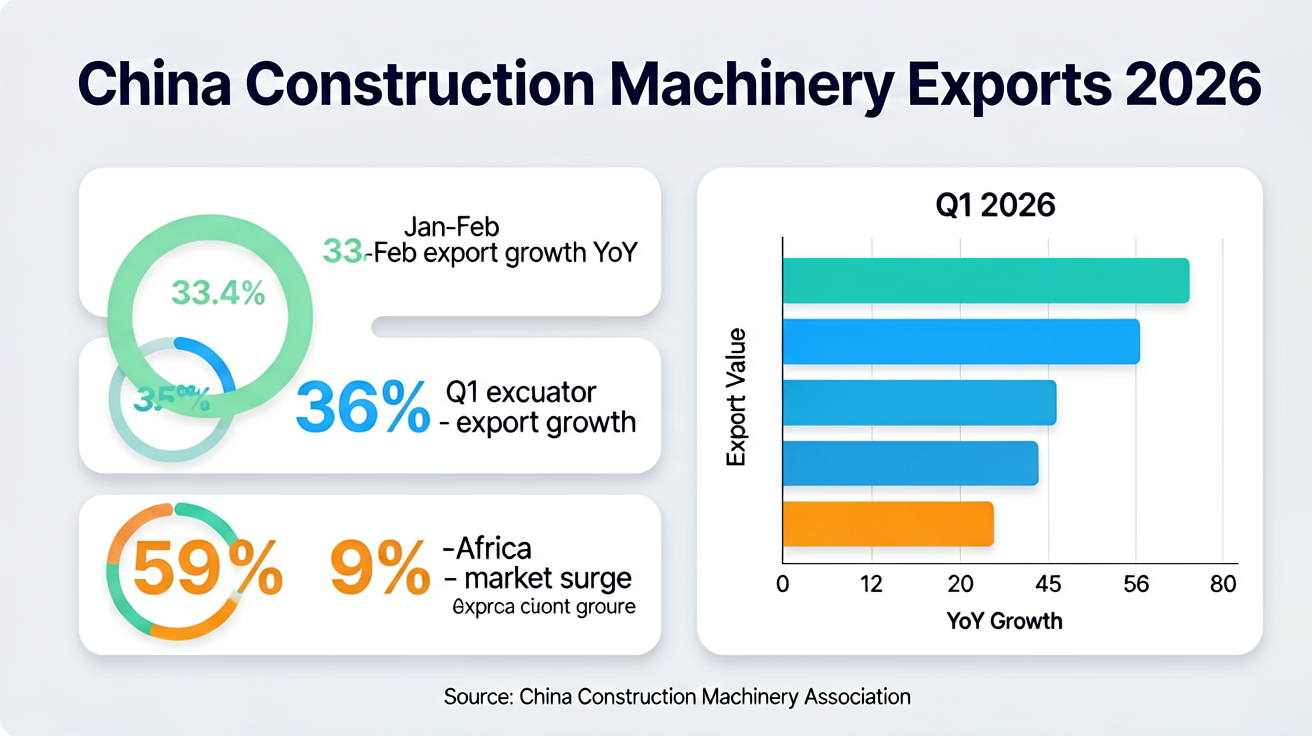
In the first half of 2026, China's construction machinery industry delivered an impressive global expansion performance. According to People's Daily, the export value of construction machinery grew 33.4% year-on-year in the first two months, continuing the strong upward momentum seen since 2025. More noteworthy is that this wave of overseas expansion is undergoing a qualitative transformation — shifting from pure product exports to a deep strategy encompassing overseas factory construction, technology transfer, and localized operations.
Export Data Continues to Climb, Electrification Emerges as a New Engine
Data from the General Administration of Customs shows that China's trade with Belt and Road partner countries continued to rise in the first half of 2026. Take Shanghai as an example: in the first half of the year, the total import and export volume with Belt and Road countries exceeded 1 trillion yuan, accounting for nearly 42%. Construction machinery, as one of China's flagship manufacturing products, has played a pivotal role in this wave of global expansion.
Electrification is becoming China's new calling card in overseas construction machinery markets. The South China Morning Post reported that while Chinese excavator exports surged 33% in the first half of the year, the share of electrified products rose significantly. Leading companies such as Sany Heavy Industry, XCMG Group, and Zoomlion have launched electric excavator, electric loader, and other new energy product lines, leveraging China's mature domestic electrification technology to gain a differentiated competitive edge in overseas markets.
Overseas Factory Construction Accelerates, Localization Enters Deep Waters
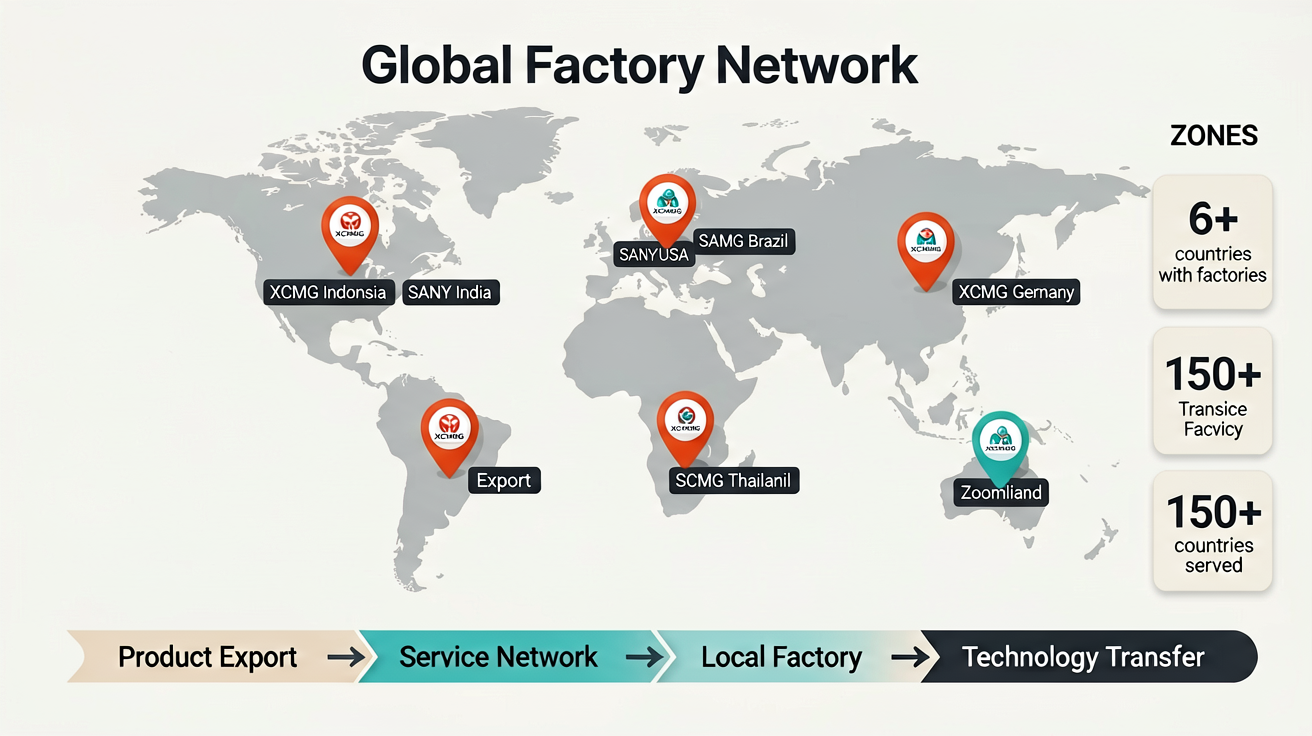
If product exports represent the first step of "going global," then building factories overseas is the critical leap of "going deep." In 2026, Chinese construction machinery enterprises have noticeably accelerated their overseas capacity deployment.
XCMG Group's first overseas new energy factory in Indonesia officially began production, marking a landmark project for China's construction machinery industry in Southeast Asia. The facility produces not only traditional construction machinery products but also assembles and tests new energy equipment, signaling that Chinese companies' overseas strategy has evolved from "selling products" to "manufacturing products" abroad.
Sany Heavy Industry has also been making frequent moves. According to China Daily, Sany Heavy Industry is considering a Hong Kong listing to raise funds for its global expansion. Prior to this, Sany had already established multiple overseas industrial parks and service centers in India, Germany, the United States, Brazil, and other locations, forming a localized network covering major global markets.
Caixin Media's earlier reporting also confirmed this trend: after the Spring Festival, leading domestic construction machinery companies accelerated their pace of overseas factory construction, vying for mid-to-high-end markets. This "produce locally, serve locally" model not only helps circumvent trade barriers but also brings companies closer to customer needs, boosting brand recognition.
From Belt and Road to the Global South, Market Map Continues to Expand
China's construction machinery global footprint is expanding beyond traditional Belt and Road countries into the broader Global South markets. According to the China Belt and Road Network, China's heavy-duty equipment is empowering industrial development across Africa — from Kenya's Standard Gauge Railway to Ethiopia's industrial parks, Chinese construction machinery can be found across the African continent.
ARC Advisory's industry report notes that China's construction machinery industry is exhibiting new characteristics of "high-quality development." Technology-driven product upgrades, comprehensive after-sales service systems, and flexible financing solutions together form the competitiveness foundation of Chinese brands in global markets.
Notably, this overseas expansion model is transitioning from "Made in China" to "Created in China." An increasing number of overseas customers are choosing Chinese equipment not merely for its price advantage, but for its technological performance and reliability. In emerging markets such as Southeast Asia, the Middle East, and Africa, Chinese construction machinery brands continue to gain market share, with certain product categories already surpassing traditional European, American, Japanese, and Korean brands.
Challenges and Opportunities Coexist, Localization Capability Determines Success
The road to global expansion is not without obstacles. Exchange rate fluctuations, geopolitical risks, local compliance requirements, and cultural integration with local dealers and customers are all challenges that Chinese companies must navigate overseas.
However, on the positive side, Chinese construction machinery enterprises are accumulating increasingly rich overseas operational experience. From initial product exports, to building after-sales service networks, to the current overseas factory construction and technology transfer, each step represents a deeper degree of localization and stronger market control.
For regions such as Africa, Southeast Asia, and the Middle East — which are undergoing large-scale infrastructure development — Chinese construction machinery offers cost-effective, technologically mature, and timely service options. As the Belt and Road Initiative continues to advance, the growth potential of these markets will be further unlocked.
For procurement solutions for brands such as Sany and XCMG equipment overseas, please contact EquipNode for professional advice. Our team has deep expertise in the global construction machinery market and can provide you with one-stop services from equipment selection to logistics.