How to Choose Among 5 Common Types of Construction Equipment

title: "How to Choose Among 5 Common Types of Construction Equipment"
date: "2026-08-09"
author: "EquipNode"
description: "Excavator, loader, bulldozer, crane, and road roller — a comprehensive guide to the functions, applications, and selection criteria for five mainstream types of construction machinery"
keywords: "construction equipment, selection, excavator, loader, bulldozer, crane, road roller"
Those "big machines" on a construction site may all look alike, but when it comes time to pick one for the job, many people get confused. The excavator, loader, bulldozer, crane, and road roller are the five most common pieces of equipment on any job site — yet each excels at completely different tasks. Choose the wrong one, and you'll face anything from reduced efficiency to serious project delays.
This article answers one key question: what does each of these five machines do, how do you choose, and how do you deploy them together?
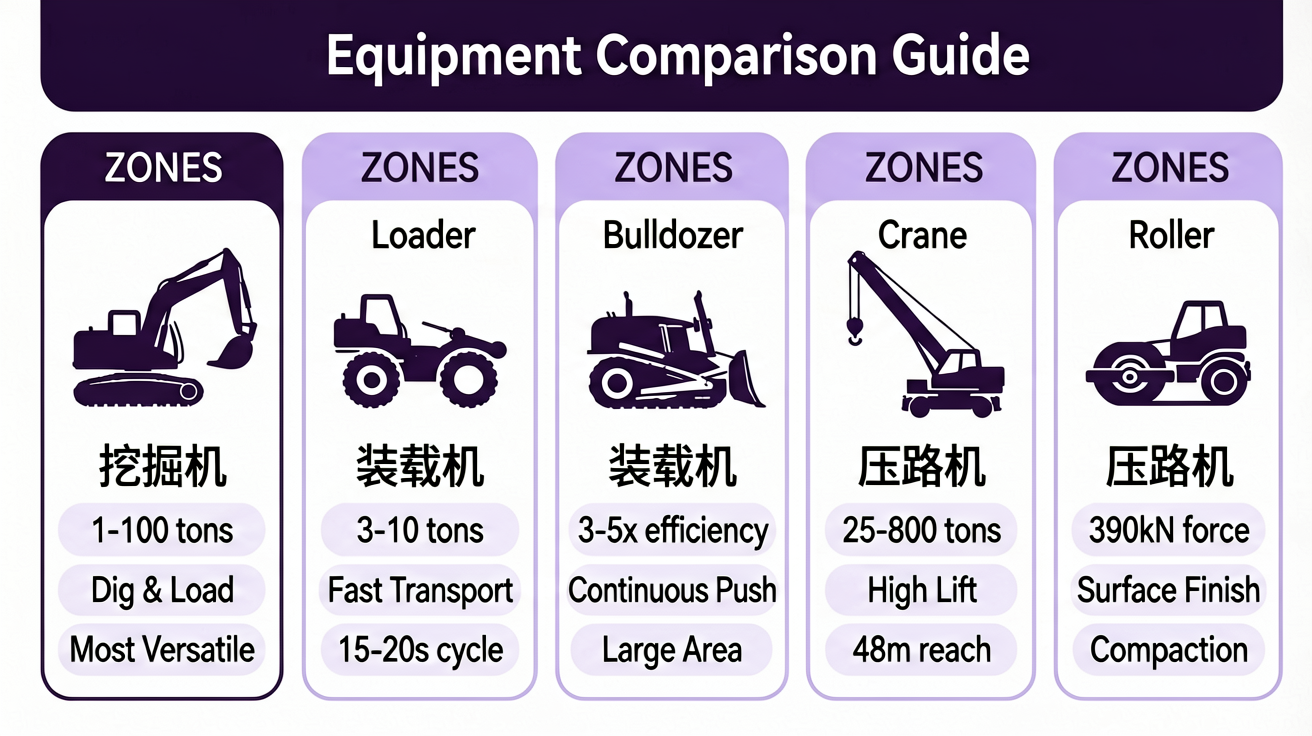
Excavator: The "All-Rounder" on the Job Site
The excavator is probably the piece of construction machinery most familiar to the general public. Its working principle is actually quite straightforward: the engine drives a hydraulic pump to produce high-pressure oil, which pushes hydraulic cylinders to achieve digging, lifting, and swinging motions with the bucket. The entire process works like a human arm — boom, stick, and bucket working in three linked stages.
### Excavator Classifications
By size, there are three main categories:
- Mini excavators (1–6 tons): Suited for urban municipal work, landscaping, and interior demolition. The Sany SY16C micro excavator is a standout in this segment — its overall width is under 1.8 meters, allowing it to easily access tight job sites.
- Medium excavators (6–30 tons): The most common specification, serving as the workhorse for earthmoving and road construction. The Sany SY215C ranked among the top ten global medium excavator sales in 2025.
- Large excavators (over 30 tons): Designed for mining operations and large-scale earthmoving projects. The Sany SY750H has a maximum bucket capacity of 4.5 cubic meters — a single scoop moves over 8 tons of earth.
### Key Selection Metrics
| Parameter | Small | Medium | Large |
|-----------|-------|--------|-------|
| Operating weight | 1–6 tons | 6–30 tons | 30–100 tons |
| Bucket capacity | 0.01–0.3 m³ | 0.3–1.5 m³ | 1.5–5 m³ |
| Engine power | 15–55 kW | 55–160 kW | 160–450 kW |
| Typical use | Municipal / landscaping | Earthmoving | Mining |
When purchasing, pay close attention to: engine power (determines digging force), hydraulic system flow rate (determines cycle speed), swing speed (affects work efficiency), and overall machine stability.
Loader: The "Strongman" for Fast Material Handling
Many people can't tell the difference between a loader and an excavator. In simple terms: the excavator "digs," and the loader "carries." A loader's working mechanism features a bucket mounted on the front of a boom, using the machine's forward momentum to push material into the bucket, then lifting, turning, and dumping.
### Core Advantages of the Loader
- Fast cycle times: A complete loading cycle takes only 15–20 seconds — far faster than an excavator.
- Excellent mobility: Wheeled loaders can travel at speeds up to 35 km/h, enabling quick repositioning between work areas.
- Versatility: With bucket swaps, the loader can handle steel pipes and timber; fit a snow blade and it becomes a snow removal machine.
### Choose by Drive Type
Wheeled (tire-type) loaders: Ideal for hard ground surfaces and situations requiring frequent repositioning, such as port loading/unloading and material stockyards. The Sany SW305 wheeled loader has a rated payload of 5 tons and engine power of 162 kW.
Crawlers (tracked loaders): Suited for soft ground and slippery conditions. Low ground pressure means less risk of getting stuck. However, travel speed is limited, generally not exceeding 10 km/h.
The single most important parameter when choosing a loader is rated payload — it directly determines per-cycle material volume and overall efficiency. Most job sites need the 3–5 ton class, while large mines or ports require 10-ton-plus heavy-duty models.
Bulldozer: The "Trailblazer" for Ground Leveling
The bulldozer's operation is the most straightforward of all: it pushes earth forward. A wide blade is mounted at the front of the machine, using pushing force to advance soil, gravel, and other materials while spreading them flat.
### The Bulldozer's Unique Value
The key differentiator of the bulldozer is its continuous working capability. An excavator scoops and pauses; a loader picks up and cycles around. But a bulldozer can push forward hundreds of meters without interruption. For large-area site grading and roadbed preparation, a bulldozer's efficiency is 3–5 times that of an excavator.
### Crawler vs. Wheeled
- Crawler bulldozers (dominant type): Large ground contact area, strong traction — ideal for dozing, backfilling, and land clearing. The Shantui SD16 is one of the most widely used medium bulldozers in China, with 120 kW of power.
- Wheeled bulldozers: Higher travel speed, no road surface damage — primarily used for highway maintenance and urban construction.
Crane: The "Powerful Arm" for High-Altitude Work
A crane's job is to lift heavy loads from point A to point B, excelling especially at high-altitude and long-range material handling. By structural type, there are three main categories:
### Main Types
- Truck cranes: Mounted on a truck chassis for strong mobility, well suited for frequent site-to-site moves. The Zoomlion QY25V has a maximum lifting capacity of 25 tons and a boom that can extend up to 48 meters.
- Tower cranes (tower derricks): Fixed at construction sites with boom lengths of 50–80 meters, they are the standard equipment for high-rise building construction. China's tower crane fleet exceeded 400,000 units in 2026.
- Crawler cranes: Large ground contact area, ideal for lifting heavy components on soft ground. The Sany SCC8000 has a maximum lifting capacity of 800 tons.
### Selection Guidelines
When choosing a crane, the first things to determine are maximum lifting capacity and working radius. Lifting capacity depends not just on the machine's rated value — you must also account for boom length, operating radius, outrigger deployment, and other variables. In practice, a truck crane rated at 50 tons may only be able to lift around 12 tons when operating at a 20-meter boom length and 15-meter radius.
Road Roller: The "Final Mile" of Pavement Engineering
A road roller compacts paving materials (asphalt, gravel, soil, etc.) to the target density using static weight pressure or vibratory compaction force. This is a critical quality-control step in road construction.
### Compaction Method Classification
| Type | Principle | Application |
|------|-----------|-------------|
| Static roller | Weight-based compaction | Final finishing of asphalt surface |
| Vibratory roller | Vibration + weight | Gravel base, earthwork compaction |
| Pneumatic tire roller | Tire kneading action | Final rolling of asphalt surface |
| Impact roller | High-energy impact | Deep compaction of roadbed |
The Sany SSR260C-6 single-drum vibratory roller delivers a centrifugal force of 390 kN, suitable for compaction of high-grade highway base layers. Asphalt pavement construction typically requires a combination of vibratory and pneumatic tire rollers — first using the vibratory roller for initial and secondary compaction, then the pneumatic tire roller for final smoothing.
How to Combine All Five Types of Equipment
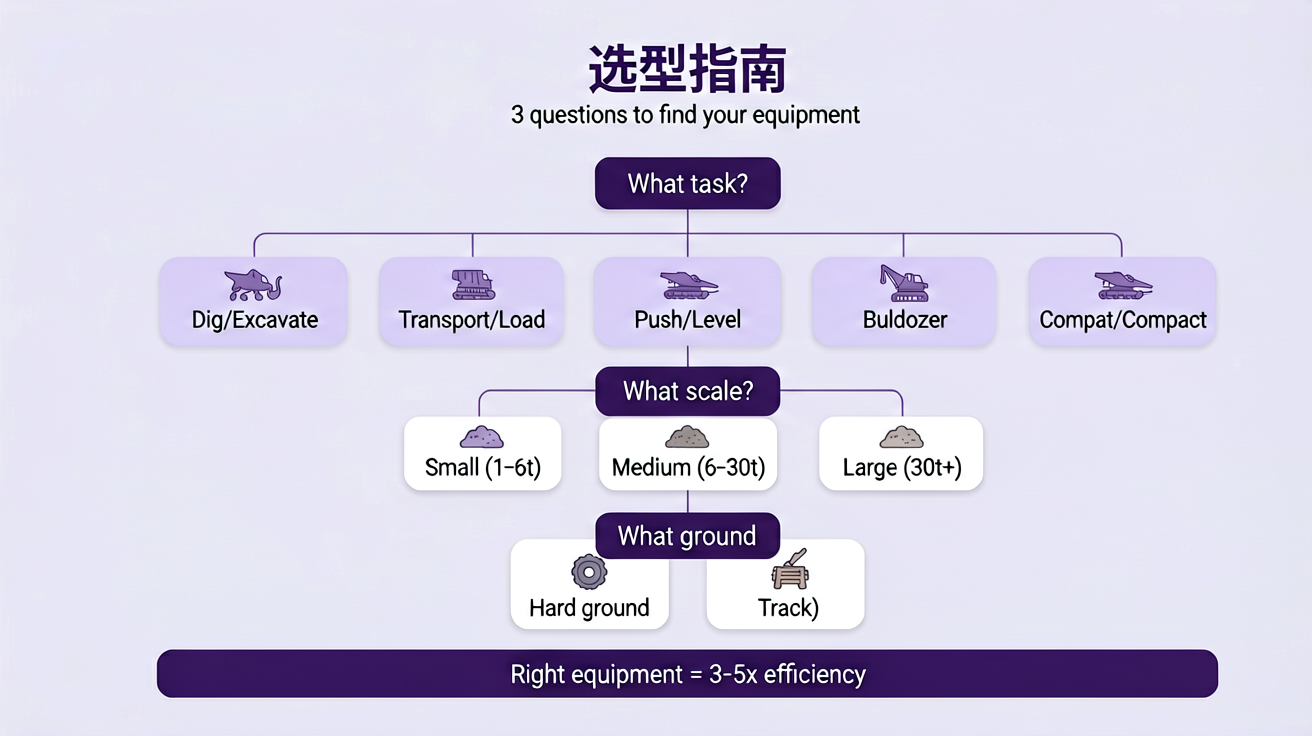
A typical earthmoving project generally requires the following configuration:
Excavator — responsible for digging and loading trucks
Loader — responsible for short-distance hauling and loading
Bulldozer — responsible for large-area site grading
Road roller — responsible for roadbed and surface compaction
Crane — responsible for material lifting and equipment installation
In practice, the excavator and loader form the most commonly used "golden pair" — the excavator digs and loads, while the loader handles material transport and support tasks. Matching equipment quantity and model to project scale is the key to achieving optimal construction efficiency and cost control.
Conclusion
There is no "one-size-fits-all answer" when choosing construction equipment. The key is to clarify three questions: what work needs to be done, where it will be done, and at what scale. Different conditions, geological environments, and project sizes call for entirely different equipment configurations.
If you need specific equipment pricing or selection advice, feel free to contact our sales team. EquipNode provides consulting and procurement services for the full Sany Heavy Industry product line, helping you find the ideal equipment solution for your project.
*Written by the EquipNode editorial team. Data sourced from the China Construction Machinery Association, Equipment World, and other public channels. Reproduction permitted with attribution.*