Emission Bans Expand as Green Transition Accelerates

title: "Non-Road Machinery Emission Bans Expand Rapidly, Industry Green Transition Enters Acceleration Phase"
date: 2026-08-06
author: EquipNode
tags: [emission standards, non-road machinery, environmental policy, green transition, construction machinery]
In the second half of 2026, China's construction machinery industry is experiencing an unprecedented wave of environmental policy action. From Jinan to Yongzhou, from Shenzhen to Henan, cities across the country are designating emission-restricted zones for high-emission non-road mobile machinery. At the same time, a conference on promoting zero-emission construction equipment was held in Beijing, and the Ministry of Industry and Information Technology launched its annual industrial energy-saving inspection — a coordinated policy push that is reshaping the industry landscape.
For equipment operators and manufacturers, this is no longer a "distant future" scenario — it is happening right now.
1. Emission-Restricted Zones Expand Rapidly, High-Emission Equipment Has Nowhere to Hide
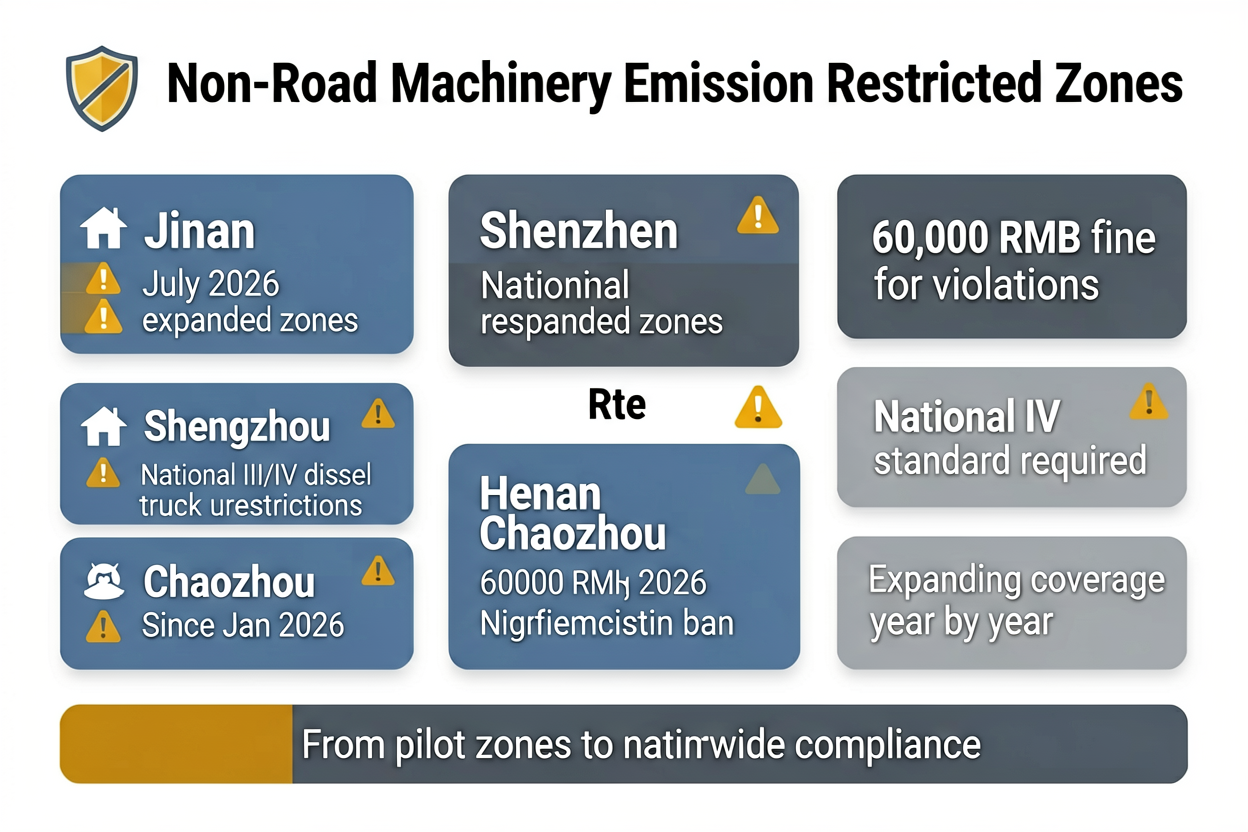
In July 2026, the Jinan Municipal People's Government issued a notice officially adjusting the boundaries of its high-emission non-road mobile machinery restricted zone. This follows Beijing and Shenzhen as yet another provincial capital to significantly expand its emissions control area.
Multiple cities in Henan took simultaneous action, drawing red lines around high-pollution equipment on construction sites. The Yongzhou Municipal Ecology and Environment Bureau also issued a notice banning high-emission non-road mobile machinery from the central urban area. Perhaps more noteworthy, Chaozhou has already been enforcing restrictions on high-emission vehicles since January 1, 2026.
A common thread runs through all these policies: the restricted zones keep growing, and penalties keep getting tougher. According to Beijing News, a concrete company was fined 60,000 yuan for operating high-emission non-road mobile machinery within a restricted zone. That is no small sum — enough to make many small and mid-sized operators take a hard look at their equipment compliance status.
Shenzhen has gone even further, introducing traffic management measures targeting National III and National IV emission-standard diesel trucks, extending controls from non-road machinery to construction transport vehicles.
2. National-Level Policy Intensifies, Zero-Emission Promotion Enters a New Stage
Local bans are just the tip of the iceberg. On July 28, 2026, a conference on promoting zero-emission construction equipment was held in Beijing, bringing together representatives from government departments, industry associations, and major manufacturers. The event signaled that zero-emission equipment promotion is moving from pilot programs to large-scale deployment.
The Ministry of Industry and Information Technology launched its 2026 annual industrial energy-saving inspection in May, closing the policy loop and pushing the green transition from "soft guidelines" to "hard compliance." For the construction machinery industry, this means non-compliant companies will face real regulatory pressure.
Looking at the broader policy trajectory, China is building a comprehensive emissions control framework: National IV standard enforcement → restricted zone designation → zero-emission promotion → energy-saving inspection — forming a complete loop from standard-setting to enforcement oversight.
3. Global Environmental Regulations Tighten in Tandem, Three Major Markets Chart Different Paths
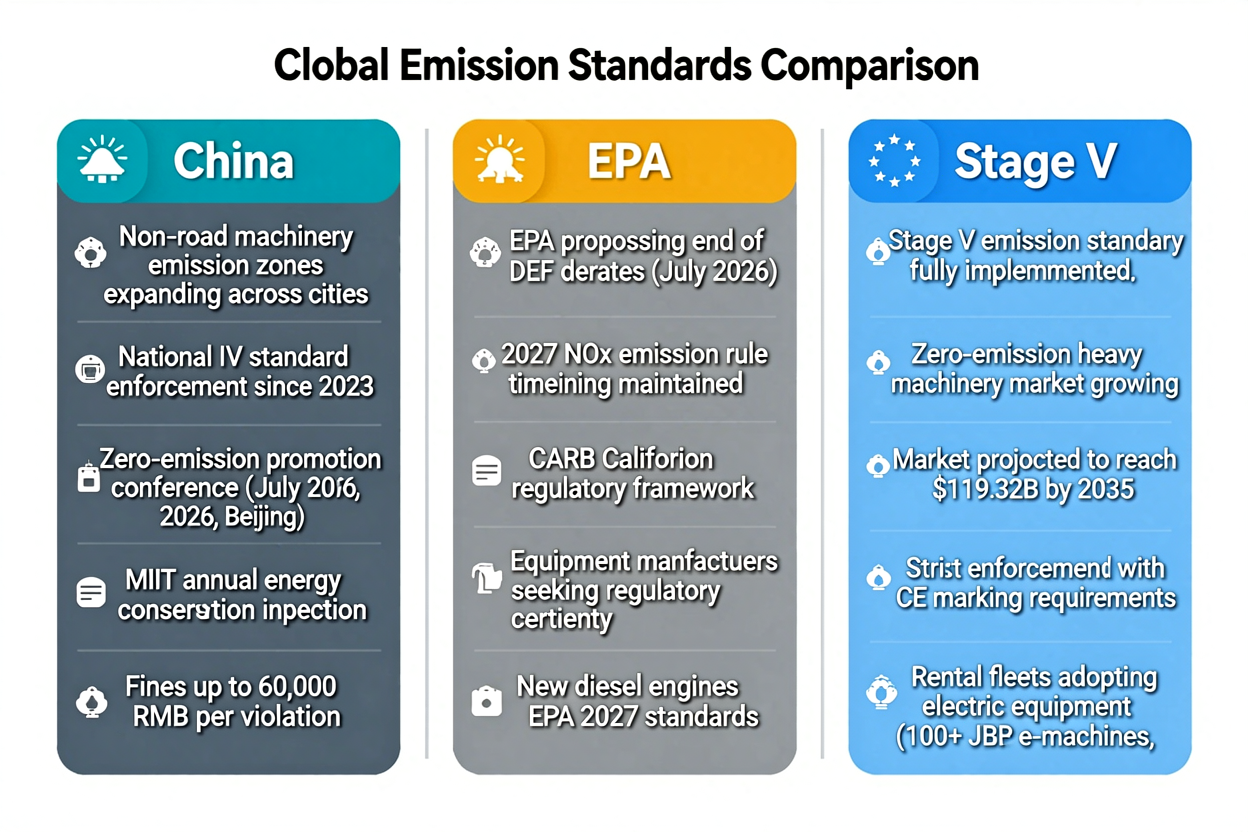
China's emission policies are not an isolated case. Around the world, environmental regulations governing the construction machinery industry are undergoing a comprehensive upgrade.
In the United States, the EPA (Environmental Protection Agency) proposed several major policy changes in 2026. On one hand, the EPA proposed ending the diesel exhaust fluid (DEF) power-derating measures, easing the compliance burden on equipment operators. On the other hand, Caterpillar showcased next-generation engine technology compliant with 2027 emission standards at CONEXPO-Con/AGG 2026. Volvo also introduced its all-new D13 diesel engine, claiming it can meet EPA 2027 emission standards without sacrificing power or fuel efficiency.
In California, CARB's (California Air Resources Board) engine emissions regulatory framework is drawing intense attention from equipment manufacturers. AEM (Association of Equipment Manufacturers) convened dedicated meetings to discuss compliance pathways, reflecting the industry's urgent demand for "regulatory certainty."
In Europe, Stage V emission standards are now fully in effect, and the market is rapidly transitioning toward zero-emission heavy machinery. According to the latest report from Precedence Research, the European construction equipment market is projected to reach $119.32 billion by 2035, with zero-emission equipment capturing an increasingly larger share.
Data from Fortune Business Insights shows that the global zero-emission heavy machinery market will maintain high growth from 2026 to 2034. MarketsandMarkets forecasts the electric construction equipment market will reach $13.81 billion by 2033.
4. Real-World Challenges Facing Operators: Compliance Costs and Transition Pathways
Tightening emission policies have direct and far-reaching impacts on equipment operators.
First, compliance costs. Equipment at National III emission standards or below is being banned in an increasing number of cities, meaning a large volume of machines still in service may need to be retired early. For small and mid-sized operators, the financial pressure of equipment replacement should not be underestimated.
Second, operational restrictions. The expansion of restricted zones means equipment scheduling becomes more complex, and cross-regional operations require advance confirmation of target areas' emission requirements. Violations result not only in fines but can also delay project timelines.
Third, the technology dilemma. Electric, hydrogen fuel cell, hybrid — the zero-emission technology roadmap is not yet fully clear. Betting too early on one path carries risk, but waiting on the sidelines could mean missing the policy window entirely.
Take Sany Heavy Industry as an example: its electric loader and electric excavator product lines have already been validated across multiple application scenarios. To learn more about the specifications and pricing of Sany's electric equipment, feel free to reach out to our sales team for a detailed proposal.
5. Industry Response Strategies: From Passive Compliance to Proactive Positioning
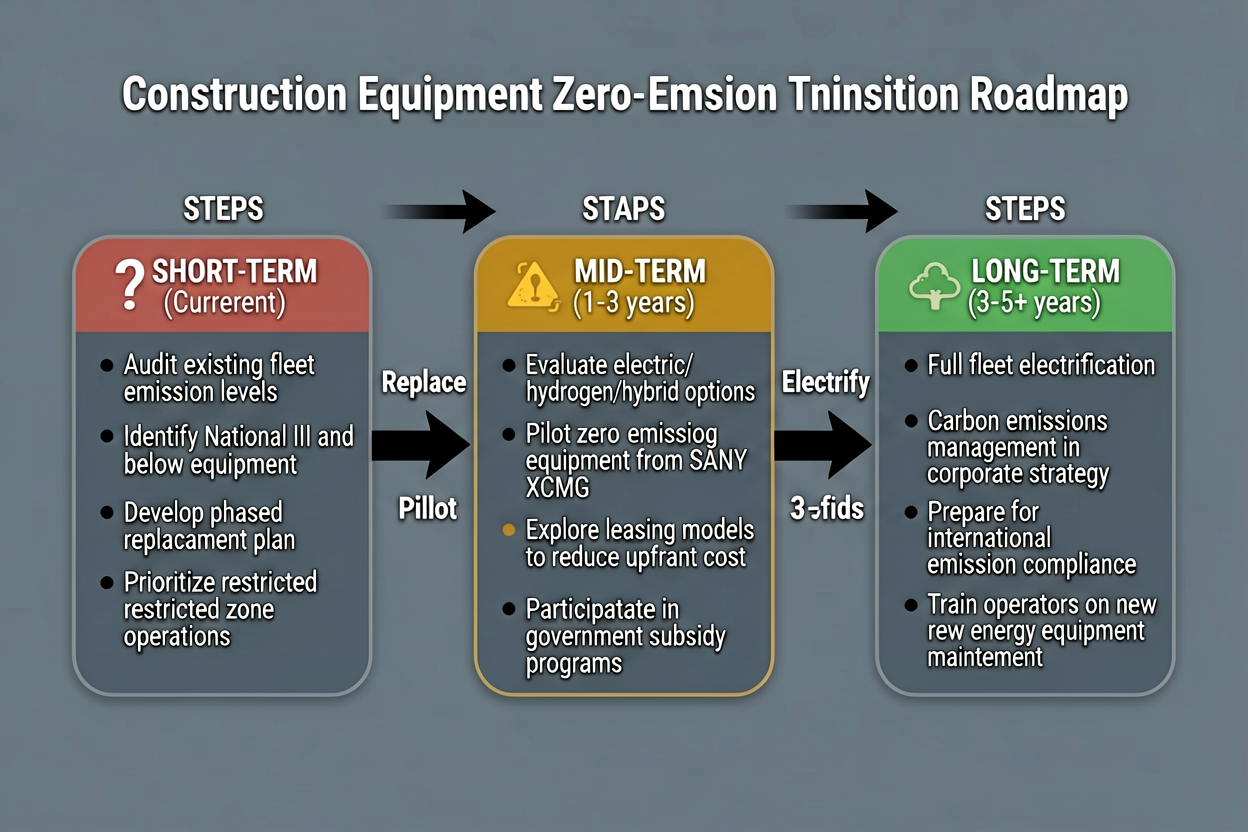
Facing this wave of emission policy adjustments, industry participants need to shift from passive compliance to proactive positioning.
Short-term strategy: Conduct a comprehensive audit of existing equipment emission tiers and develop a phased retirement plan. Prioritize upgrading equipment operating in restricted zones to National IV or zero-emission models. Establish an emissions compliance management system to track changes to restricted zones across regions in real time.
Medium-term strategy: Assess the feasibility of electrification transitions, and pay close attention to the electric equipment product lines from domestic brands such as Sany and XCMG. Explore equipment leasing models to reduce the burden of one-time capital investment. Participate in local zero-equipment promotion programs to secure policy subsidies.
Long-term strategy: Integrate carbon emission management into corporate strategic planning. Monitor the development of international emission standards and prepare compliance readiness for equipment exports. Invest in training operators to develop the skills needed for using and maintaining new-energy equipment.
6. Outlook: The Green Transition Is a Challenge — but Also an Opportunity
Tightening emission policies may look like constraints, but they are in fact creating new growth opportunities for the industry. The zero-emission equipment market is expanding rapidly, and whoever completes the transition first will hold a competitive edge in the decade ahead.
For equipment buyers in overseas markets, choosing equipment that meets the latest emission standards is not just a compliance requirement — it is an investment safeguard. Low-emission equipment offers longer service life, higher residual value, and broader application scenarios.
As an overseas partner for Chinese construction machinery brands including Sany Heavy Industry, EquipNode closely tracks global emission regulation developments and provides clients with the latest compliance equipment information and selection guidance. If you need details on emission requirements or equipment pricing for a specific market, feel free to contact us anytime.
*Data sources: Google News, Sina Finance, Jinan Municipal People's Government, AEM, Fortune Business Insights, MarketsandMarkets, Precedence Research*