How to Choose Between Four Types of Earthmoving Equipment

title: How to Choose Between the Four Major Earthmoving Machines
author: EquipNode
date: 2026-08-02
tags: [Equipment Comparison, Operating Principles, Buying Guide, Earthmoving Machinery, Explainer]
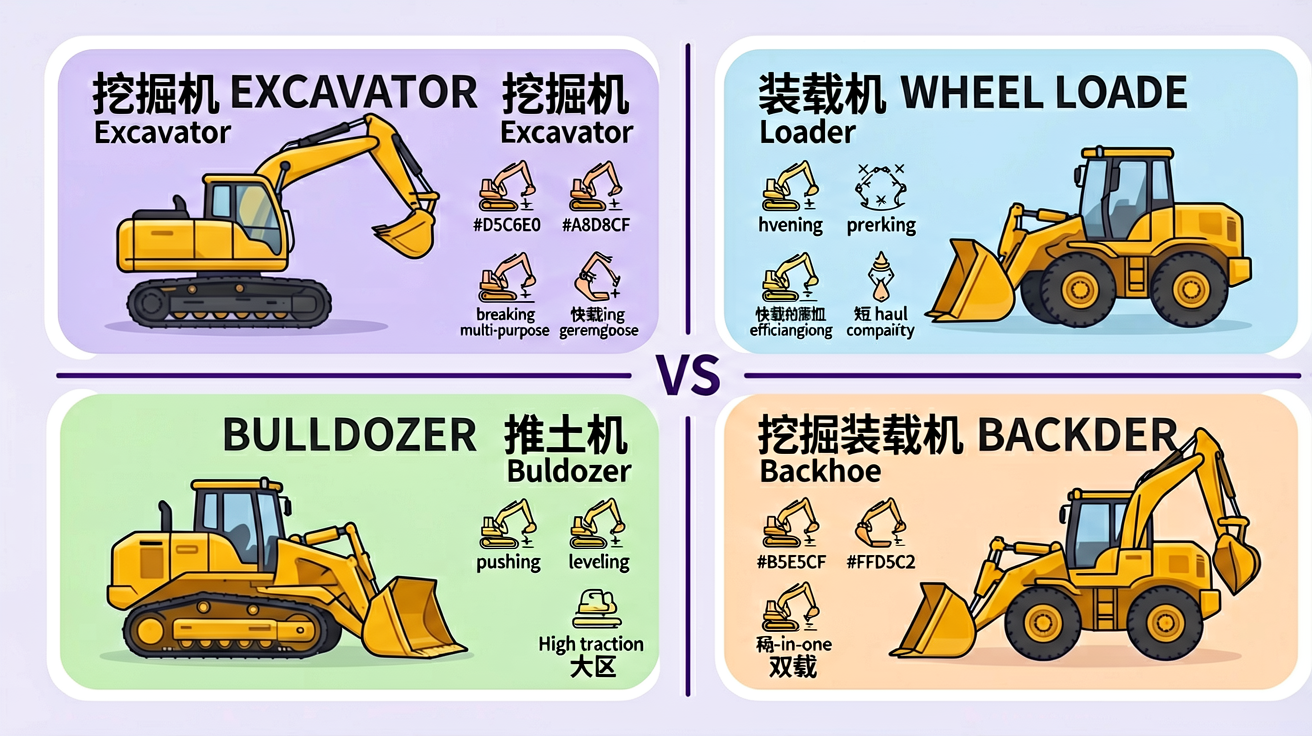
The four most common types of earthmoving machines on construction sites — excavators, loaders, bulldozers, and backhoe loaders (backhoe diggers) — what can each one do? How do you choose without wasting money? This article provides a comprehensive overview from three dimensions: operating principles, applicable scenarios, and purchasing considerations, helping you quickly build a clear understanding of these four "earthmoving workhorses."
1. Excavator: The Underlying Logic of a Versatile All-Rounder
The excavator is the most frequently seen piece of equipment on construction sites, ranging from 1-ton mini excavators to 800-ton ultra-large mining excavators, covering virtually every scenario from landscaping to open-pit mining.
Operating Principle: The core of an excavator is "hydraulic drive + bucket digging." The engine drives a hydraulic pump, and a multi-way valve controls the extension and retraction of the boom, stick, and bucket hydraulic cylinders, enabling the cyclical actions of digging, swinging, and dumping. The crawler undercarriage allows it to traverse soft ground freely, while the swing mechanism gives it 360-degree working capability.
Applicable Scenarios:
- Earthwork Excavation: Foundation pits, trenches, and utility ditches — this is the excavator's "bread and butter"
- Demolition & Breaking: Equipped with a hydraulic breaker hammer, it can handle concrete and rock
- Material Handling: Paired with grapples, clamshell buckets, and other attachments to handle lumber, scrap steel, and other bulk materials
- Precision Grading: Combined with GPS/laser guidance systems, accuracy can reach millimeter-level
Purchasing Considerations: Small excavators (under 6 tons) are suited for municipal works and landscaping; medium excavators (13–25 tons) are the mainstay of municipal and residential construction; large excavators (30 tons and above) focus on mining and major infrastructure projects. When purchasing, pay close attention to engine power, bucket capacity, and maximum digging depth.
2. Loader: The Efficiency King of Quick Loading
The loader (also known as a bucket loader or front-end loader) excels at "speed" — it can complete the load-carry-dump cycle in the shortest possible time, making it the benchmark for short-distance material handling efficiency.
Operating Principle: The loader adopts a "front bucket, rear counterweight" layout, with the front bucket raised and tilted by hydraulic cylinders. The engine is generally located behind the cab, both to balance the front load and to facilitate cooling. Four-wheel drive provides excellent ground traction.
Applicable Scenarios:
- Bulk Material Loading: Quick loading of sand, gravel, earth, and coal is the loader's forte
- Short-Distance Transport: On-site material handling over distances of 100–300 meters
- Cleanup Operations: Equipped with snow plows or sweepers for road maintenance
- Material Stockpiling: Stacking and piling operations in warehouses or material yards
Purchasing Considerations: Rated load capacity is the core metric (ranging from 1 to 10 tons), and bucket volume determines per-cycle productivity. For frequent heavy-load conditions, it is recommended to equip reinforced buckets and extended booms.
3. Bulldozers: The Irreplaceable Master of Large-Scale Grading
The bulldozer is the ultimate representative of "pushing" in earthwork engineering. When large-scale ground leveling, pushing loose materials, or building road subgrades is required, no other equipment can match its efficiency.
Operating Principle: The bulldozer's core component is the front blade, which is controlled for lift and angle via a hydraulic system. The crawler undercarriage provides powerful traction, enabling operation on various soft or rough terrain. Some high-end models are equipped with ripper attachments that can loosen material before pushing, improving work efficiency.
Applicable Scenarios:
- Site Grading: Large-area land leveling where precision requirements are low but earth volumes are large
- Subgrade Construction: Earth spreading and compaction assistance
- Material Pushing: Material pushing in mines and quarries
- Clearance Operations: Forest clearing and demolition debris removal
Purchasing Considerations: Engine power and blade width are the key factors. Small bulldozers (under 100 HP) are suited for landscaping and small construction sites; medium bulldozers (100–250 HP) are the mainstay for municipal projects; large mining bulldozers (300 HP and above) are used in major mining operations.
4. Backhoe Loader: The Versatile All-In-One Workhorse
The backhoe loader is commonly known as a "backhoe digger." Its front end is a loader bucket, and its back end is a digging arm. A single machine combines both loading and digging functions, making it the first choice for small construction sites and multi-purpose operations.
Operating Principle: The front and rear working devices share the same engine and hydraulic system, with time-sharing control to switch between the two. The cab can typically rotate 180 degrees, making it convenient for the operator to switch between the two working faces.
Applicable Scenarios:
- Municipal Maintenance: Trench excavation + backfilling + material transport — all handled by one machine
- Farm Operations: Cleaning livestock sheds, transporting feed, and maintaining field boundaries
- Landscaping: Trench digging, grading, and material transport on small sites
- Emergency Repairs: Road and pipeline emergency repairs where rapid deployment is needed
Purchasing Considerations: The digging depth of the backhoe arm and the capacity of the loader bucket are the core parameters. Because the backhoe loader must serve two sets of equipment simultaneously, it cannot match a dedicated excavator or loader in any single function, but the flexibility and cost advantage of "one machine, two jobs" is its core competitive edge.
5. How to Choose Between the Four Types? A Quick Comparison Table
| Comparison Dimension | Excavator | Loader | Bulldozer | Backhoe Loader |
|----------------------|-----------|--------|-----------|----------------|
| Core Function | Digging, breaking, grappling | Loading, transport | Pushing, spreading | Digging + Loading |
| Work Precision | High | Medium | Low | Medium |
| Mobility | High | High | Medium | High |
| Versatility | ★★★★★ | ★★★ | ★★ | ★★★★ |
| Unit Cost | Relatively High | Medium | Relatively High | Relatively Low |
| Typical Scenario | Foundation pits, mining | Sand/gravel loading | Site grading | Municipal maintenance |
Key Takeaway: There is no "best" equipment, only the "right" equipment. Choose an excavator for foundation pit excavation, a loader for bulk material loading, a bulldozer for large-scale leveling, and a backhoe loader for multi-function small construction sites. If your budget only allows one purchase, the excavator offers the greatest versatility.
6. New Selection Thinking in the Era of Electrification
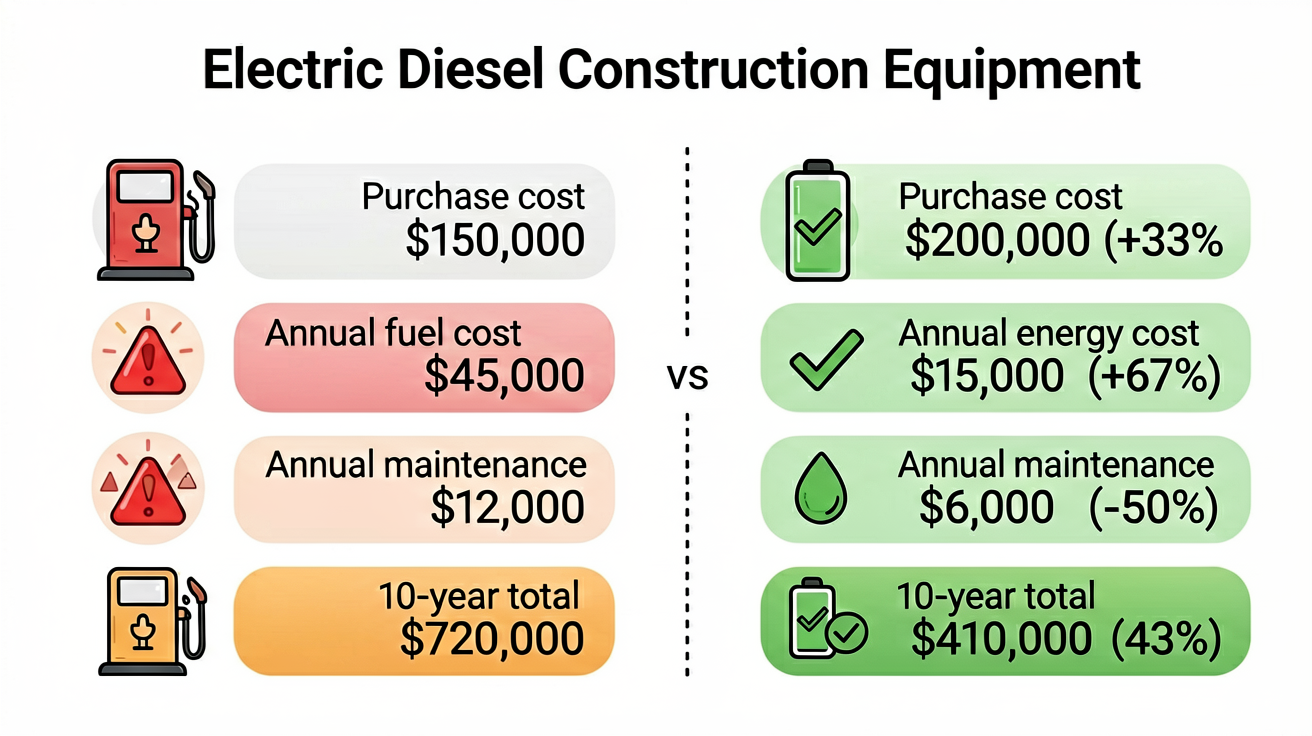
In 2026, the electric construction machinery market continues to heat up. According to the latest MarketsandMarkets report, the global electric construction equipment market is projected to reach significant growth by 2033. Products such as SANY electric excavators and Caterpillar all-electric mining excavators have already entered the commercialization stage.
When selecting equipment, in addition to traditional parameters, you should also consider:
- Charging Infrastructure: Whether the construction site has electrical access
- Range/Endurance: Whether a single charge can cover one work shift (8 hours)
- Total Cost of Ownership: Electricity costs vs. fuel costs, maintenance cost comparison
- Noise Regulations: Some urban areas have strict limits on construction noise, giving electric equipment a clear advantage
If you would like to learn about specific equipment pricing or selection advice, feel free to contact the EquipNode sales team. Our engineers can provide the most suitable equipment solution based on your project requirements.