Right to Repair Battle Reshapes Construction Equipment Aftermarket
title: The Battle Over Repair Autonomy
date: 2026-07-31
author: EquipNode
tags: [Maintenance & Repair, Parts Purchasing, Right to Repair, Aftermarket, Industry Trends]
In the summer of 2026, a heated debate over "who has the right to repair machines" continues to unfold across the global construction equipment industry. From U.S. courtrooms to EU legislative bodies, from Caterpillar's dealer networks to Sany's parts ecosystem, the Right to Repair is reshaping the rules of the entire aftermarket game.
1. What Is "Right to Repair"?
Right to Repair is exactly what it sounds like: equipment owners should have the right to choose their own repair channels, rather than being locked into the OEM after-sales system.
The concept originally emerged in consumer electronics. Apple users who had to wait in long lines for an officially authorized battery replacement had long been vocal about their frustration. But it was the construction equipment industry that truly thrust Right to Repair into the spotlight.
In May 2026, John Deere was sued once again over repair rights. The plaintiffs argued that Deere uses software locks and proprietary diagnostic tools to prevent independent repair shops from fixing its construction and forestry equipment. This was not Deere's first time in court — as early as 2023, the company reached a preliminary settlement over similar issues, but the problem is clearly far from resolved.
2. Global Aftermarket Size: An Upward Curve
The intensity of the Right to Repair debate is driven by enormous economic stakes.
According to a report published by Global Market Insights in July 2026, the global construction equipment engine repair market is expected to maintain steady growth from 2026 to 2035. Market Data Forecast's North American MRO (Maintenance, Repair & Operations) report also shows that while parts and labor costs dipped slightly in Q4 2025, the overall five-year trend remains upward.
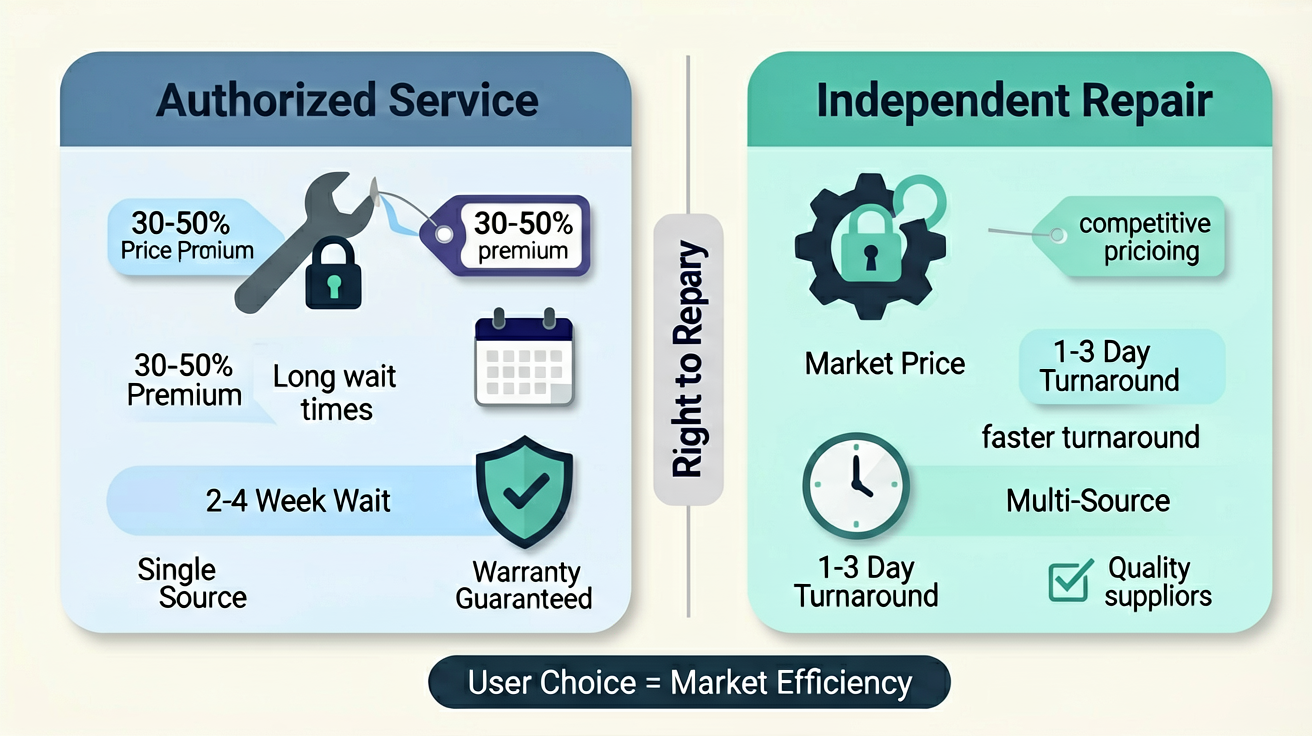
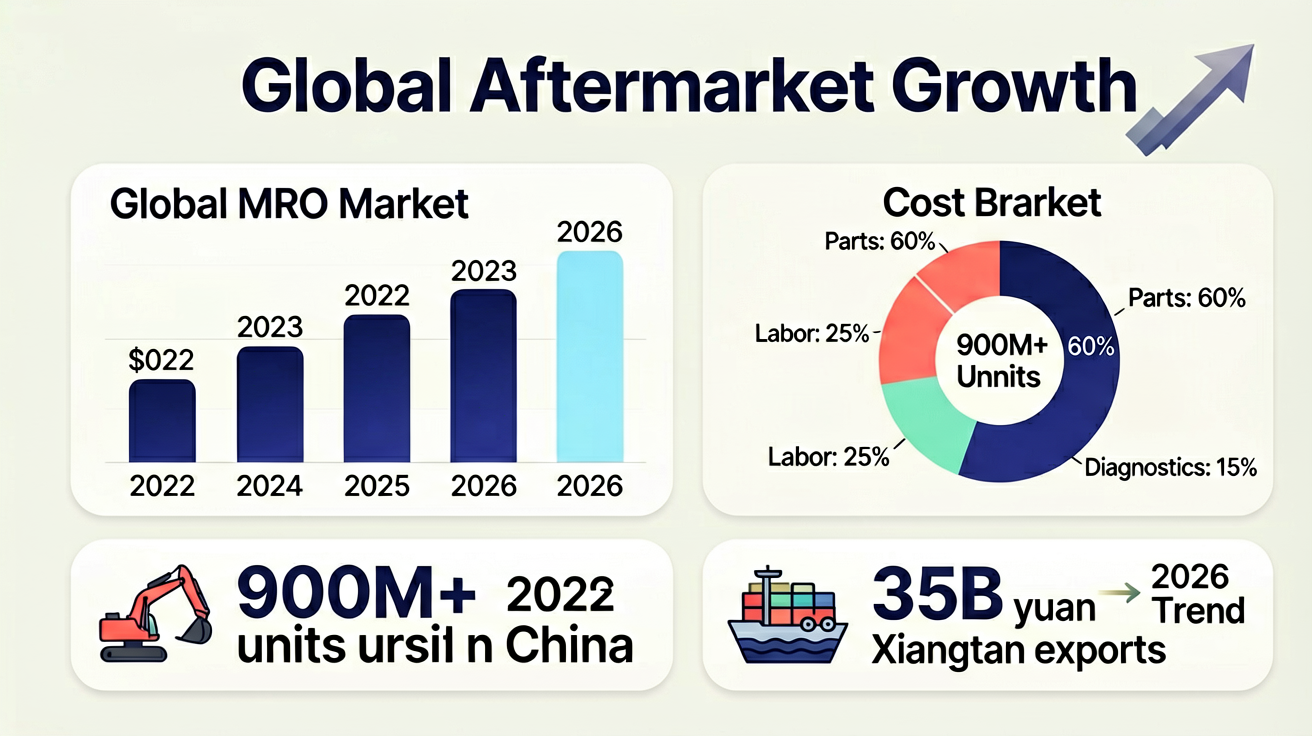
For end users, repair costs directly impact the return on investment over a machine's entire lifecycle. A 20-ton-class excavator incurs annual maintenance and repair costs of approximately ¥80,000–150,000, of which parts account for more than 60%. If parts can only be sourced through OEM channels, prices are typically 30%–50% higher than from independent suppliers.
3. The Opportunity Window for Independent Repair Shops
The Right to Repair movement has opened unprecedented opportunities for independent repair shops.
A February 2026 in-depth report from Fleet Equipment Magazine pointed out that parts availability remains the key factor driving repair decisions. Whoever can provide the right parts in the shortest time wins the customer. This is precisely where independent repair shops have the advantage — they typically maintain relationships with multiple parts suppliers, enabling rapid price comparison and sourcing.
Fab Heavy Parts, for example, leverages OEM cross-reference data to help fleets "repair rather than replace" components. Their core logic is simple: a seal from one brand may be completely interchangeable with another brand's, yet OEM pricing can differ dramatically.
In the Chinese market, Xiangtan's used excavator export business generated ¥3.5 billion in transaction volume in 2025. Nearly all of these used machines require a complete repair and refurbishment process before export, supported by a vast independent parts supply chain.
4. OEM Strategies in Response
Faced with the pressure of Right to Repair, OEMs are far from standing still.
Sany unveiled a new parts and service program at ConExpo 2026, emphasizing the value proposition of "genuine parts + professional service." TVH announced a two-year warranty on parts, using service commitments to offset their price disadvantage.
Caterpillar delivered strong earnings in Q1 2026, but the growth of its after-sales service revenue is equally noteworthy. For a giant like Caterpillar, aftermarket services have become a critical profit source — equipment sales are one-time transactions, while parts and repair represent recurring revenue.
Volvo is also making moves. In February 2026, Volvo announced the opening of a new parts distribution center in Tacoma, Washington, further reducing parts delivery times. Shortening wait times is essentially a race to capture the time window against independent repair shops.
For international brand parts price comparisons, visit our [Parts Purchasing Guide](https://equipnode.com/zh/blog-collection.html)
5. The Unique Ecosystem of the Chinese Market
China's construction equipment aftermarket has its own distinct logic.
First, the installed base is enormous. As of the end of 2025, China's construction equipment fleet exceeded 9 million units, generating an astronomical volume of annual repair and parts demand.
Second, channels are highly diversified. Beyond the OEM authorized service network, China has a vast independent parts market, used equipment trading market, and regional repair networks. This diversified channel structure has made the advancement of Right to Repair relatively smooth in China.
Third, digital penetration is high. China's parts e-commerce platforms, online fault diagnostics, and remote technical support services have developed rapidly, further reducing users' dependence on OEM systems.
But challenges remain. The quality of non-standard parts is uneven, and some users prioritize low prices while overlooking safety risks. How to ensure parts quality while keeping repair channels open is an issue the entire industry must address together.
6. Practical Advice for End Users
In the face of aftermarket disruption, equipment users can optimize their repair strategies in several ways:
Build diversified parts channels. Don't rely on a single supplier. Maintain 2–3 reliable parts sources simultaneously, including OEM channels, brand-certified dealers, and verified independent suppliers. This ensures supply speed in emergencies and gives you negotiating leverage on pricing.
Prioritize preventive maintenance. 80% of repair costs stem from unexpected failures. Follow your equipment manual's maintenance schedule and regularly replace consumables such as filter elements, hydraulic oil, and track shoes to dramatically reduce the probability of major overhauls. For an excavator, replacing the hydraulic oil filter every 500 hours costs less than ¥2,000 but can prevent hydraulic system failures that easily run into tens of thousands of yuan.
Track equipment health data. Modern construction equipment is generally equipped with sensors and data acquisition systems. Regularly exporting and analyzing operational data can help detect potential issues early, enabling intervention before failures occur.
Prioritize certified repair shops. When choosing an independent repair shop, favor service providers that hold industry certifications or brand authorizations. While prices may be slightly higher, they offer greater assurance in parts quality and workmanship.
7. Outlook: Balancing Openness and Safety
The essence of Right to Repair lies in finding a balance between equipment manufacturers' intellectual property protection and users' right to choose freely.
The EU is already pushing for related legislation requiring manufacturers to provide repair manuals and diagnostic tools. Several U.S. states are also discussing similar bills. In China, while there are no dedicated repair rights regulations yet, market competition is already driving the diversification of repair channels.
At EquipNode, we always stand on the side of the user. Whether you need to understand parts pricing for specific equipment, find a reliable repair channel, or evaluate the residual value of used equipment, our team can provide professional advice and support.
The aftermarket transformation is only just beginning. Right to Repair is not merely a legal issue — it is a business proposition about efficiency, cost, and trust.
*For specific equipment pricing or parts information, please contact our sales team. EquipNode — your trusted construction equipment partner.*