Construction Machinery Emissions Reduction Enters Critical Phase

title: "Construction Machinery Emissions Reduction Enters a Critical Phase"
date: 2026-07-30
category: Policy / Industry Trends
author: EquipNode
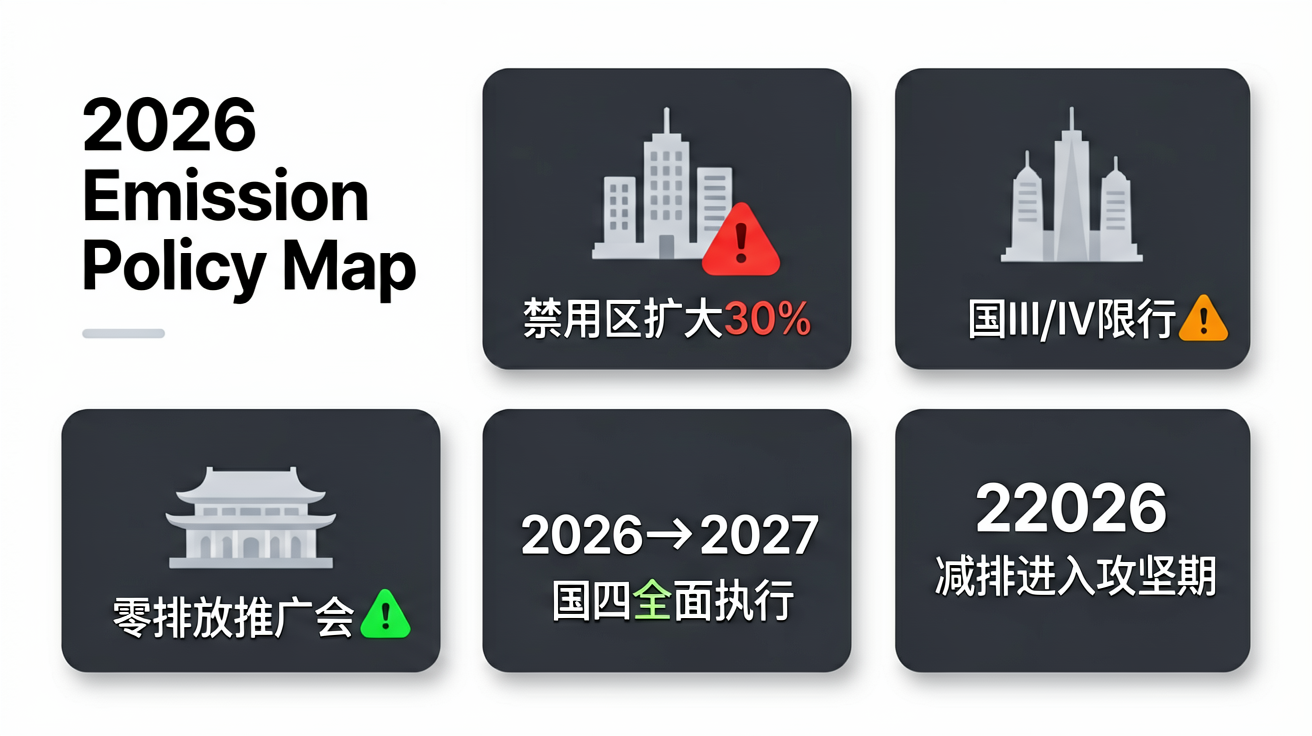
In the second half of 2026, a wave of emissions regulations is hitting the construction machinery industry. From Jinan expanding its non-road machinery restricted zones, to Shenzhen tightening restrictions on diesel trucks, to the Beijing Zero-Emission Construction Machinery Promotion Conference — a series of moves clearly signals that emissions reduction has moved from an "advocacy stage" to a "critical battle stage."
Jinan Takes the Lead: High-Emission Machinery Restricted Zones Expanded Again
The Jinan Municipal People's Government recently issued a notice adjusting the boundaries of its high-emission non-road mobile machinery restricted zones. The new policy expands the restricted area from the main urban district further into suburban fringe areas, increasing coverage by approximately 30%. This means that excavators, loaders, and other equipment still operating under National II emission standards or below will face stricter operational restrictions.
For local construction firms, this is not new — Jinan has been phasing in tighter restrictions on restricted zones for some time. However, the speed and intensity of this expansion have exceeded expectations. Industry analysts believe this is closely tied to the acceleration of the national "Blue Sky Defense Campaign" implementation plan for 2026. For guidance on compliant equipment selection, feel free to contact our sales team.
Shenzhen Tightens Restrictions: National III and National IV Diesel Trucks Limited
On the Shenzhen front, the Municipal Bureau of Ecology and Environment, in conjunction with the Public Security Bureau and the Transportation Bureau, issued a notice imposing restricted access measures on National III and National IV emission standard diesel trucks. Although this policy targets road vehicles, its signaling significance is equally important for the non-road machinery sector — urban emissions reduction is taking shape as a dual-track approach covering both "road and non-road."
The emissions contribution of construction machinery in urban projects cannot be ignored. A single National II standard 20-ton-class excavator produces nitrogen oxide emissions equivalent to dozens of National VI diesel trucks. Shenzhen's restriction policy provides a reference template for other cities.
What Signals Does the Zero-Emission Promotion Conference Send?
The "2026 Zero-Emission Construction Machinery Promotion Conference," held in Beijing at the end of July, brought together leading enterprises including SANY Heavy Industry, XCMG, and Zoomlion. The conference focused on promoting pathways for electric construction machinery, building charging and battery-swap infrastructure, and the role of leasing models in the zero-emission transition.
Notably, several companies showcased their latest electric product lines at the conference. Electric excavators and electric loaders have progressed from the "proof of concept" stage to "mass delivery." For pricing on SANY electric excavators, feel free to contact us.
EPA Proposed Rule Revisions: Global Emission Standards Converge
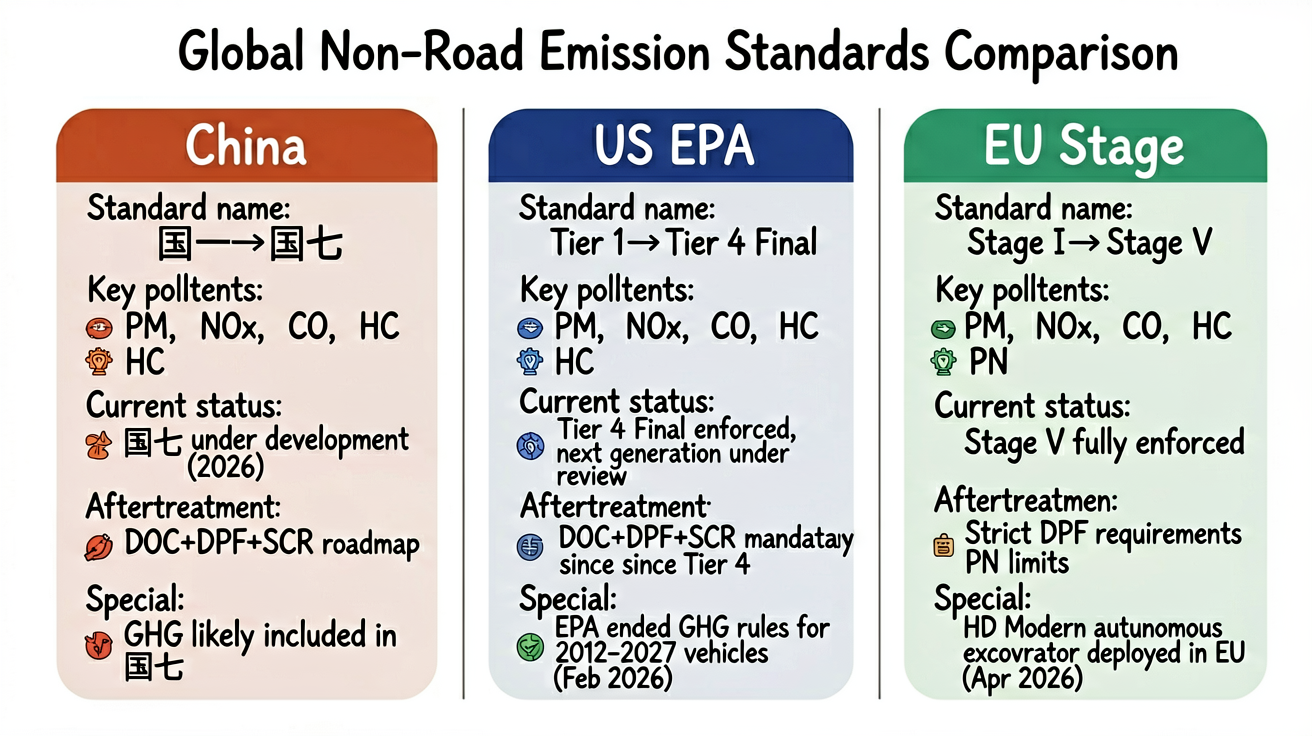
Looking overseas, the U.S. EPA recently proposed revisions to its heavy-duty engine rules, seeking to eliminate the mandatory requirement for DEF (Diesel Exhaust Fluid) and streamline the New Source Review process. This move may appear to be a "loosening," but it actually reflects a divergence in emissions technology pathways — the U.S. is leaning toward achieving emissions reduction targets through technological progress rather than mandatory restrictions.
Meanwhile, emission standards in Europe and China continue to tighten. Volvo has already launched new diesel engines compliant with the 2027 EPA standards, proactively positioning for the compliance window. For Chinese construction machinery exporters, this means they must simultaneously meet multi-country emission standards, driving further increases in product certification costs.
Industry Response: From Passive Compliance to Proactive Transformation
Facing mounting regulatory pressure, leading enterprises are shifting from passive compliance to proactive transformation:
- Product side: Accelerating R&D of electric and hydrogen-powered machinery to capture the new-energy construction equipment market
- Service side: Establishing systems for recycling and retrofitting older equipment to extend the service life of compliant machinery
- Management side: Deploying real-time emissions monitoring systems to track emissions data for every piece of equipment
For small and medium-sized enterprises, the most practical strategy is "phased replacement" — prioritizing the retirement of the worst-emitting equipment while retaining models that still have compliance potential. At the same time, companies should keep a close eye on local government trade-in subsidy programs to reduce the cost of equipment upgrades.
Looking Ahead: 2027 May Prove to Be a Watershed Year
On balance, 2027 will be a critical watershed for construction machinery emission standards. By then, National IV emission standards will be fully enforced, and non-compliant equipment will be completely phased out of the market. Companies that plan ahead will gain a competitive advantage, while those that react slowly face the dual risk of idle equipment and eroding market share.
EquipNode will continue to monitor policy developments and provide customers with the latest guidance on compliant equipment selection and market analysis. For specific equipment pricing or policy interpretation, feel free to contact us.