Downtime Costs Money: Three Keys to Maintenance
title: "Downtime Burns Cash: Three Key Factors in Maintenance Decisions"
date: 2026-07-10
author: EquipNode
tags: [Maintenance, Parts Guide, Used Equipment, Troubleshooting, Service Life]
In the construction machinery industry, every hour a piece of equipment sits idle means more than just lost schedule time. Downtime costs for a 30-ton excavator range from $200 to $500 per hour, while losses for a large concrete pump truck can reach as high as $800 per hour. In 2026, with labor costs climbing and project timelines compressing, finding ways to reduce downtime and optimize maintenance decisions has become one of the most critical challenges for equipment managers.
At CONEXPO 2026 this past March, SANY USA unveiled a new parts and service system. In June, EquipXR launched a heavy-equipment downtime cost calculator for contractors. At the same time, John Deere was hit with yet another antitrust lawsuit over repair restrictions. These events all point to one reality: competition in the construction machinery aftermarket is entering an intensely fierce phase.
1. Downtime Costs: The Underestimated Hidden Loss
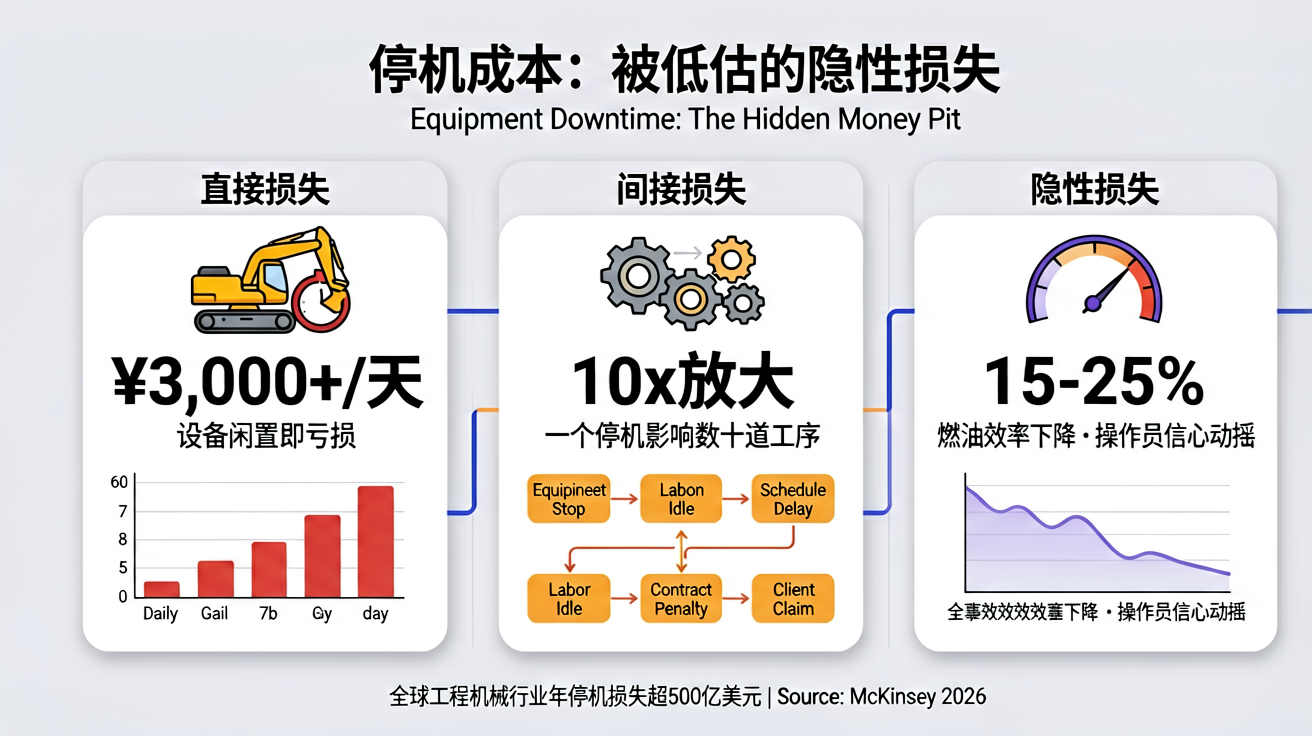
Many equipment managers carefully scrutinize every dollar during procurement, yet lack a quantitative understanding of downtime costs during the operations phase. According to an industry report published by McKinsey this year, unplanned downtime causes over $50 billion in economic losses annually for the global construction machinery industry.
Downtime costs are primarily composed of three parts:
- Direct losses: Lost productivity from equipment unable to operate. For an excavator with a daily rental rate of ¥3,000, one day of downtime means ¥3,000 in lost rental income or equivalent operational value.
- Indirect losses: Penalties from schedule delays, idle labor costs, and coordination costs. On large projects, downtime of critical equipment can trigger a chain reaction affecting dozens of downstream processes.
- Hidden losses: Degraded equipment performance, reduced fuel efficiency, and shaken operator confidence. Even after a repair, operators of a frequently breaking-down machine tend to ease up on operational intensity.
The downtime cost calculator launched by EquipXR in June 2026 aims precisely to help contractors quantify these "invisible losses." The tool lets users input equipment type, daily rental rate, failure frequency, and other parameters to generate intuitive cost analysis reports. For small and medium-sized construction companies that haven't yet established systematic maintenance management, this is a valuable starting tool.
2. Parts Availability: The First Variable in Maintenance Decisions
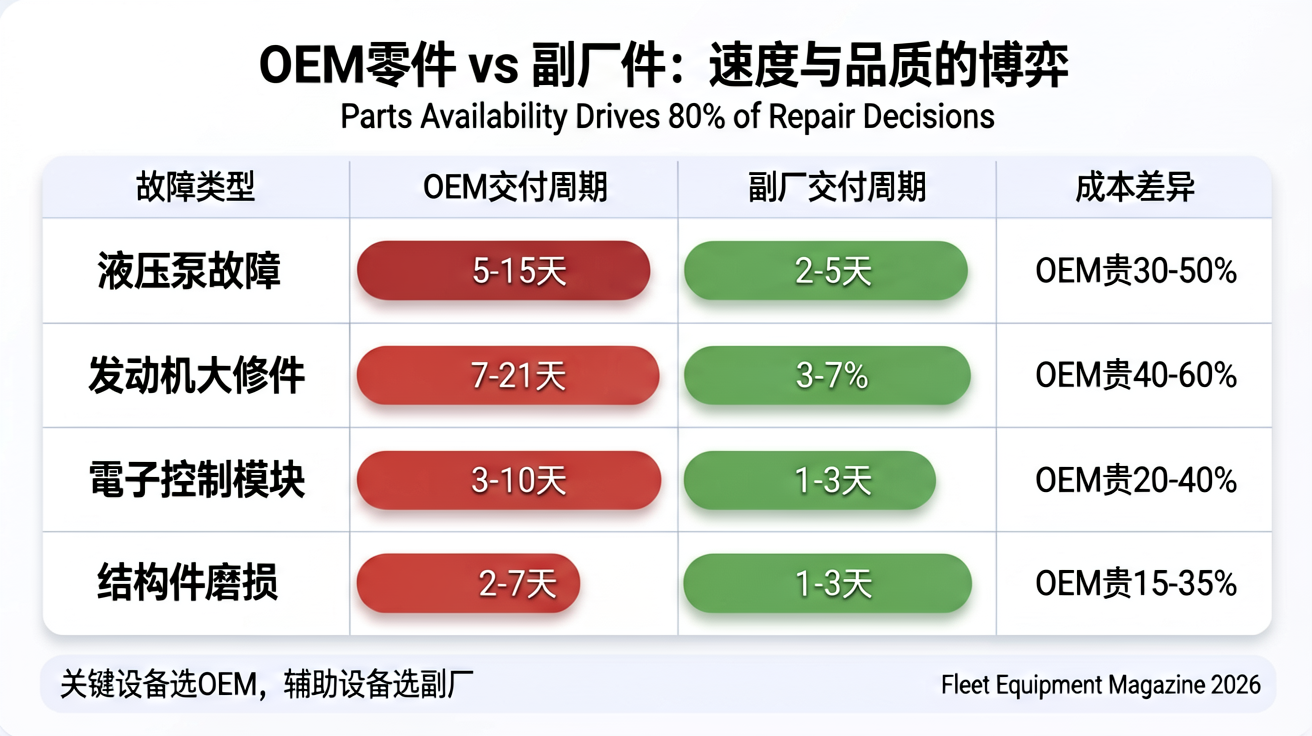
A February in-depth report by Fleet Equipment Magazine noted that parts availability remains the primary factor influencing maintenance decisions. When a piece of equipment breaks down, over 80% of equipment managers don't first think about "whether to repair it" — they think about "whether the parts can be obtained."
Parts availability directly impacts the choice of maintenance strategy:
| Failure Type | OEM Parts Delivery Time | Aftermarket Parts Delivery Time | Maintenance Cost Difference |
|---------|---------------|--------------|------------|
| Hydraulic pump failure | 5-15 days | 2-5 days | OEM 30%-50% higher |
| Engine rebuild parts | 7-21 days | 3-7 days | OEM 40%-60% higher |
| Electronic control module | 3-10 days | 1-3 days | OEM 20%-40% higher |
| Structural component wear | 2-7 days | 1-3 days | OEM 15%-35% higher |
This data reveals a real-world contradiction: OEM (Original Equipment Manufacturer) parts guarantee quality but come with long lead times and high prices; aftermarket parts are fast to deliver and cheaper, but quality varies widely. In practice, most equipment managers make flexible choices based on the urgency of the failure and the remaining service life of the equipment.
SANY USA's new parts strategy announced at CONEXPO 2026 is clearly responding to this market demand. The new system emphasizes faster parts delivery and more flexible service network coverage, with the goal of shortening North American parts delivery times to within 48 hours. For SANY equipment users, this means a direct reduction in downtime.
3. The Right to Repair: A Battle at the Institutional Level
In 2026, John Deere has been sued repeatedly over repair restriction issues, and the cases have sparked industry-wide attention to "Right to Repair." The core dispute is whether equipment manufacturers have the right to restrict users from choosing third-party repair service providers.
From the user's perspective, right to repair means:
- Greater flexibility: Freedom to choose between OEM or independent repair shops.
- Lower costs: Competitive pressure drives down repair service pricing.
- Faster response: Not constrained by the OEM's service network layout.
From the manufacturer's perspective, repair restrictions are intended to ensure equipment safety and performance consistency. Modern construction machinery electronic control systems are increasingly complex, and improper repairs can create safety hazards.
But the market trend is clear: multiple U.S. states are advancing right-to-repair legislation, and the EU is drafting related regulations. For equipment users, the freedom to choose repair options will expand significantly in the coming years.
4. How to Optimize Your Maintenance Decisions
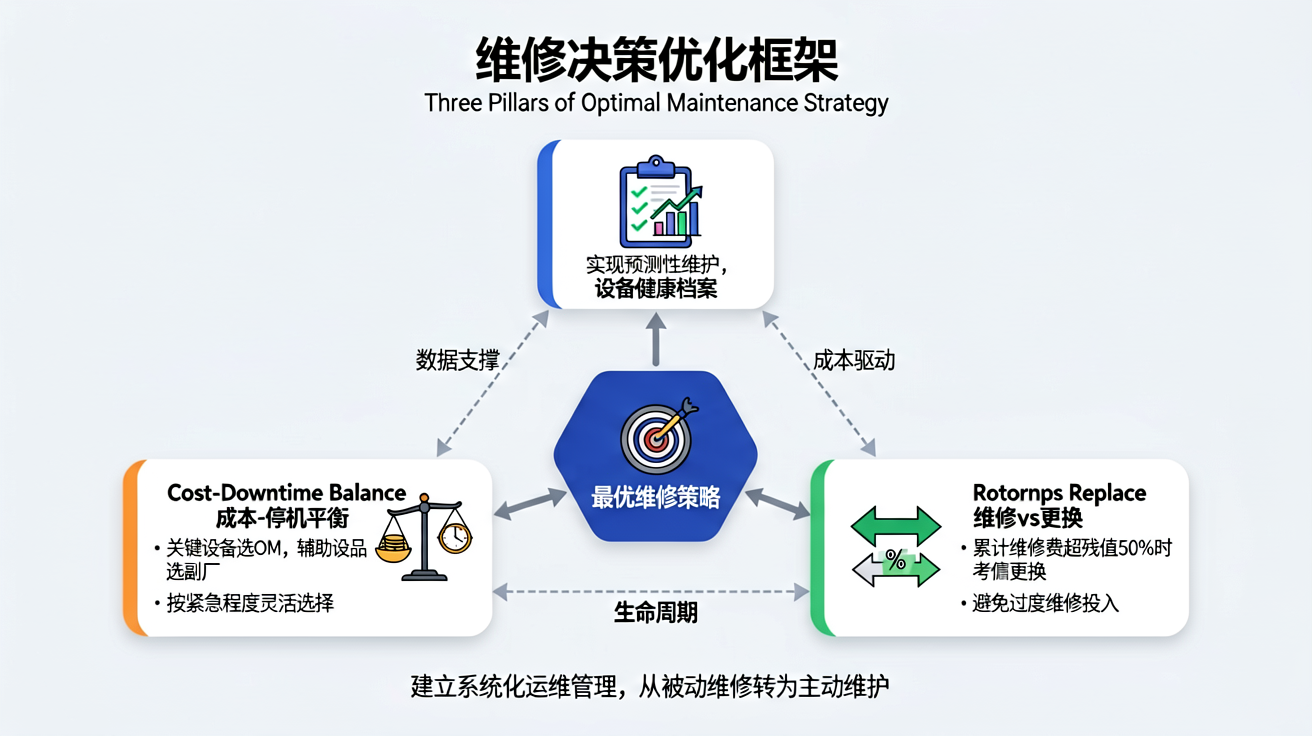
Based on the analysis above, equipment managers can optimize their maintenance strategies across three dimensions:
First, build an equipment health record. Track each machine's operating hours, repair history, and parts replacement cycles. Once enough data accumulates, you can implement predictive maintenance — proactively replacing wear parts before failures occur, rather than passively reacting after downtime strikes.
Second, balance parts costs against downtime losses. For critical production equipment (such as primary excavators and pump trucks), prioritize OEM parts to ensure reliability. For auxiliary equipment (such as small loaders and forklifts), quality aftermarket parts can be used to reduce costs.
Third, evaluate the repair-vs-replace threshold. When cumulative repair costs on a machine exceed 50% of its residual value, it's time to seriously consider replacement. Many companies fall into the inertia of "it still works" and keep pouring money into repairs, ultimately spending far more than the cost of buying new.
5. Aftermarket Opportunities and Challenges
Looking at industry trends, the construction machinery aftermarket is undergoing profound transformation:
- Digital transformation: Remote diagnostics, predictive maintenance, and online parts ordering are becoming widespread. Leading domestic companies like SANY and XCMG have built nationwide telematics platforms for real-time equipment monitoring.
- Service model innovation: Shifting from "selling parts" to "selling services," with all-inclusive maintenance contracts and hourly-fee models gaining popularity.
- Competitive landscape reshaping: Third-party repair chains are expanding rapidly, competing directly with OEM service systems.
- Environmental regulation drivers: Upgraded emission standards are creating new maintenance demands — aftertreatment system servicing and emissions testing will become key growth areas.
For equipment users, this is both an opportunity and a challenge. The opportunity lies in more choices, better service, and more controllable costs. The challenge is the need for stronger maintenance management capabilities to navigate an increasingly complex service ecosystem.
If you'd like to learn about specific equipment repair plans and parts pricing, feel free to contact our professional team. EquipNode, as a global construction machinery trading platform, will continue to provide you with the latest industry insights and practical operations guides.
*Data sources: McKinsey industry report, Fleet Equipment Magazine, Construction Equipment Guide, EquipXR*