Emission Rules Accelerate Equipment Upgrade

title: "New Emission Rules Drive Equipment Upgrades"
date: 2026-07-09
author: EquipNode
tags: [emission standards, environmental policy, trade show updates, industry conferences, compliance requirements]
As the second half of 2026 gets underway, the global construction machinery industry has been hit with a wave of policy signals. From California's $70 million off-road equipment emission reduction fund in the U.S., to accelerated equipment trade-in subsidies across multiple Chinese provinces, to tightened tractor emission standards in India, one clear theme has emerged—emission regulations are reshaping the competitive landscape of the construction machinery industry at an unprecedented pace.
For equipment manufacturers, construction enterprises, and end users, this is no longer a change that will happen someday in the future—it is happening right now. Whoever adapts first to the new regulations and embraces electrification and clean energy technologies will seize the initiative in the next wave of market realignment.
I. Global Emission Regulations Tighten Across the Board
U.S.: CARB's $70 Million Emission Reduction Fund Takes Effect
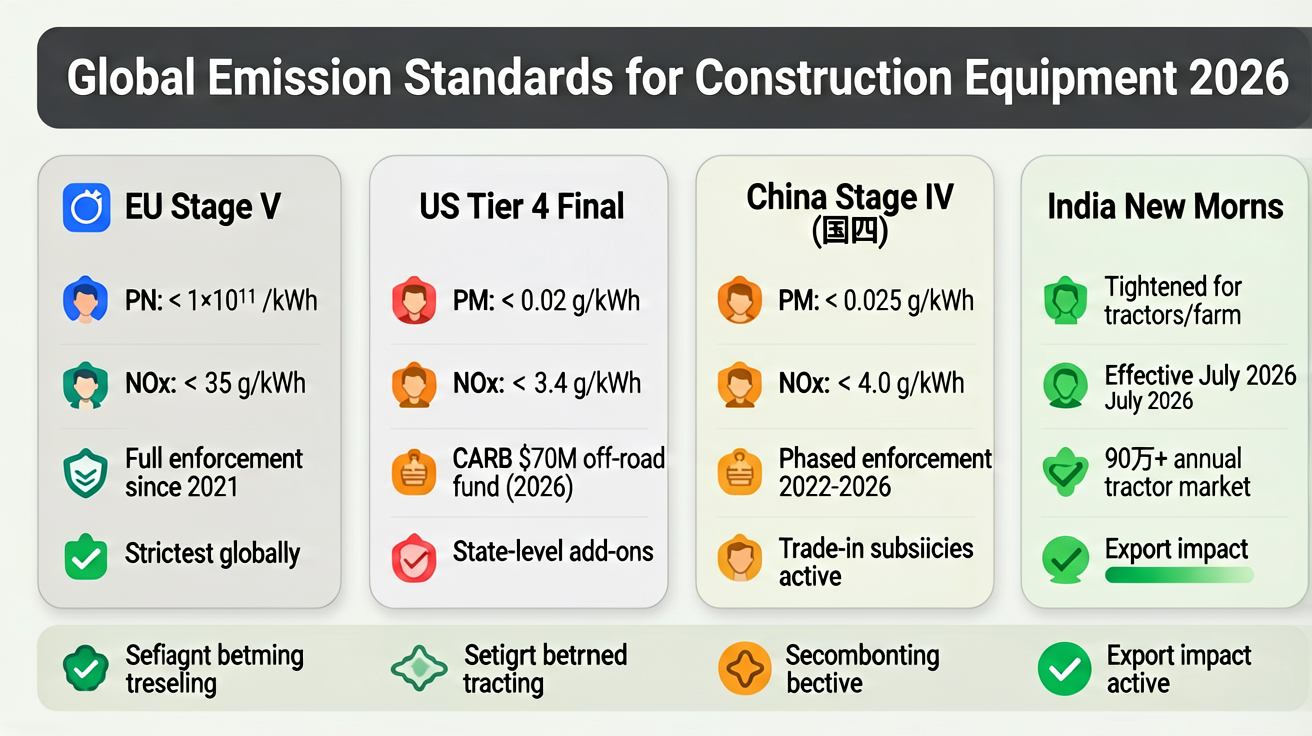
In early July, the California Air Resources Board (CARB) approved a total of $70 million in dedicated funding to support emission reduction retrofits for off-road diesel equipment. The funds will directly subsidize equipment owners to replace older, high-emission equipment or install advanced emission control devices. This is the largest single emission reduction investment in California's off-road sector to date, sending a clear policy signal: the operating costs of older equipment will only continue to rise.
Meanwhile, at the federal level, the U.S. is also advancing stricter off-road emission standards. The Association of Equipment Manufacturers (AEM) warned in an April report that emission rules are evolving rapidly, and off-road equipment manufacturers need to act immediately rather than wait.
European Union: Stage V Full Implementation Countdown
The EU's Non-Road Mobile Machinery (NRMM) Stage V emission standards are now fully in effect, with significantly tightened limits on particulate matter number (PN) and nitrogen oxides (NOx). For new equipment sold after 2026, non-compliant products will no longer be marketable in the EU. Implementation of this standard is forcing global manufacturers to accelerate technology upgrades.
China: National Stage IV Deepened Implementation + Equipment Renewal Subsidies
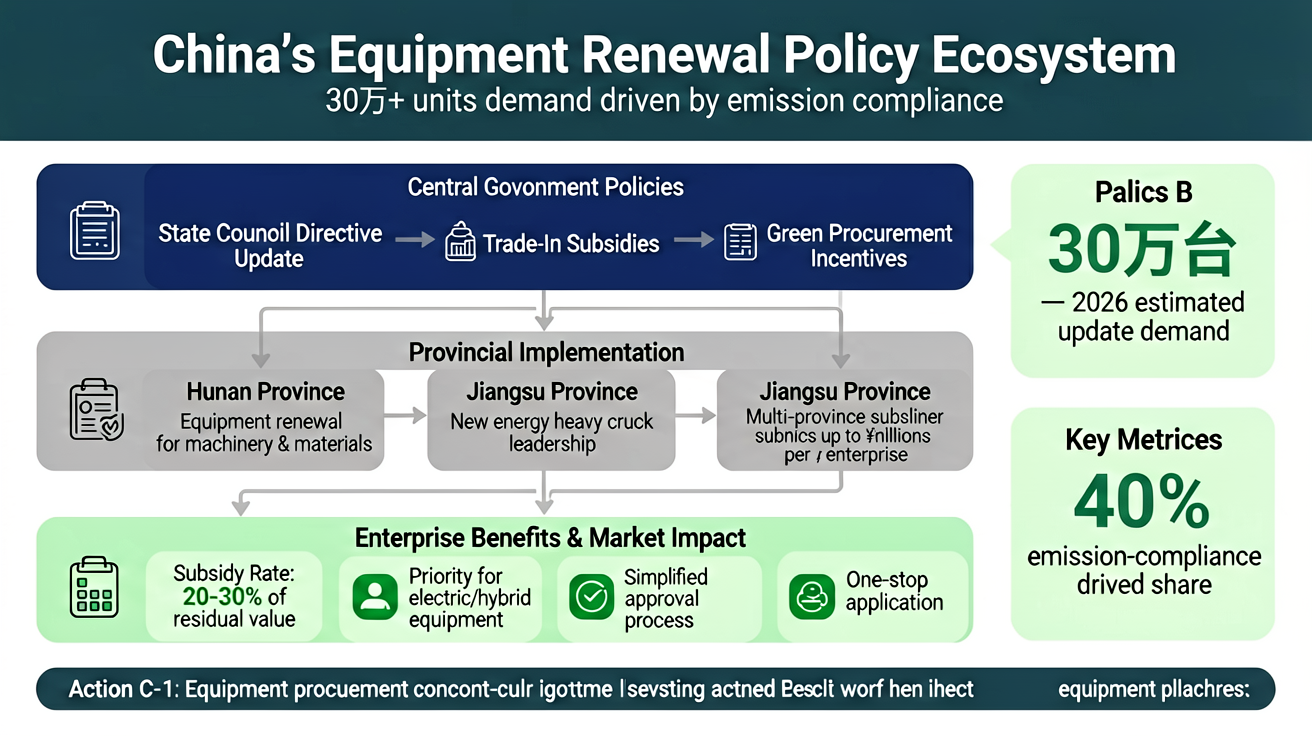
Domestically, China's National Stage IV emission standards for non-road mobile machinery have entered a deepened implementation phase. Multiple provinces and cities have rolled out supporting policies restricting or banning non-compliant National Stage II and Stage III equipment. Manufacturing powerhouses such as Hunan and Jiangsu provinces have released large-scale equipment renewal implementation plans in 2026, using fiscal subsidies to encourage enterprises to phase out older equipment and purchase electric or hybrid equipment that meets the new emission standards.
Hunan Province's implementation plan explicitly states that key industries such as construction machinery and new materials will receive dedicated funding support for equipment upgrades, with individual enterprises eligible for subsidies of up to several million yuan. This is injecting powerful momentum into the industry's equipment renewal cycle.
II. Electrification Becomes the Shortest Path to Compliance
Facing increasingly stringent emission regulations, electrification has emerged as the most practical compliance pathway for the construction machinery industry. Compared to traditional diesel equipment, fully electric equipment enjoys an inherent advantage in emission metrics—zero emissions, zero particulate matter—completely bypassing all emission limit assessments.
A report released by IndexBox in July indicates that, driven by emission regulations, demand for mobile equipment electrification will accelerate through 2035. The Chinese market stands out in particular: in the first half of 2026, sales of electric excavators and electric loaders surged over 200% year-on-year, with market penetration rates climbing rapidly.
Sany Heavy Industry, XCMG Group, and Zoomlion—the three leading enterprises—are all intensifying investment in electrification. Sany's electric excavator lineup now covers the 20-ton to 50-ton class, with endurance exceeding 8 hours, essentially meeting the demands of a full standard workday. XCMG showcased integrated, scenario-based electric solutions at CONEXPO 2026, spanning full-process electric coverage from excavation to loading to transportation.
For construction enterprises, electric equipment not only meets emission compliance requirements but also significantly reduces operating costs. For a 20-ton-class electric excavator, hourly energy costs are only 30% to 40% of those for an equivalent diesel unit, saving over 150,000 yuan annually in fuel expenses.
III. Trade-In Policies Unlock Renewal Demand
In 2026, the Chinese government continues to advance large-scale equipment renewal and consumer trade-in policies. As a core category under the large-scale equipment renewal initiative, construction machinery has received multi-level policy support from the central government down to local authorities.
Specifically, the subsidy policies exhibit several key characteristics:
- Broad coverage: From excavators and loaders to cranes and concrete pumps, all major equipment categories are included in the subsidy scope.
- Substantial subsidy levels: In some regions, subsidies for phasing out National Stage II and below equipment reach 20% to 30% of the equipment's residual value.
- Linked to green transformation: Priority support is given to enterprises purchasing electric, hybrid, or hydrogen-powered equipment.
- Streamlined approval processes: Many regions have implemented one-stop application systems to shorten the subsidy disbursement cycle.
According to industry estimates, national construction machinery equipment renewal demand in 2026 will exceed 300,000 units, of which approximately 40% is directly driven by emission policies. This means that emission compliance alone will generate over 120,000 units of equipment replacement demand in 2026.
For equipment dealers and manufacturers, this represents a massive market opportunity. To inquire about specific equipment pricing and subsidy policies, feel free to contact our sales team. We will provide you with professional equipment selection advice and procurement solutions.
IV. India: An Emerging Economy's Emission Upgrade Case Study
Worth noting is that the trend of tightening emission regulations is not unique to developed economies. In early July, India's central government announced tightened emission standards for tractors and agricultural machinery, requiring all newly sold products to meet more stringent emission limits.
India is one of the world's largest tractor markets, with annual sales exceeding 900,000 units. The emission standard upgrades will directly impact tens of billions of dollars worth of equipment in service. For Chinese construction machinery exporters, this is both a challenge and an opportunity—high-quality equipment that meets the new standards will gain access to greater market share.
Shantui Group explicitly stated in its mid- to long-term strategy released in June that it aims to achieve globalized operations by 2030, with intelligentization and electrification serving as the two core drivers for unlocking overseas growth. This strategic assessment aligns closely with the overarching global trend of tightening emission regulations.
V. Beyond Compliance: Emission Standards Reshape the Competitive Landscape
The impact of emission regulations extends far beyond mere compliance. It is reshaping the industry's competitive landscape across several dimensions:
Higher technology barriers. Meeting Stage V, National Stage IV, and other new standards requires more complex aftertreatment systems, more sophisticated electronic control technologies, and greater R&D investment. This will accelerate industry consolidation, putting increased pressure on smaller enterprises with weaker technical capabilities.
Total cost of ownership recalculated. Emission compliance involves not only higher purchase costs but also the full chain of subsequent maintenance, inspection and certification, and insurance expenses. Savvy equipment managers are using TCO (Total Cost of Ownership) models to re-evaluate equipment selection.
Used equipment market bifurcation. Equipment meeting new standards holds its value significantly better than older units. In European and American markets, Tier 4 Final and above equipment commands resale prices 15% to 25% higher than equivalent Tier 3 models.
Service model innovation. Emission regulations have created new demands for remote equipment monitoring, real-time emission data upload, and related services, driving the construction machinery industry to transition from selling equipment to selling services. Equipment equipped with telematics and remote diagnostic capabilities is increasingly favored by the market.
Closing Remarks
The overarching trend of tightening global emission regulations is irreversible. For China's construction machinery industry, this represents both a rigorous compliance test and a rare opportunity to overtake competitors during the transition. The maturation of electrification technology, the scale advantages of the domestic market, and strong policy-level support have laid a solid foundation for Chinese brands to seize the initiative in the global green transformation.
EquipNode will continue to monitor global construction machinery industry policy developments, providing industry practitioners with timely, professional market insights and equipment procurement services. For the latest equipment pricing or policy analysis, please feel free to contact us at any time.
Data sources: CARB, AEM, IndexBox, Hunan Provincial People's Government, China Construction Machinery Association, and other public sources.