How to Choose: Excavator vs Loader vs Backhoe

title: How to Choose Between Excavators, Wheel Loaders, and Backhoe Loaders
date: 2026-08-23
author: EquipNode
tags: [Construction Machinery Guide, Equipment Comparison, Selection Guide]
Construction sites are endlessly varied, but three types of equipment appear on virtually every job site — excavators, wheel loaders, and backhoe loaders. Many newcomers to the industry struggle to tell these machines apart, sometimes even assuming they can substitute for one another. In reality, each type is designed for specific applications, and choosing the wrong one can lead to poor efficiency and even safety hazards. This article breaks down the decision from three perspectives: working principles, applicable scenarios, and cost-effectiveness.
1. Excavators: The "Swiss Army Knife" of Construction
### Working Principle
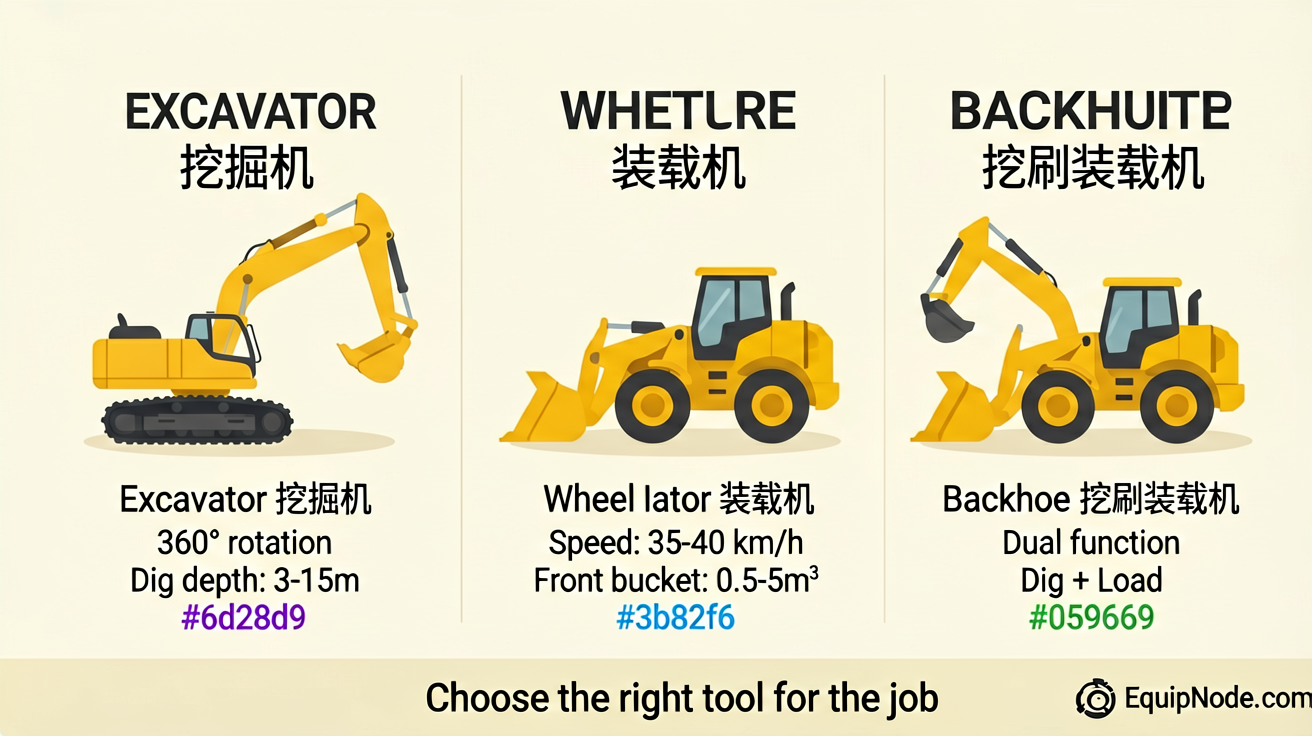
The core components of an excavator are the boom, arm, and bucket — together forming the hydraulic working apparatus. The operator uses control levers to extend and retract the hydraulic cylinders, driving the working apparatus to perform digging, loading, leveling, and other tasks. The undercarriage comes in either crawler or wheeled configurations, and the upper structure can rotate a full 360 degrees.
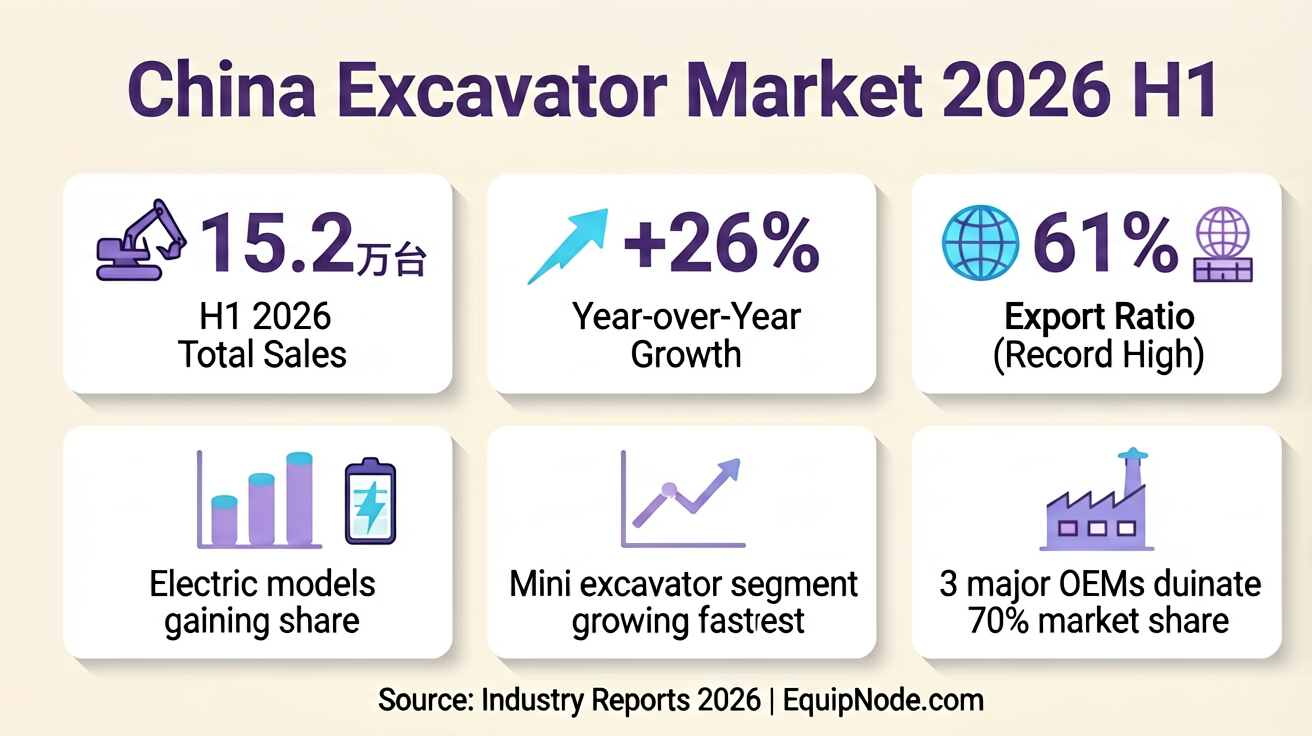
In the first half of 2026, China's excavator sales reached 152,000 units, a year-on-year increase of 26%. Exports accounted for over 61% of the total, setting a new record. This demonstrates that excavators are not only the backbone of domestic infrastructure but also highly competitive in the global market.
### Applicable Scenarios
- Earthwork Excavation: foundation pits, trenches, tunnels, etc.
- Material Handling: with attachments such as hydraulic breakers and grapples
- Demolition Work: paired with hydraulic shears and breakers
- Precision Work: using mini excavators for construction in confined spaces
### Key Selection Criteria
| Tonnage | Applicable Scenario | Reference Price Range |
|---------|-------------------|----------------------|
| 1–6 tons (Mini) | Municipal maintenance, landscaping | ¥80,000–250,000 |
| 6–15 tons (Small) | Farmland water conservancy, rural construction | ¥250,000–600,000 |
| 15–30 tons (Medium) | Highway construction, general earthwork | ¥600,000–1,500,000 |
| 30+ tons (Large) | Mining, large-scale infrastructure | ¥1,500,000+ |
For specific SANY excavator pricing, feel free to contact our sales team.
2. Wheel Loaders: The Efficiency King of Short-Distance Hauling
### Working Principle
A wheel loader's working apparatus consists of a boom and bucket, driven by a hydraulic system. Unlike excavators, a loader's working apparatus cannot rotate — it can only scoop and dump material in front of the machine. Its wheeled undercarriage gives it excellent mobility, with travel speeds reaching 35–40 km/h.
The 2026 Equipment World Heavy Equipment Buyer's Guide specifically notes that wheel loaders remain the "efficiency king" in material handling, especially for operations requiring frequent repositioning.
### Applicable Scenarios
- Loading Operations: scooping loose material into transport vehicles
- Short-Distance Hauling: on-site material transfer (within 500 meters)
- Site Leveling: pushing and spreading backfill earth
- Bulk Material Handling: scooping sand, gravel, soil, coal, and other loose materials
### Key Selection Criteria
- Under 1 ton (Mini Loader): suitable for farms, landscaping, and other light-duty tasks
- 3–5 tons (Small Loader): top choice for municipal projects and small job sites
- 5–8 tons (Medium Loader): mainstay for highway construction and aggregate yards
- 8+ tons (Large Loader): mining and large-scale earthwork projects
SANY loaders are known for their reliability and fuel efficiency. Learn more about our products.
3. Backhoe Loaders: The Versatile "Dual-End" Machine
### Working Principle
A backhoe loader (also called a "dual-end" machine) features a loading bucket on the front and an excavation apparatus on the rear, both powered by a single engine. This unique design allows one machine to perform both loading and digging functions, significantly reducing equipment procurement and management costs.
According to 2026 Equipment World data, while backhoe loaders have seen a decline in market share, they remain a popular choice among small-to-medium contractors and farm owners. The report clearly states: "Backhoes May Be Down, But They're Far From Out" — backhoe loaders are far from obsolete.
### Applicable Scenarios
- Municipal Projects: utility trenching, road repair
- Farm Operations: digging ditches, loading feed
- Small Job Sites: limited space requiring multi-functional equipment
- Emergency Response: rapid deployment with multi-purpose capability
### Key Selection Criteria
The core advantage of a backhoe loader is its "two-in-one" capability. If your job site needs both digging and loading functions and you don't want to purchase two separate machines, the backhoe loader is the best choice. When shopping, pay close attention to the digging depth of the rear excavator and the bucket capacity of the front loader.
4. Head-to-Head Comparison: A Single Table Shows the Differences
| Comparison Dimension | Excavator | Wheel Loader | Backhoe Loader |
|---------------------|-----------|--------------|----------------|
| Core Function | Digging, breaking, demolition | Loading, hauling, dozing | Digging + Loading |
| Working Range | 360° rotation | Front only | Front and rear (dual direction) |
| Mobility | Medium (crawler slow / wheeled fast) | High (wheeled) | Medium |
| Earthwork Volume | Large-scale excavation | Short-distance bulk hauling | Small-to-medium multi-function |
| Purchase Cost | Medium-High | Medium | Medium |
| Operating Cost | Higher | Lower | Medium |
| Maintenance Difficulty | Higher | Lower | Medium |
5. Selection Decision Tree: Three Steps to Decide
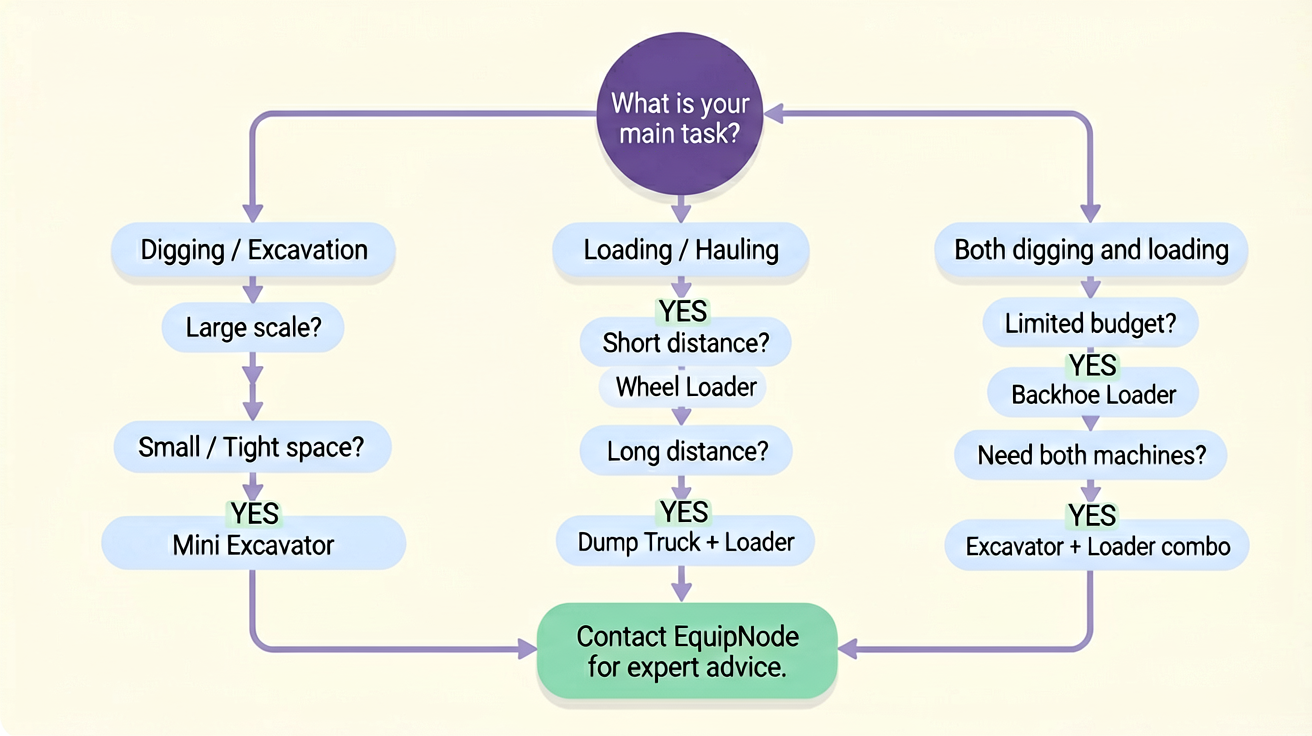
Step 1: Identify the Primary Work Type
- Digging-focused → Excavator
- Loading and hauling-focused → Wheel Loader
- Both needed → Backhoe Loader
Step 2: Assess Project Scale
- Large mine / major infrastructure → Choose high-tonnage excavator
- Small-to-medium job site → Mini excavator + mini loader combo, or backhoe loader
- Farm / landscaping → Mini equipment or backhoe loader
Step 3: Consider Economic Factors
- Generous budget → Specialized equipment offers higher efficiency
- Tight budget → Backhoe loader provides multi-function value
- Long-term operation → Focus on fuel efficiency and maintenance costs
6. Industry Trends: Electrification and Intelligence Are Reshaping Selection Logic
Two major trends in the construction machinery industry in 2026 are reshaping equipment selection:
Electrification: Brands such as SANY and XCMG have launched multiple electric excavators and electric wheel loaders. For fixed job sites or areas with strict environmental regulations, electric equipment offers clear cost advantages (electricity vs. fuel costs). At CONEXPO 2026, over 140,000 attendees experienced electric-powered equipment.
Intelligence: Features like remote operation, auto-cruise, and smart diagnostics are moving from high-end models down to mid-range products. This means even smaller equipment can benefit from the efficiency gains that smart technology brings.
Conclusion
Excavators, wheel loaders, and backhoe loaders each have their strengths — there is no absolute "best," only the most "suitable" for your needs. When selecting equipment, consider your job site conditions, budget, and long-term operational plan.
If you're looking to purchase equipment for your project, EquipNode provides professional selection advice and quotes on the full SANY product range. Whether you need an excavator, a wheel loader, or other construction machinery, we can help you find the right solution.