July Excavator Sales Steady as Prices Begin Rising
title: "July Excavator Sales Hold Steady as Prices Begin to Rise"
keywords: "construction machinery sales, excavator market data, July 2026, export growth, startup rate"
date: "2026-08-17"
author: "EquipNode"
Data released by the China Construction Machinery Industry Association on August 7 shows that major excavator manufacturers sold a total of 19,500 units of various excavator models in July 2026, representing a year-on-year increase of 13.9%. This follows the record single-month export figures set in June, delivering another strong performance for the industry. At the same time, SANY and XCMG have successively announced product price adjustments, signaling subtle shifts in the market landscape.
I. Data Overview: High Growth from H1 Extends into July
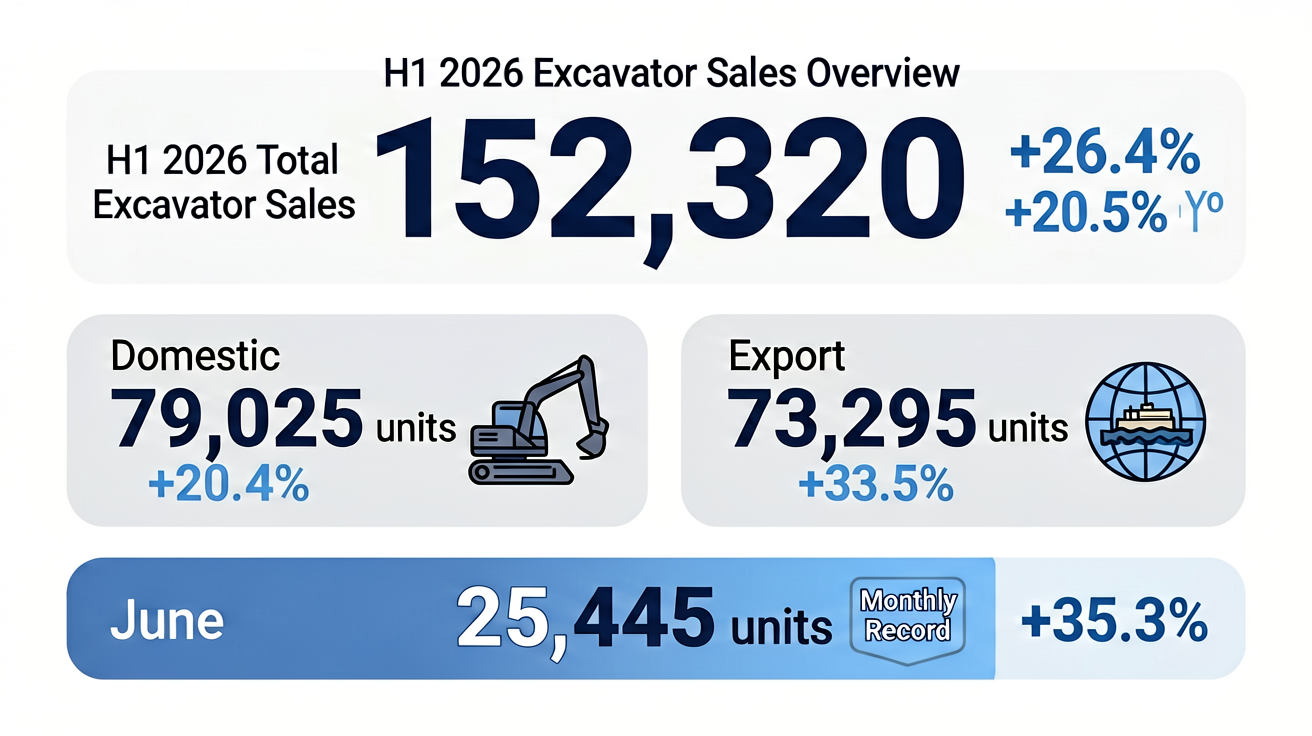
Looking at the half-year data, cumulative excavator sales for the first half of 2026 reached 152,000 units, up 26% year-on-year, continuing the recovery momentum seen since the second half of 2025. Specifically:
- January–May cumulative sales exceeded 120,000 units, with the first five months already demonstrating strong growth momentum
- May saw 24,794 units sold, up 36.2% year-on-year — the highest monthly growth rate in the first half
- June exports hit a single-month record, driving overall H1 excavator export growth of 33%
While July's 19,500 units represented a slight sequential decline, the 13.9% year-on-year growth remained solid. From a structural perspective, slowing domestic demand and sustained high export growth formed a stark contrast.
Notably, China's total construction machinery import and export trade volume reached $35.627 billion in the first half of 2026, up 20.5% year-on-year. This figure far exceeded the industry's earlier expectations, underscoring the growing competitiveness of Chinese manufacturing in the global infrastructure market.
II. Export Share Surpasses 61%: Growth Engine Fully Shifts
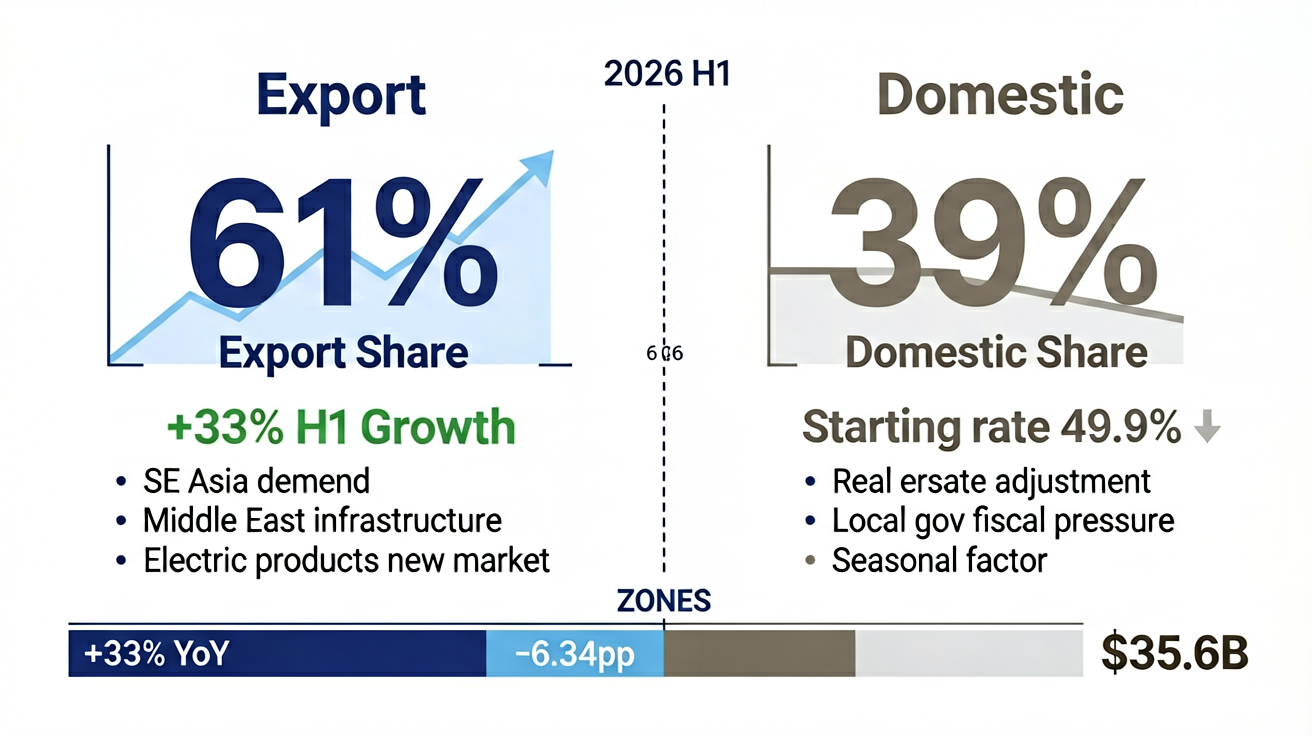
The most striking figure in July was excavator exports surpassing 61% of total sales — another all-time record. This means that for every 10 excavators sold, more than 6 went to overseas customers.
Several key factors are driving the robust export growth:
Strong demand in emerging markets. Infrastructure investment in Southeast Asia, the Middle East, and Africa continues to grow at a rapid pace. Saudi Arabia's "Vision 2030," India's infrastructure development plans, and urbanization processes across Southeast Asian nations are all creating enormous demand for construction machinery.
Electrified products opening new markets. According to the South China Morning Post, exports of Chinese electrified construction machinery products continue to climb, with electric excavators and electric loaders gaining increasing market penetration in Europe and the United States. These products not only align with global carbon neutrality trends but also offer significant advantages in operating costs — energy costs for electric equipment are typically only 30%–50% of those for diesel equivalents.
Sustained price competitiveness. Despite emerging price increase trends in the industry, Chinese manufacturing's cost-performance advantage remains pronounced. Leading enterprises such as SANY and XCMG continue to strengthen customer loyalty through localized service networks and comprehensive parts systems.
For export pricing and overseas service support for products such as SANY concrete pumps and XCMG cranes, please contact our sales team for the latest solutions.
III. Startup Rate Under Pressure: Domestic Demand Concerns
While export data continued its impressive trajectory, the startup (utilization) rate for major construction machinery products in July was 49.9%, down 6.34 percentage points year-on-year. The startup rate has remained in contraction territory below 50% for consecutive periods, reflecting the true state of domestic end-user demand.
The decline in startup rates is attributable to multiple factors:
The real estate market remains in adjustment. Real estate development investment — a key source of traditional infrastructure demand — continues to languish. While the year-on-year decline in new construction starts has narrowed, it has not yet turned positive.
Local government fiscal pressures. Infrastructure investment relies heavily on local government special-purpose bonds, but fiscal capacity in some regions remains limited, causing project commencement schedules to slow.
Seasonal factors. July is traditionally an off-season, with high temperatures and rainy conditions affecting construction progress. A seasonal dip in the startup rate is a normal phenomenon.
However, looking at historical data, while July's 49.9% startup rate represents a year-on-year decline, the absolute level is not considered poor. The rate also dipped below 50% for extended periods during the same period in 2022–2023. With positive factors on the horizon — accelerated special-purpose bond issuance in H2 and concentrated commencement of major infrastructure projects — the startup rate is expected to recover in Q4.
IV. Price Signals: What SANY and XCMG's Joint Price Increases Mean
Another important industry signal in July was SANY and XCMG successively announcing product price adjustments. Synchronized price increases by leading enterprises have been uncommon in recent years, and carry several implications:
Rising raw material costs. Prices of core raw materials such as steel and hydraulic components have continued to rise over the past six months, squeezing profit margins for complete machine manufacturers. Leading enterprises adjusting prices first helps pass cost pressures downstream.
Product structure upgrading. Alongside price increases, the share of high-end products is also rising. Sales growth in high-value-added products such as mining machinery and large-tonnage excavators has pushed up overall average selling prices. Industry analysts note that leading excavator manufacturers achieved breakthroughs in high-end mining products in 2026 and are expected to sustain the recovery trajectory for the full year.
Earnings recovery imperative. Since 2025, despite commendable sales growth, net profit growth for top-tier players like SANY and XCMG has been underwhelming — exchange rate losses, price competition, and increased R&D spending have eroded margins. Price increases represent a proactive choice by leading enterprises to improve profitability.
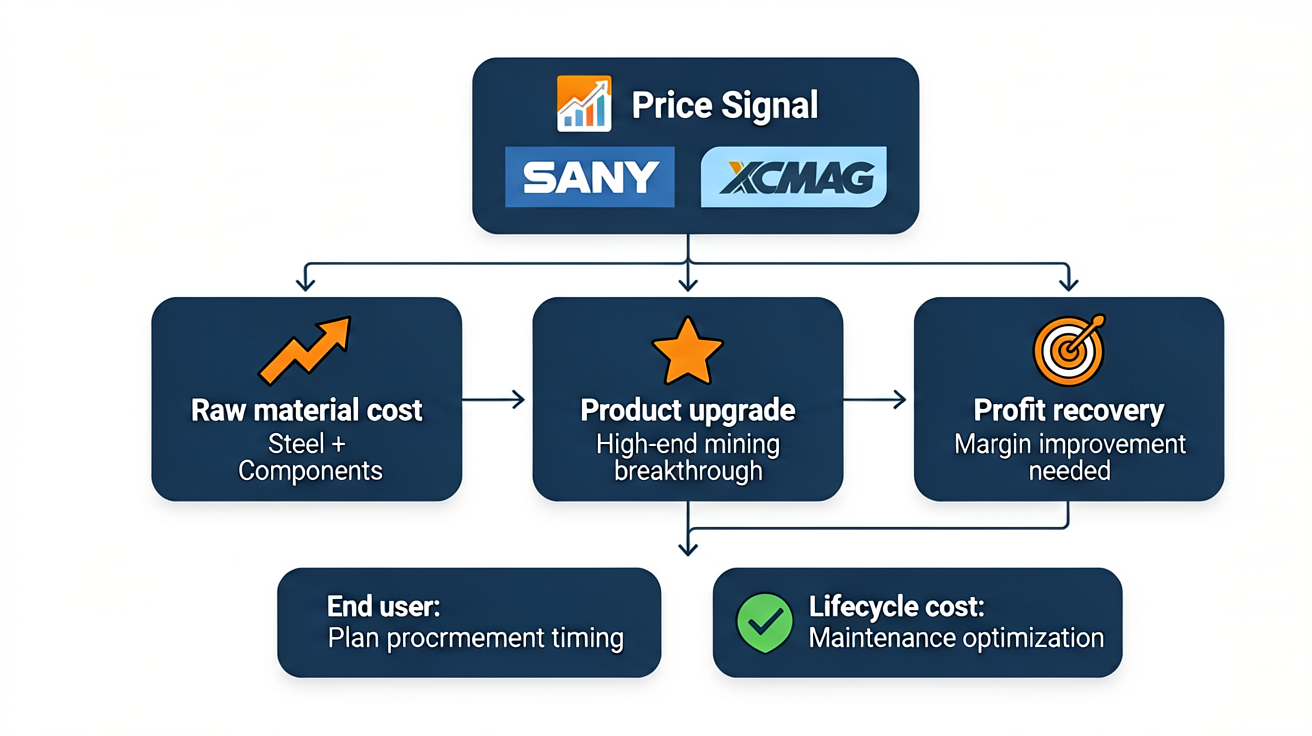
For end users, price increases mean a direct rise in procurement costs. It is recommended that users with procurement plans monitor the timing of leading enterprises' price adjustments and arrange purchase schedules accordingly. Meanwhile, cost optimization in the maintenance segment can also effectively reduce total lifecycle costs.
V. Shifting Global Landscape: Opportunities and Challenges for Chinese Brands
From the perspective of the global construction machinery market landscape, Chinese enterprises are going through a critical inflection point.
Strengths: Chinese brands' share of the global market continues to expand. In the 2026 Yellow Table ranking of the world's top 50 construction machinery manufacturers, the combined share of Chinese companies has surpassed 40%, with SANY, XCMG, and Zoomlion firmly established in the top 10. In emerging markets, Chinese brands have built formidable competitive moats through product quality and service networks.
Challenges: Competitive pressure facing Chinese enterprises is also intensifying. Caterpillar raised its 2026 sales growth forecast, leveraging AI-powered intelligent solutions to consolidate its North American market position. The Russian market saw road construction equipment sales plunge more than 30% due to sanctions and geopolitical factors, significantly impacting companies that had previously built deep market positions in that region.
Additionally, trade barriers against Chinese products in European and American markets are escalating. Tariffs, anti-dumping investigations, and other uncertainties require Chinese enterprises to adopt more refined and localized strategies in their overseas market operations.
VI. H2 Outlook: Structural Recovery Remains the Dominant Theme
Overall, the construction machinery market in the second half of 2026 is highly likely to follow a pattern of "strong exports, stable domestic demand, rising prices":
Exports remain the core growth engine. Global infrastructure investment stays elevated, and Chinese electrified products are opening new market spaces. Full-year export growth is expected to remain above 25%.
Domestic demand sees a modest recovery. Accelerated special-purpose bond issuance in H2, concentrated commencement of major infrastructure projects, and the real estate market stabilizing at the bottom should gradually improve the startup rate.
Leading enterprises' profitability recovers. Price increases combined with product structure optimization should enable top-tier players' profit margins to bottom out and rebound in H2.
For industry practitioners, seizing export market opportunities, optimizing supply chain costs, and enhancing product-service value-added will be key to capturing this round of recovery.
*This article's data is sourced from the China Construction Machinery Industry Association, Securities Times, The Paper, South China Morning Post, and other public information. For specific equipment pricing and market analysis, please contact EquipNode for professional support.*
Further Reading
- [July Excavator Export Share Surpasses 61%](/zh/blog-news-20260810.html) — In-depth analysis of the export market
- [Practical Guide to Saving on Maintenance](/zh/blog-news-20260814.html) — Replacement cycles and cost optimization for 5 key wear parts
- [Chinese Enterprises' Yellow Table Share Breaks 40%](/zh/blog-news-20260815.html) — Shifts in the global competitive landscape