Wheel Loader or Excavator? A 5-Minute Selection Guide

title: "Wheel Loader or Excavator? A 5-Minute Selection Guide"
author: EquipNode
date: 2026-07-12
category: Industry Knowledge
tags: [Equipment Comparison, Selection Guide, Wheel Loader, Excavator, Working Principles]
On a construction site, the two most commonly seen heavy machines — wheel loaders and crawler excavators — what exactly is the difference between them? Many people can't figure out what each machine excels at, so they end up choosing the wrong equipment: low efficiency and wasted money. This article breaks down their structure, working principles, application scenarios, and costs so you can make an informed decision.
1. Core Structural Differences
Wheel Loader — Features a four-wheel-drive chassis with a large bucket mounted at the front. Its core actions are "scooping" and "loading" — scooping up material and lifting it into transport vehicles. The center of gravity shifts forward, with the front axle bearing most of the load, which is why tire specifications tend to be large (e.g., 23.5R25).
Crawler Excavator — Uses a crawler track chassis with an upper structure that can rotate 360 degrees, and a bucket at the end of the arm. Its core actions are "digging" and "swinging" — digging down into the earth and then rotating to discharge the load. The large track contact area distributes ground pressure evenly, making it suitable for soft terrain.
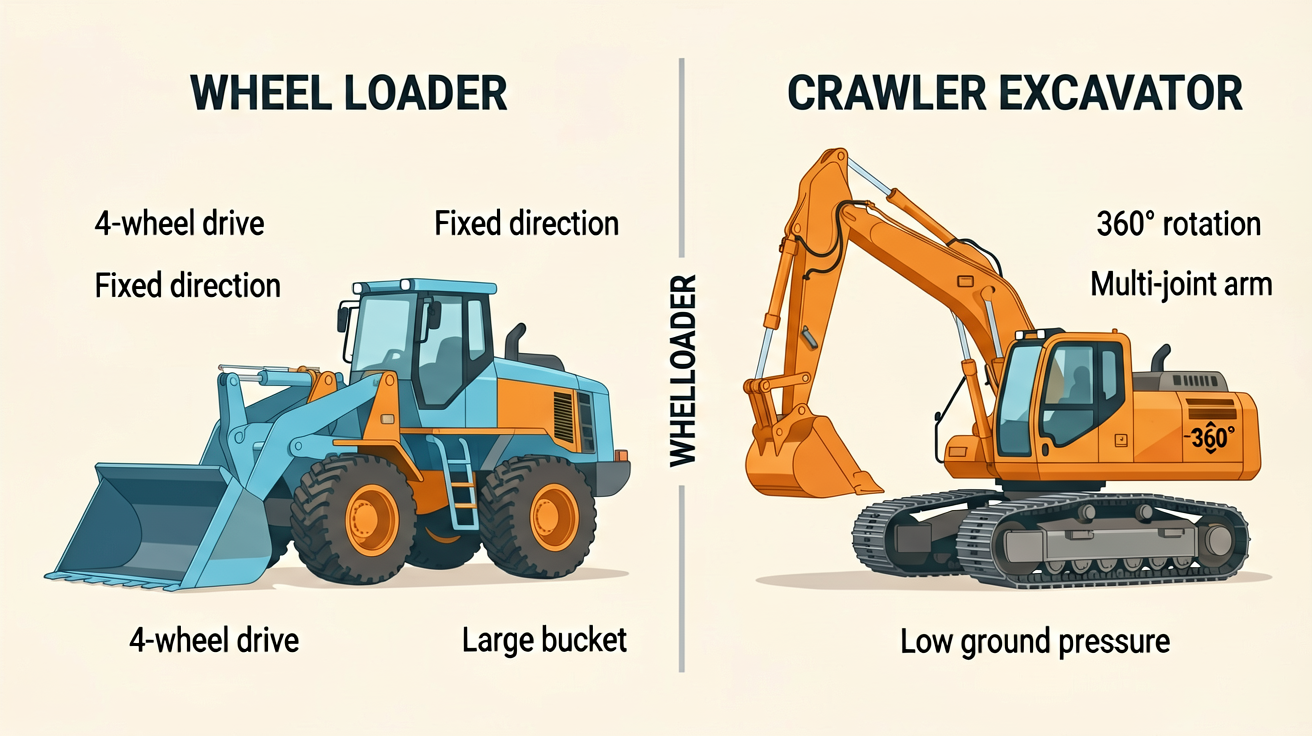
| Comparison Item | Wheel Loader | Crawler Excavator |
|--------|-----------|-------------|
| Travel Method | Wheeled | Crawler |
| Working Direction | Forward | 360° all-around |
| Primary Actions | Scooping, lifting | Digging, swinging, discharging |
| Ground Pressure | High (concentrated on tires) | Low (distributed across tracks) |
| Travel Speed | 30-40 km/h | 3-5 km/h |
2. Working Principles Breakdown
### Loader Hydraulic System
Wheel loaders use a dual-pump combined-flow hydraulic system. A diesel engine drives two main pumps — one responsible for lifting the boom, the other for tilting the bucket. The operator uses forward and backward control levers to coordinate these two actions — lift first then tilt, or tilt first then lift, depending on working conditions.
Modern loaders are commonly equipped with pilot hydraulic control systems, which significantly reduce operator effort and minimize fatigue during extended operation. High-end models such as the Caterpillar 966M feature Load Sensing systems that automatically adjust hydraulic flow based on load demand, delivering noticeable fuel savings.
### Excavator Digging Principles
The excavator's hydraulic system is more complex. It has three independent circuits: main pump, swing motor, and travel motor. The boom, arm, and bucket each have their own hydraulic cylinder, plus the swing motor, totaling five main actuators.
An excavator's "digging force" depends on two factors: the bucket cylinder's thrust force and the tooth's angle of engagement. In actual operation, the operator must adjust the bucket angle based on soil hardness — use a smaller angle for hard soil to penetrate, and a larger angle for loose soil to fill the bucket quickly.
If you're interested in how hydraulic systems work, you can refer to our previous article on Hydraulic Drive Fundamentals, which provides a detailed explanation of how hydraulic oil transmits force through pipelines.
3. Application Scenario Comparison
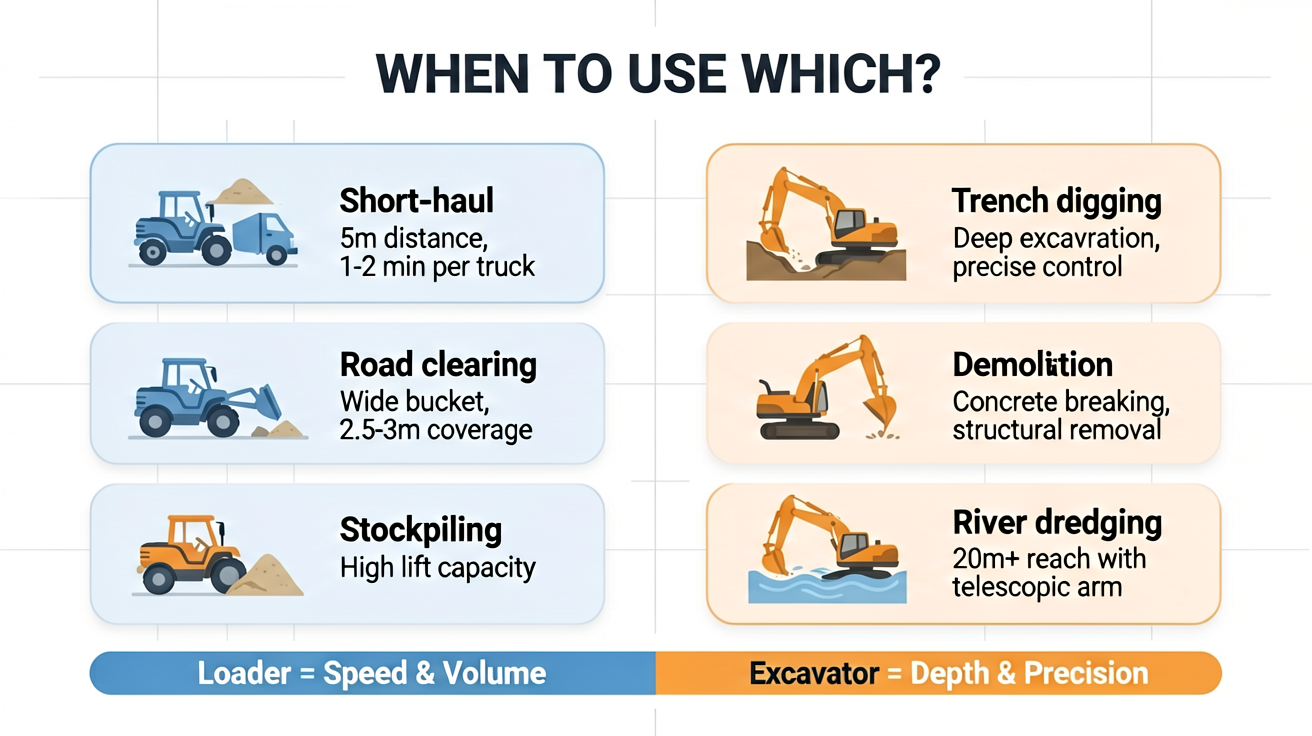
### Loader's Home Turf
- Short-distance material transfer: Scooping sand and gravel from a stockpile and loading it onto a truck just 5 meters away — the loader far outperforms an excavator in efficiency.
- Road clearing: Flattening large areas of road surface — the loader's bucket width (typically 2.5-3 meters) far exceeds an excavator's bucket.
- Material stockpiling: Stacking sand, gravel, or ore in front of a warehouse — the loader's lifting height and discharge distance give it the advantage.
- Loading loose materials: For sand, gravel, coal powder, and other loose materials, a loader can fill a 20-ton truck in just 1-2 minutes.
### Excavator's Home Turf
- Earthwork excavation: Foundation pits, trenches, tunnel boring — only an excavator can handle these tasks.
- Demolition: Equipped with a hydraulic breaker attachment, an excavator can demolish concrete structures.
- Pile driving: Working with a vibratory hammer, an excavator can drive steel sheet piles.
- River dredging: Telescopic boom excavators can reach working radii of over 20 meters.
In practice, many construction sites deploy both loaders and excavators — the excavator handles excavation while the loader manages material transfer and truck loading. This "dig-and-load combination" is the standard approach for earthwork projects. If you're planning your site equipment configuration, our Equipment Selection Guide offers more detailed recommendations.
4. Cost Comparison Analysis
### Purchase Cost
Using 20-ton class equipment as an example:
- Wheel Loader (e.g., LiuGong 856H): approximately 1.8-2.2 million yuan
- Crawler Excavator (e.g., SANY SY215C): approximately 1.5-2.0 million yuan
It looks like the loader is more expensive? But don't rush to conclusions.
### Operating Costs
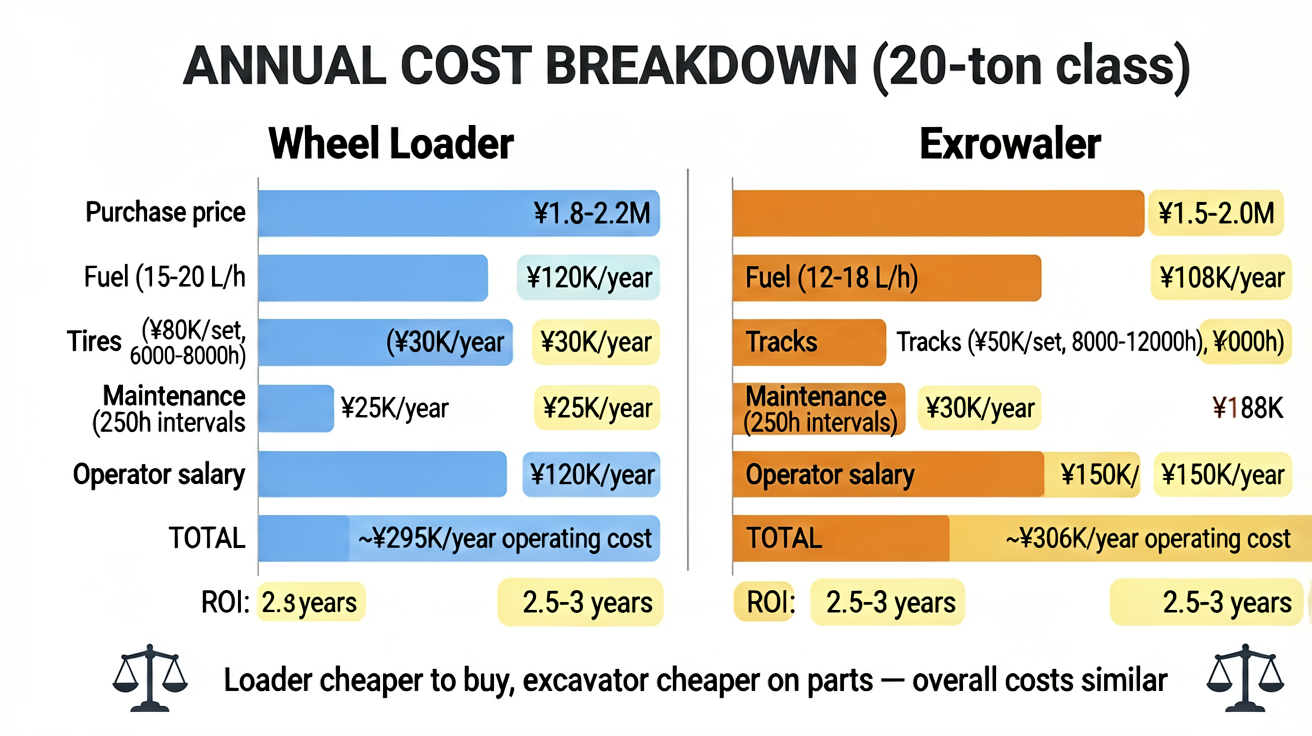
| Cost Item | Loader | Excavator |
|--------|--------|--------|
| Fuel Consumption | 15-20 L/h | 12-18 L/h |
| Tires/Tracks | Tires approx. 80,000 yuan per set, lifespan 6,000-8,000 hours | Track pads approx. 50,000 yuan per set, lifespan 8,000-12,000 hours |
| Maintenance Cycle | Oil change every 250 hours | Oil change every 250 hours |
| Operator Salary | 8,000-12,000 yuan/month | 10,000-15,000 yuan/month |
Excavator operation is more difficult, so operator salaries are generally higher than for loaders. However, the excavator's versatility (swapping attachments) can offset the cost of purchasing other equipment.
### Return on Investment Estimate
Assuming a loader works 10 hours per day, generating 500 yuan of value per hour, operating 250 days per year, the annual revenue is approximately 1.25 million yuan. After deducting fuel, labor, maintenance, and other costs of approximately 500,000 yuan, the annual net profit is roughly 750,000 yuan, with an investment payback period of approximately 2.5-3 years.
The excavator's payback period is similar, but with greater fluctuations — earthwork projects have clear peak seasons (spring and autumn construction peaks) and off-seasons (winter frozen ground, summer rainy season). During idle periods, fixed costs still need to be covered.
5. Selection Decision Framework
Facing the question "Should I buy a loader or an excavator?", you can use a simple decision framework:
Step 1: Look at your primary working conditions
- If 80% of the work is earthwork excavation → Excavator
- If 80% of the work is material transfer → Wheel Loader
- If both are significant → Buy one of each, or consider a backhoe loader
Step 2: Look at the operating environment
- Site has hardened roads with easy vehicle access → Loader has a major advantage
- Site is muddy and soft, requiring in-place operation → Excavator is more suitable
Step 3: Look at your budget
- Limited budget, can only buy one → Prioritize the excavator (more versatile)
- Ample budget → Loader + excavator combination is the optimal choice
If you're interested in specific model parameters, the EquipNode website has detailed Equipment Parameter Comparison Tables to help you quickly find the most suitable model. For specific equipment quotes, feel free to contact our sales team.
6. Industry Trends: Electrification Is Changing the Landscape
In 2026, electric construction machinery has entered a growth surge. SANY, XCMG, and Zoomlion have all launched electric loaders and electric excavators.
Electric loaders have more obvious advantages: in short-distance transfer scenarios, electric loaders don't need to run continuously, and charging time can be scheduled during overnight hours or lunch breaks. Moreover, the low-speed torque characteristics of electric motors are naturally well-suited for loading operations.
Electric excavators currently face a range limitation — earthwork projects typically require continuous operation for 8+ hours, while mainstream electric excavators currently offer 4-6 hours of runtime. However, as battery technology improves and battery-swapping models become more widespread, this gap is narrowing.
To learn more about the latest developments in electric construction machinery, follow our New Technology Column.
Summary
There is no absolute superiority between wheel loaders and crawler excavators — it all depends on your working conditions. Loaders excel at short-distance transfer and loose material handling, while excavators shine in earthwork excavation and multi-functional operations. For most construction projects, using both together delivers maximum efficiency.
When selecting equipment, remember three core principles: assess your working conditions, assess your environment, and assess your budget. Get these three points right, and you'll make the correct equipment decision.
*EquipNode — Industry insights and professional news for the construction machinery sector. For specific equipment quotes, please feel free to contact us.*