Construction Equipment Selection Guide

On construction sites, there are the "Big Five" — excavators, loaders, cranes, bulldozers, and graders. Each has a clearly defined role, yet many newcomers struggle with the question: which one should I choose? This article helps you quickly build a selection framework from three dimensions: working principles, applicable scenarios, and cost.
Excavators: The All-Rounder on Site
The excavator is the most common piece of equipment on construction sites. It uses a hydraulic system to drive the boom, stick, and bucket, enabling a variety of tasks such as digging, breaking, and grabbing. By travel method, excavators are divided into two types: crawler and wheeled.
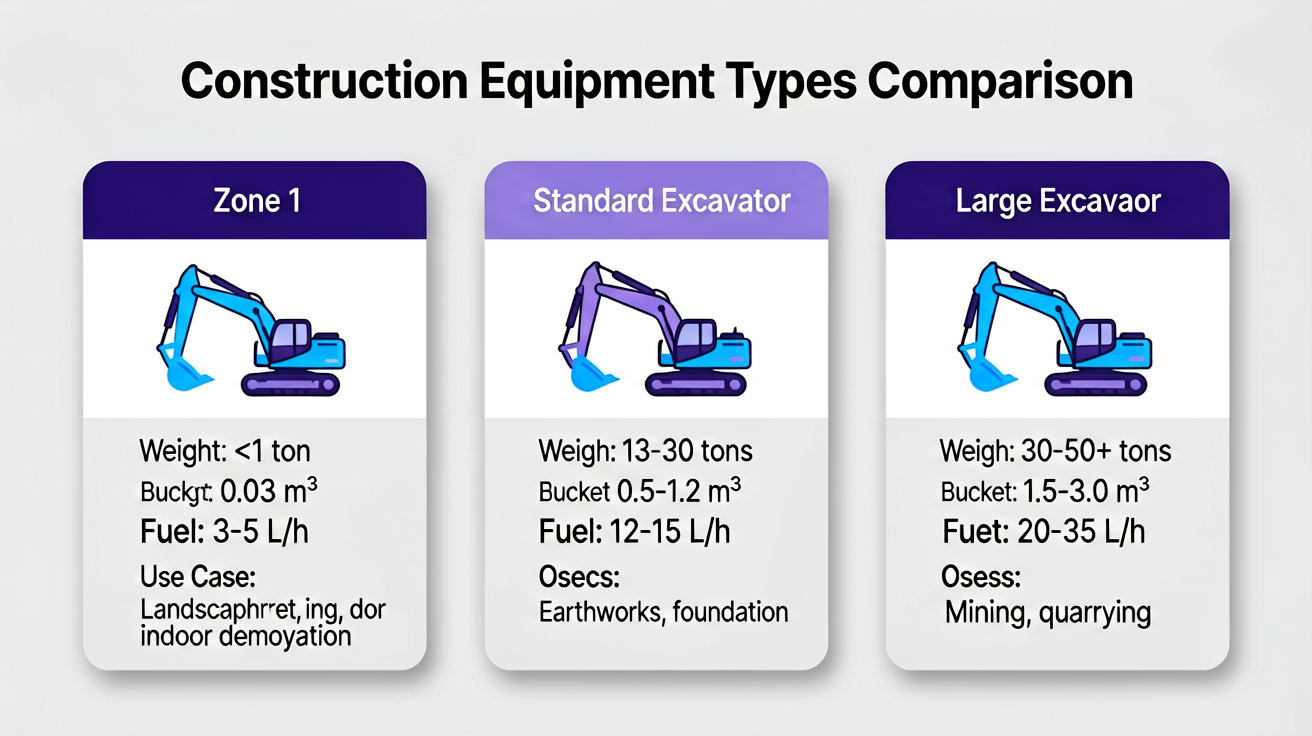
Crawler excavators have low ground pressure, making them suitable for soft, muddy job sites. In 2026, mainstream models in the Chinese market range from 13 to 30 tons. Take the Sany SY215C as an example: it has an operating weight of 21.5 tons, a bucket capacity of 1.0 cubic meter, comes standard with a turbocharged engine, and consumes approximately 12–15 liters of fuel per hour.
Wheeled excavators offer high mobility and can travel between sites on their own, making them ideal for municipal utility networks, road repairs, and other applications that require frequent relocation. However, their smaller contact area with the ground makes them prone to slipping on soft terrain — a drawback that must be considered when selecting a model.
The key consideration when purchasing an excavator is tonnage matching: micro machines under 1 ton for landscaping; small machines under 6 tons for indoor demolition; medium machines from 13–30 tons for earthwork excavation; and machines over 30 tons for mining operations. Choose the wrong tonnage, and you either sacrifice efficiency or waste money.
Loaders: The Workhorse of Earth Moving
The core function of a loader is to scoop and short-haul bulk materials. It uses a front-mounted bucket to lift sand, gravel, soil, and other materials, loading them into trucks or depositing them at designated stockpiles.
By drive type, loaders are divided into wheeled loaders and tracked (crawler) loaders. Wheeled loaders are the dominant type, accounting for over 90% of the domestic market. Take the Liugong CLG856H as an example: it has a rated load capacity of 5 tons, a bucket capacity of 3.0 cubic meters, and is equipped with a Sichuan/Shangchai or Weichai engine, along with a standard torque converter and planetary transmission.
The selection logic for loaders is relatively straightforward: look at bucket capacity and load requirements. The 1-ton micro class is suited for farms and small job sites; the 3-ton class covers most municipal engineering projects; the 5–6 ton class is the mainstay of earthwork projects; and 8-ton-and-above models are used for large-scale mining operations.
Unlike excavators, loaders have a small working radius but high efficiency, making them particularly well-suited for continuous "scoop-load-haul" operations. If a site requires a large volume of sand and gravel transfer, a loader offers far better cost-effectiveness than an excavator.
Cranes: The Core of Vertical Transport
Cranes are responsible for lifting heavy objects to specified heights and are indispensable equipment in building construction. By structural form, they are classified into tower cranes, mobile truck cranes, crawler cranes, and gantry cranes.
Tower cranes are the standard equipment for high-rise building construction. Take the Zoomlion TC6013 as an example: it has a maximum lifting capacity of 6 tons, a jib length of 60 meters, and an independent height of approximately 40 meters. The key selection criterion for tower cranes is the lifting moment (ton·meter), which determines the actual lifting capacity at different jib lengths.
Mobile truck cranes offer good mobility and are suitable for rapid redeployment between job sites. The 25-ton class is the best-selling segment in the market. The Sany STC250 has a main boom maximum hoisting height of approximately 48 meters and a maximum rated lifting capacity of 25 tons.
When selecting a crane, three parameters deserve primary attention: maximum lifting capacity, working radius, and hoisting height. Blindly pursuing a larger tonnage not only increases acquisition costs but also brings higher installation/dismantling fees and transportation costs.
Bulldozers and Graders: The Pair for Site Leveling
Bulldozers and graders are often confused with each other, but their functions are quite different.
Bulldozers use powerful thrust to push earth forward, making them suitable for site clearing, pit backfilling, and short-distance earth hauling. Take the Shantui SD16 as an example: it has an engine power of 120 kW, a blade width of 3,720 mm, and a maximum thrust of approximately 180 kN. With its low ground pressure, a bulldozer can even operate in wetlands and marshy areas.
Graders, on the other hand, focus on precision finishing of roads and surfaces. Through its blade, it scrapes and shapes the ground to millimeter-level accuracy. Take the XCMG GR215 as an example: it has a blade width of 3,658 mm and a maximum traction force of approximately 100 kN. Graders are essential equipment in highway and airport runway construction.
The difference between the two can be summed up in one sentence: bulldozers handle "rough work," while graders handle "fine work." If a site requires large-scale earth pushing, use a bulldozer; if it requires precise leveling, use a grader.
How to Calculate the Cost
Selection is not just about technical parameters — cost is ultimately the deciding factor.
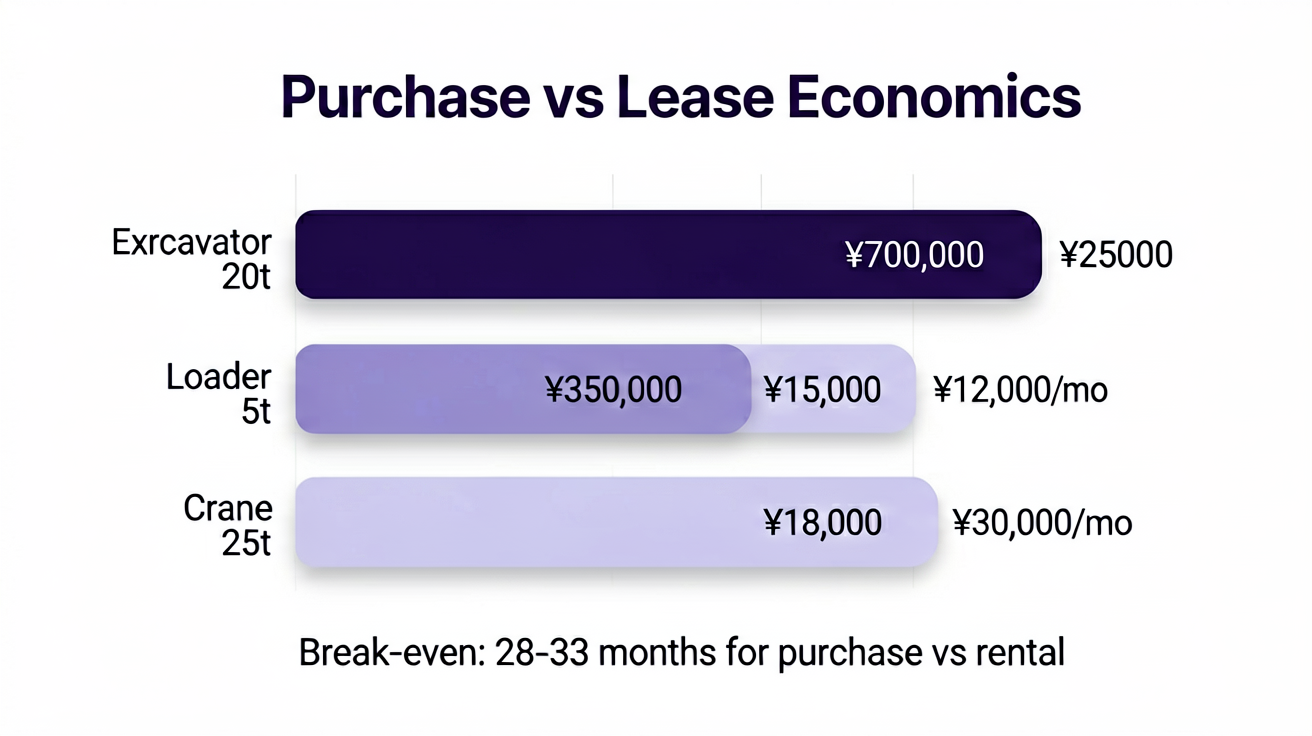
In terms of acquisition cost, a 13-ton-class excavator costs approximately ¥600,000–800,000; a 5-ton-class loader costs approximately ¥300,000–400,000; a 25-ton-class truck crane costs approximately ¥500,000–700,000; and a 160-horsepower bulldozer costs approximately ¥800,000–1,200,000. Imported brands are typically 30%–50% more expensive than domestic ones but offer advantages in residual value retention and resale value.
In terms of operating cost, taking an excavator as an example: fuel consumption is approximately 12–15 liters per hour. At a diesel price of ¥7.5 per liter, hourly fuel cost is approximately ¥90–112. Adding in consumables such as filters, hydraulic oil, and track shoes, the average monthly operating cost ranges from ¥20,000 to ¥30,000.
For users with uncertain project volumes or limited budgets, leasing is a more flexible option. The monthly rental for a 20-ton-class excavator is approximately ¥15,000–25,000, far below the average monthly depreciation cost of purchasing. For specific equipment quotes, feel free to contact our sales team.
Quick-Reference Selection Table
| Equipment Type | Core Function | Typical Tonnage | Monthly Rental Reference | Applicable Scenario |
|---------------|--------------|----------------|------------------------|-------------------|
| Crawler Excavator | Digging, Breaking | 7–50 tons | ¥15,000–50,000 | Earthwork excavation, Mining |
| Wheeled Excavator | Digging, Trenching | 6–20 tons | ¥12,000–30,000 | Municipal maintenance |
| Wheeled Loader | Loading, Hauling | 1–8 tons | ¥8,000–20,000 | Sand and gravel transfer |
| Mobile Truck Crane | Lifting, Installation | 25–100 tons | ¥20,000–80,000 | Building construction |
| Tower Crane | High-altitude Lifting | 6–20 ton·meter | ¥10,000–30,000 | High-rise buildings |
| Bulldozer | Pushing, Backfilling | 100–230 HP | ¥20,000–40,000 | Site clearing |
| Grader | Precision Grading, Shaping | 120–200 HP | ¥15,000–30,000 | Road construction |
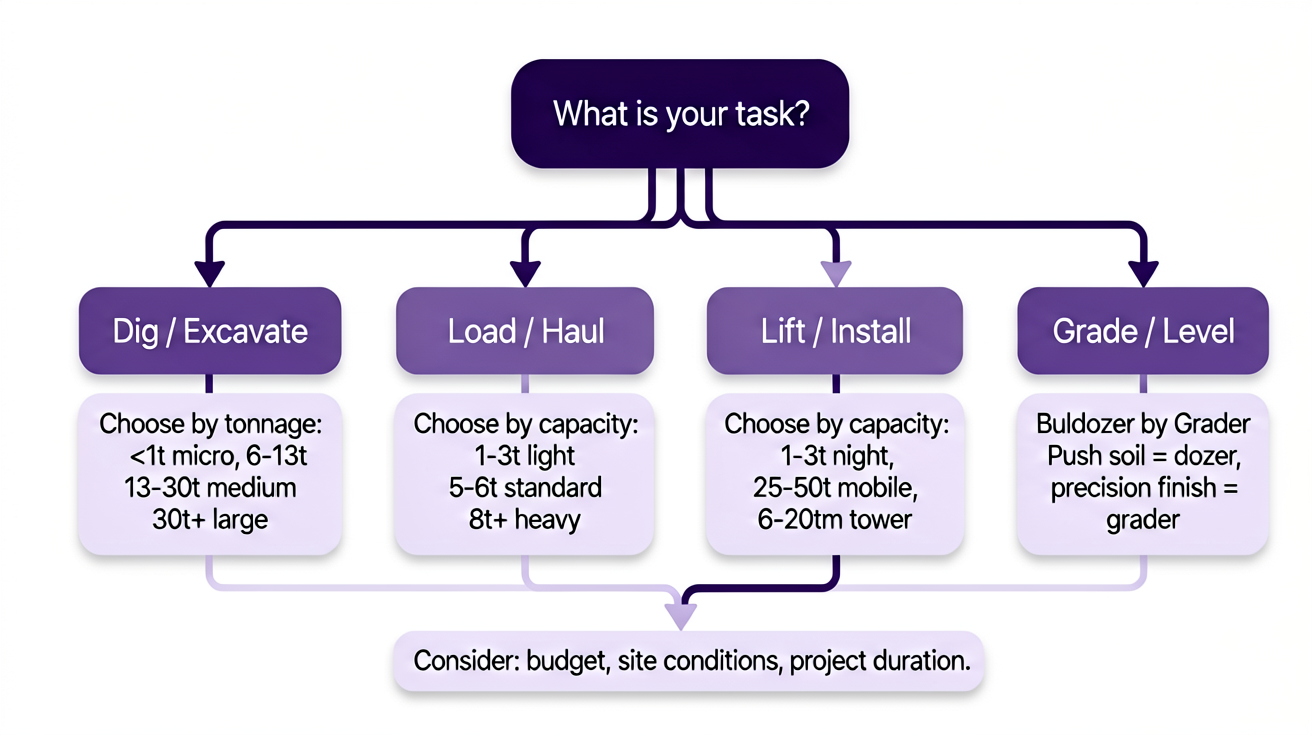
There is no "best" equipment choice — only the "most suitable" one. Define your project volume, site conditions, and budget range, then refer to the table above to quickly identify your target machine. For professional selection advice, visit equipnode.com for more technical resources.